
- Alphea's AI-native Layer 1 execution network is designed to enable autonomous AI agents to operate independently, managing tasks and transactions without human intervention.
- The platform introduces 'Delta,' a novel packaging format that transforms AI-generated outputs into self-contained, executable units for immediate, autonomous execution.
- The economic model is usage-based, with the native token ALP functioning as the unit of account for resource consumption, aiming to create a stable and predictable operational infrastructure market.
Experts in AI and blockchain technology would likely conclude that Alphea's AI-native blockchain represents a significant step toward enabling truly autonomous AI agents by addressing critical infrastructure gaps in the current digital ecosystem.
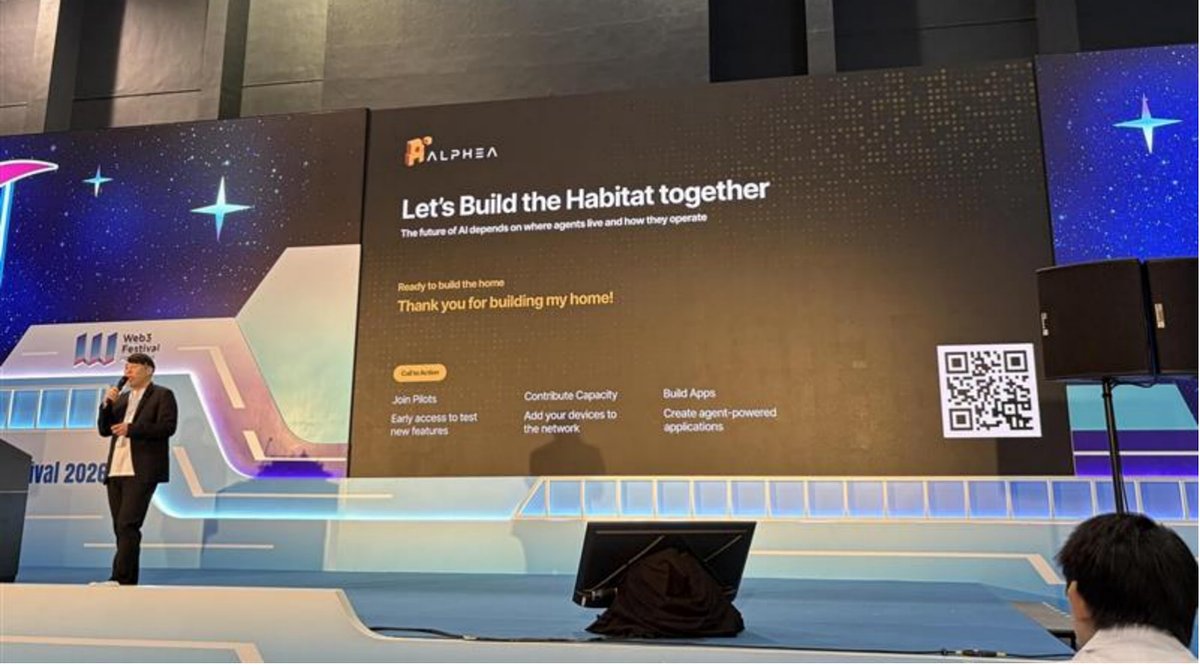
Alphea Debuts AI-Native Blockchain to Power Autonomous Agents
HONG KONG – April 29, 2026 – A new venture named Alphea took the stage at the Hong Kong Web3 Festival 2026 today to unveil a bold vision: a foundational layer for the internet where artificial intelligence can operate not just as a tool, but as an independent economic actor. The project debuted its AI-native Layer 1 execution network, a decentralized environment purpose-built to let autonomous AI agents run tasks, manage services, and transact without human intervention.
The presentation, delivered by Dee Lee, Chief Publishing Officer and Head of Alphea’s UAE Office, positioned the platform as a critical piece of missing infrastructure in the evolution of AI. While models have become adept at generating content, code, and analysis, they remain dependent on human-centric systems for deployment and operation. Alphea aims to close this gap.
"Today's AI can generate almost anything, but it still needs a human in the loop to deploy it, run it, and keep it running," said Henry Park, Founder and CEO of Alphea, in a statement. "We're building the layer where AI doesn't just produce work, it lives and operates. That means execution, memory, and economics all have to be rethought from the ground up."
An Operating System for an Autonomous Future
Alphea's core argument is that the current digital infrastructure, from cloud computing services to existing blockchains, was designed for human users. This design creates a fundamental bottleneck for autonomous agents, which require continuous, stateful, and machine-to-machine operation to function effectively.
As AI shifts from a passive assistant to an active agent capable of executing complex, multi-step tasks, the need for a native environment becomes paramount. Alphea's architecture is designed to be that environment, integrating key functions like verifiable computation, persistent memory, and resource billing as native primitives of the network itself, rather than as application-level add-ons.
This approach seeks to provide a decentralized, trustless foundation where an AI agent can be deployed and then operate independently—procuring computational resources, accessing and storing data, and interacting with other services or agents on the network. The goal is to eliminate the operational friction that currently prevents AI from achieving true autonomy at scale.
Redefining Infrastructure with 'Delta' and Verifiable Compute
At the heart of Alphea’s technical design is a novel packaging format called 'Delta.' This mechanism transforms AI-generated outputs into self-contained, executable units. Instead of a developer receiving code or instructions from an AI and then manually deploying it, a Delta package arrives on the Alphea network with all the context, permissions, and resources needed for immediate, autonomous execution.
This is supported by an execution-centric architecture built on the S62 mainnet, which is optimized for performance-critical applications. The network is designed to handle various execution environments, enabling complex workloads like AI computation to run directly on-chain.
To ensure trust and transparency in this decentralized system, every task is accompanied by a 'proof of execution.' This cryptographic proof verifies not only that a computation was completed but also provides an auditable record of how it was performed and what resources it consumed. This allows the network to validate work done by any node without relying on a central authority, a critical component for enabling secure and reliable AI services.
Furthermore, the platform incorporates a dynamic storage system. Data is managed in tiers, with active, frequently used information kept close to the execution layer for low-latency access, while less-used data is migrated to more durable, cost-effective storage. This intelligent data management is crucial for stateful AI agents that need to maintain memory and context over time.
Beyond Speculation: An Economy for AI Services
Alphea is making a concerted effort to distance itself from the speculative token economies that have characterized many blockchain projects. The platform’s economic model is explicitly usage-based, designed to function as an operational infrastructure market.
In this system, the native token, ALP, functions as the unit of account for resource consumption. AI agents running on the network pay directly for the computation, storage, and bandwidth they use, creating a direct link between token activity and real-world utility. This 'pay-as-you-go' model aims to provide a predictable and sustainable economic framework for developers and enterprises building AI services.
By tying the economy directly to resource consumption, Alphea intends to foster a stable environment where costs are rational and transparent. This focus on utility is designed to attract builders who need a reliable and economically viable platform for deploying AI at scale, rather than speculators focused on short-term price movements.
From Gaming Scale to AI Infrastructure
Underpinning the project's ambitious technical vision is a leadership team with a background in operating large-scale consumer platforms. CEO Henry Park previously led Gala Lab, a company known for operating online games across dozens of international markets. This experience in managing complex, high-volume systems is being touted as a key differentiator for Alphea.
"The problems we're solving at Alphea are operational, not theoretical," noted David Bae, Head of Strategy and Partnerships. "Our team has spent years running real systems at global scale. That operational discipline is what this new category of AI infrastructure actually needs."
This emphasis on operational expertise suggests a pragmatic approach focused on solving the real-world engineering and economic challenges of decentralized AI. The team, which also includes James Lee and Dee Lee leading technology and product, is leveraging its combined experience in gaming, live operations, and Web3 to build what it hopes will be the go-to platform for the next generation of AI.
Alphea's debut marks the project's first major public milestone. The company plans to release more detailed technical documentation and a public roadmap in the coming months, inviting developers and partners to register for early collaboration opportunities through its official website.