
- 50 TOPS: Emdoor's PF59 AI laptop delivers 50 Tera Operations Per Second (TOPS) of dedicated AI performance.
- 180 TOPS: The YQ14 model combines CPU, GPU, and NPU for a total of 180 TOPS of AI computing power.
- 849 grams: The LG14 ultra-thin notebook weighs just 849 grams, making it exceptionally lightweight.
Experts would likely conclude that Emdoor’s AI-centric hardware lineup represents a strategic shift in China’s tech identity, aligning with national goals to lead in intelligent and sustainable innovation while challenging global competitors in the AI PC market.
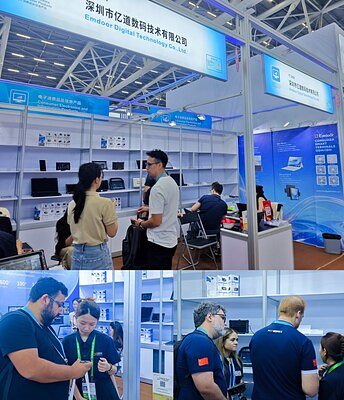
Emdoor’s AI Gambit: Redefining 'Made in China' at Canton Fair
SHENZHEN, China – April 17, 2026 – At the bustling 139th Canton Fair, a venue historically synonymous with China's manufacturing might, Shenzhen-based Emdoor Digital is signaling a profound shift in the nation's technological identity. Moving beyond the traditional export showcase, the company has unveiled a formidable lineup of hardware designed not just to compete, but to lead in the burgeoning era of artificial intelligence. Headlining the launch are high-performance AI laptops capable of running complex large language models locally, a move that challenges the industry's reliance on the cloud and places a premium on user privacy and efficiency.
Flanked by ultra-lightweight notebooks crafted from advanced materials, Emdoor's presentation is a deliberate statement. It represents a calculated push to transform the 'Made in China' label from a symbol of mass production to a hallmark of 'intelligent and green' innovation, aligning perfectly with Beijing's national strategy to dominate next-generation technology sectors.
The Dawn of the Desktop Supercomputer
The centerpiece of Emdoor’s exhibition is a pair of AI-centric computing devices, the PF59 and YQ14, each representing a different path to achieving on-device AI supremacy. These are not mere upgrades; they are engineered to function as personal AI supercomputers, shifting the nexus of processing power from distant data centers directly to the user's desk.
The PF59, housed in an ultra-compact 2.69-liter chassis, is built around AMD's potent Ryzen AI Max+ 395 processor. The key to its power lies in its Neural Processing Unit (NPU), which delivers 50 TOPS (Tera Operations Per Second) of dedicated AI performance. According to the company, this enables the machine to run sophisticated 70-billion-parameter large models locally. This capability is transformative, allowing professionals in creative and technical fields to generate content, analyze complex data, and run AI-driven simulations without an internet connection, thereby ensuring data privacy and eliminating cloud-related latency and costs.
Complementing the PF59 is the YQ14, which leverages Intel's next-generation Panther Lake platform. This model boasts a staggering 180 TOPS of total AI computing power by combining the capabilities of its CPU, integrated GPU, and a dedicated NPU also rated around 50 TOPS. Designed for high-load tasks like 3D rendering and advanced video editing, the YQ14 exemplifies the industry-wide pivot toward hybrid processing architectures where AI workloads are distributed intelligently across all available silicon. By championing local AI, Emdoor is tapping into a growing demand for secure and sustainable computing, as on-device processing is inherently more energy-efficient than transmitting data to and from power-hungry cloud servers.
Material Science Meets Sustainable Design
Beyond the raw computational horsepower, Emdoor is also redefining expectations in industrial design and material innovation, directly tackling the 'green' component of its strategic vision. The new LG14 and DL14 series of ultra-thin notebooks demonstrate a meticulous focus on creating highly mobile yet durable and sustainable devices.
The LG14 is a standout, weighing a mere 849 grams—lighter than many of its competitors in the premium ultra-thin category. This remarkable lightness is achieved through the use of a sophisticated magnesium alloy and composite material chassis. Despite its featherlight profile and slender 14.85mm thickness, the device packs a large-capacity 70Wh battery, delivering a promised 8-10 hours of real-world endurance. This combination of portability and longevity is aimed squarely at mobile professionals and digital nomads who demand performance without compromise.
Meanwhile, the DL14 series offers a more cost-effective alternative by utilizing an innovative full plastic composite material that retains a lightweight profile while significantly reducing production costs. This dual-product strategy allows Emdoor to cater to different market segments without sacrificing its core design principles. Both series are outfitted with modern user-centric features, including fingerprint recognition for secure login, a physical camera shutter for privacy, a 180-degree hinge for versatile use cases, and the high-speed USB4 interface as a standard, ensuring seamless connectivity.
A Strategic Play in a Crowded Field
Emdoor Digital’s ambitious product launch does not exist in a vacuum. It enters a fiercely competitive global market where established giants like Apple, Lenovo, Dell, and HP are all vying for dominance in the AI PC space. These competitors are rolling out their own solutions powered by chips from Qualcomm, Intel's Lunar Lake series, and Apple's formidable M-series silicon. However, Emdoor's deep roots as a leading Original Equipment Manufacturer (OEM) and solution provider give it a unique advantage. The company's extensive R&D capabilities and experience serving over 1,700 clients in 80 countries position it to rapidly scale production and form strategic partnerships globally.
This initiative is also a clear reflection of China's national ambitions. The government's 'AI plus manufacturing' plan aims to deeply integrate artificial intelligence into the industrial economy, fostering globally influential enterprises. Emdoor's focus on developing specialized, high-performance hardware that supports local AI processing and green manufacturing principles is a textbook execution of this national strategy. By developing core competencies in both hardware and software integration, the company is not just building products; it is helping to construct a more self-reliant and technologically sovereign domestic tech ecosystem. As the industry pivots toward on-device intelligence, Emdoor Digital's latest offerings serve as a clear declaration that the future of computing is not only becoming more powerful but also more localized and thoughtfully designed.