
- Weight-to-area ratio: 300-900 grams per square meter, significantly lighter than traditional rigid panels.
- Power conversion efficiency: 23-35%, with potential to reach the upper end using advanced tandem HJT cells.
- Cost reduction claim: Up to 90% cheaper than traditional Gallium Arsenide (GaAs) cells.
Experts would likely conclude that Cando Solar Cloth represents a transformative advancement in space solar technology, with its lightweight, cost-efficient design poised to accelerate the deployment of low Earth orbit satellite constellations and potentially revolutionize terrestrial solar applications.
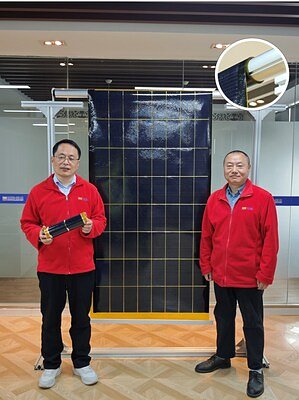
Cando Solar Cloth: A New Fabric to Power the Space Race
WASHINGTON, D.C. – March 26, 2026 – In a move poised to dramatically alter the economics of space, lightweight solar technology firm Cando Solar has unveiled a product that looks less like a traditional solar panel and more like a high-tech fabric. The “Cando Solar Cloth,” a rollable solar wing solution, was introduced at the SATELLATE × GovMilSpace event, promising to solve two of the biggest obstacles hindering the rapid expansion of commercial space: weight and cost.
This innovative technology is aimed squarely at the burgeoning market for low Earth orbit (LEO) satellite constellations, which are foundational to next-generation services like global 6G communications and in-orbit computing. By creating a solar solution that is both incredibly lightweight and drastically cheaper than current standards, Cando Solar is betting it can become a key enabler of the new space economy.
The Engineering Behind Ultra-Light Space Power
At the heart of the Cando Solar Cloth is a sophisticated technology known as crystalline silicon heterojunction (HJT). HJT cells combine the high efficiency and stability of traditional crystalline silicon with the superior light absorption and passivation qualities of amorphous silicon thin films. This hybrid approach has long been recognized for its potential, but Cando Solar has engineered it into a uniquely flexible and durable format for the harsh environment of space.
The company’s specifications are ambitious. It claims a weight-to-area ratio as low as 300-900 grams per square meter—a fraction of the weight of traditional rigid panels. When not in use, the solar wings can be rolled into a compact cylinder just 65 millimeters in diameter, a critical feature that drastically reduces the volume and, therefore, the cost of launching satellites into orbit. This represents a strategic shift in design philosophy, moving from maximizing “area efficiency” to perfecting “weight efficiency.”
Furthermore, the company reports a power conversion efficiency of 23-35%, with advanced tandem HJT cell configurations potentially reaching the upper end of that range. This level of performance is highly competitive, rivaling and even exceeding some existing space-grade solar technologies. To prove its reliability, Cando Solar subjected the material to 10,000 roll-and-unroll cycles, with electroluminescence testing confirming no significant degradation in performance. This durability is essential for ensuring a stable power supply throughout a satellite's service life.
Reshaping the Economics of LEO Constellations
The most disruptive claim made by Cando Solar is its potential economic impact. The company asserts that its HJT-based Solar Cloth can reduce solar cell costs by up to 90% compared to the traditional Gallium Arsenide (GaAs) cells that have long dominated the space industry. While GaAs cells are known for their high efficiency and radiation resistance, their exorbitant cost has been a major barrier to the mass deployment of satellites.
This cost reduction could not come at a more opportune time. The LEO satellite market is in a period of explosive growth, with analysts from firms like Gartner and Technavio forecasting a market that could add over $20 billion in value by 2030. Companies like SpaceX, OneWeb, and Amazon’s Project Kuiper are racing to deploy tens of thousands of satellites to provide global broadband and other services. The primary constraint on the speed and scale of these deployments has been the immense cost of manufacturing and launching each satellite.
By attacking both weight and cost, Cando Solar's technology directly addresses this bottleneck. A 90% reduction in the cost of a major component, combined with the lighter payload weight that translates to cheaper launch fees, could lower overall satellite manufacturing costs by up to 30%. This makes the business case for large-scale constellations significantly more viable and could lower the barrier to entry for new players in the market. While competitors like Solestial are also developing flexible silicon-based solar solutions for space, Cando Solar’s emphasis on a rollable design and its aggressive cost-reduction claims position it as a formidable new force.
From Orbit to Earth: A Dual-Use Revolution
Perhaps one of the most forward-thinking aspects of Canto Solar’s strategy is its plan for dual-use production. The company intends to leverage the same core manufacturing processes for both its space-grade Solar Cloth and terrestrial applications, creating economies of scale that benefit both markets. This approach addresses the high costs that have often prevented space technologies from finding practical, widespread use on Earth.
The potential terrestrial applications are vast. In agriculture, this lightweight and flexible solar technology could be integrated into greenhouse structures or deployed as part of “agrivoltaic” systems that allow for dual use of land for both farming and energy generation. In construction, the material could be used in Building Integrated Photovoltaics (BIPV), turning facades and roofs into power-generating surfaces without adding significant structural load. The technology could also find a home in transportation, powering everything from electric vehicles to remote infrastructure along railways and highways.
This dual-use model feeds into the company's stated mission of enabling “power equity on Earth.” By driving down the cost of advanced, high-efficiency solar technology, innovations developed for the extreme environment of space could accelerate the transition to sustainable energy in a variety of sectors on the ground.
The Path to Adoption
Despite the promising technical specifications and market potential, the Cando Solar Cloth still faces the rigorous process of space qualification. New materials must prove their ability to withstand the extreme radiation, thermal cycling, and vacuum of orbit over many years. However, Cando Solar, founded by veterans from major tech firms and recognized as a national high-tech enterprise in China, appears to have the institutional backing and technical expertise to navigate these challenges.
As founder Huang Qiang noted, the unveiling is a “critical step in Cando Solar's global expansion strategy.” He added, “Moving forward, we will continue to drive the large-scale application of lightweight solar technologies in space communications and in-orbit computing power, making efficient, cost-effective clean energy a core enabler for humanity's journey beyond Earth.”
As satellite constellations grow and the demand for in-orbit data processing and communication intensifies, technologies like the Cando Solar Cloth are not just improving existing systems. They are fundamentally redefining the economic and physical boundaries of what is possible, both in the vacuum of space and across the landscapes of Earth.