
- 18 MW capacity: SANY's PURRANQUE wind project in Chile, a strategic entry into Latin America's renewable energy market.
- 70% renewable electricity: Chile's current share of renewables in its energy mix (as of December 2024).
- 6,000 GWh lost: Estimated wind and solar energy curtailed in Chile in 2025 due to grid congestion.
Experts would likely conclude that SANY's Chilean wind project exemplifies the strategic expansion of Chinese industrial giants into global renewable energy markets, leveraging integrated solutions to address both generation and grid challenges in key regions.
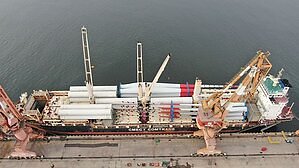
SANY's Chilean Wind Project: A New Front in the Global Energy Race
NEW YORK, NY – June 17, 2026 – A seemingly routine shipment from the Port of Tianjin in China carries implications that ripple far beyond the transoceanic journey to Chile. SANY Renewable Energy, a subsidiary of the Chinese industrial behemoth SANY Group, has dispatched the core components for its inaugural Latin American wind power project: the 18 MW PURRANQUE facility. While the project's capacity is modest, its strategic importance is anything but. This move marks a calculated entry into a fiercely competitive market and serves as a powerful demonstration of a new model for global infrastructure development, one where Chinese industrial giants are no longer just suppliers, but end-to-end solution architects.
Chile's Green Ambitions Meet Grid Realities
To understand the significance of SANY's arrival, one must first look at Chile itself. The nation stands as a vanguard of Latin America's energy transition, driven by some of the world's most aggressive decarbonization targets. While the official goal has long been 70% renewable electricity by 2030, the government's latest "Energy Roadmap 2026-2030" has pushed the ambition even further, now aiming for a 100% green grid by the end of the decade. This isn't just aspirational talk; as of December 2024, renewables were already supplying 70% of the country's electricity, a monumental leap from just five years prior.
Yet, this rapid success has created its own set of complex challenges. The country's long, narrow geography means that its prime renewable generation zones—boasting world-class solar irradiance in the northern Atacama Desert and powerful winds in the south—are often far from its population centers. The result has been severe grid congestion. In 2025 alone, an estimated 6,000 GWh of potential wind and solar energy were lost, or curtailed, simply because the transmission infrastructure couldn't carry the power to where it was needed. This bottleneck is the central paradox of Chile's green revolution: an abundance of clean power that cannot always be used. It is within this context that projects like the 18 MW PURRANQUE facility, owned by Windkraft Purranque 1 SpA and now being equipped by SANY, find their purpose. Each new installation is a vital piece in a national puzzle, contributing not just to generation capacity but also testing the limits and driving the necessary expansion of the grid.
A Calculated Entry into a Crowded Market
SANY's move into Chile is anything but a speculative venture. It represents a deliberate, strategic beachhead in a region where it has, until now, been absent from the wind energy sector. Globally, SANY ranked as the fifth-largest wind turbine supplier in 2025, a testament to its rapid growth. However, the Latin American market is a different story, historically dominated by European and American incumbents like Vestas and Nordex Group, with Chinese rival Goldwind also holding a significant share. In 2025, Vestas alone commanded over 44% of the market.
In this environment, an 18 MW project is not intended to conquer the market overnight. Instead, it serves as a powerful proof of concept. It is a showcase for what SANY bills as its integrated supply, transportation, and installation services—a turnkey solution that is becoming its primary calling card. This project allows SANY to demonstrate its ability to navigate local customs, manage complex logistics, and deliver a fully operational asset in a new and challenging regulatory environment. This follows a pattern of deliberate global expansion accelerated since 2022, with the company establishing a significant presence in Europe through projects like the 168 MW Alibunar wind farm in Serbia and a massive hybrid power hub in Romania. For SANY, PURRANQUE is the gateway to a continent, a chance to prove its model works before scaling up.
The Why Behind the Buy: Integrated Systems Over Siloed Parts
What truly sets this new wave of industrial players apart is their focus on the entire value chain. The press release's emphasis on "end-to-end delivery capabilities" and "seamless multimodal transportation" is the core of SANY's strategic advantage. For decades, the challenge of wind power has not just been turbine efficiency, but the monumental task of getting massive components to remote, often inhospitable locations. Blades now routinely exceed 100 meters, and nacelles can weigh over 100 tons. Moving such equipment requires custom-built vehicles, painstaking route planning, and flawless coordination between sea, rail, and road transport.
SANY is leveraging its deep heritage in heavy equipment and logistics to turn this challenge into a competitive moat. By offering a single, integrated package, it removes immense complexity and risk for the project developer. This is further bolstered by technological customization. The announcement that the PURRANQUE project's technical solution was "tailored to Chile's specific geographical and climatic conditions" is critical. Chile's diverse environment, which includes seismic zones, corrosive coastal air, and extreme wind patterns, demands more than off-the-shelf hardware. True value is created by engineering systems that are optimized for reliability and peak performance in a specific location. SANY's ability to deliver this customization at scale is underpinned by advanced facilities like its "lighthouse factory for smart blade manufacturing," which integrates intelligent design and production to create bespoke solutions efficiently.
China's Industrial Giants and the New Energy Order
Zooming out, SANY's Chilean project is a microcosm of a profound shift in the global industrial landscape. Chinese companies are rapidly evolving from being the world's workshop for components to becoming global leaders in providing complex, high-value systems. This evolution leverages decades of accumulated expertise in manufacturing, logistics, and large-scale project execution, often honed domestically before being exported worldwide. SANY's parallel successes in the heavy mining equipment sector, including recent deliveries of massive hydraulic excavators to overseas markets, underscore this deep industrial capability.
This transformation is fundamentally altering the geopolitics of the energy transition. The ability of firms like SANY to provide not just equipment, but also financing, logistics, and installation services, makes them highly attractive partners for nations looking to accelerate their decarbonization efforts. It introduces a new dimension of competition for established Western firms and has the potential to speed up the global deployment of renewable energy. As these integrated industrial powerhouses expand their reach, they are not just selling turbines; they are exporting a new, highly efficient model for building the infrastructure of a sustainable future, reshaping the global economy in the process.