
- Enterprises often have three times more APIs than they realize, creating a vast and poorly understood attack surface. - Salt AI API Summaries translate complex API schemas into plain English summaries, enabling instant risk assessment. - The tool aims to reduce time-consuming investigations by providing immediate context about API functions and sensitive data handling.
Experts would likely conclude that Salt Security's Generative AI solution addresses a critical gap in API security by providing immediate, human-readable context, significantly improving threat prioritization and incident response efficiency.
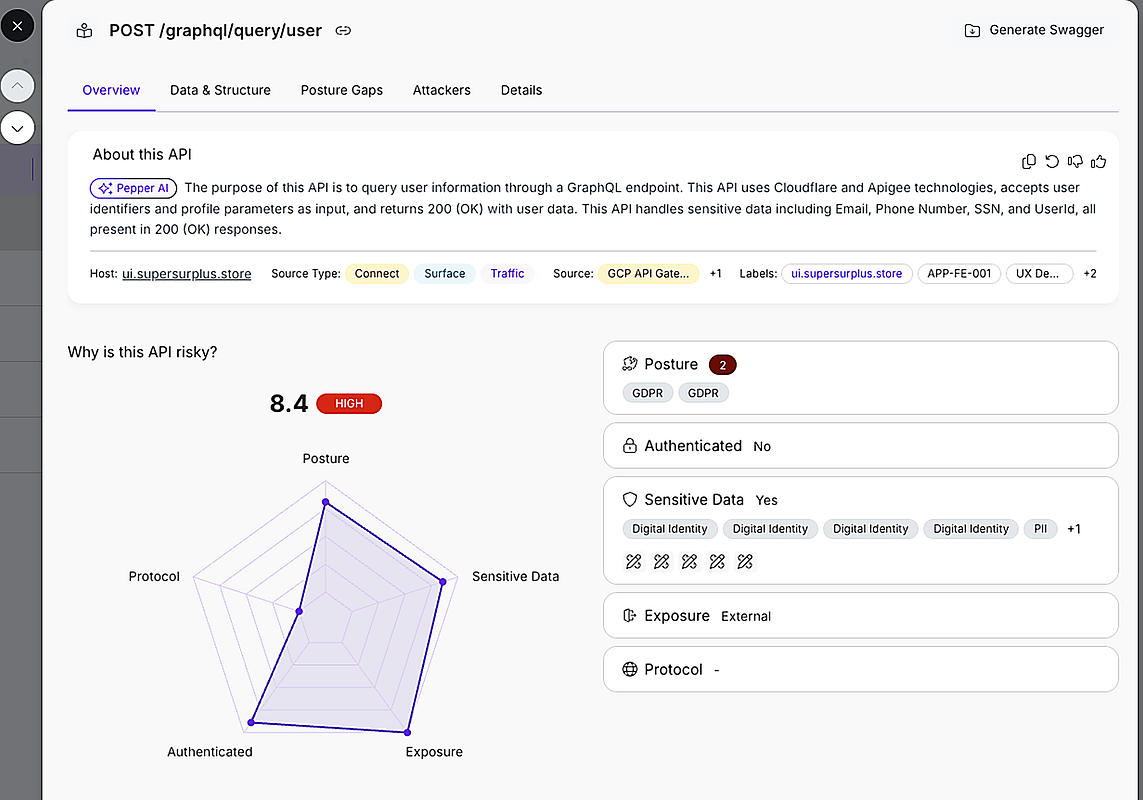
Salt Security's GenAI Translates Complex APIs into Plain English
PALO ALTO, CA – January 28, 2026 – API security leader Salt Security today launched a groundbreaking suite of features that use Generative AI to solve a critical problem plaguing cybersecurity teams: understanding what the thousands of APIs powering their applications actually do. The new capabilities, headlined by Salt AI API Summaries, promise to translate complex API schemas into simple, human-readable language, addressing what the company calls the "Context Crisis" in application security.
The release, which also includes a redesigned Deep Context Side Drawer, aims to empower security analysts, from junior staff to seasoned veterans, to instantly triage risks and govern their API ecosystem without needing to decipher developer code or consult outdated documentation. These tools are designed to bridge the persistent skills gap between security departments and the development teams that build the APIs, a friction point that often slows down threat response and creates security blind spots.
The API "Context Crisis" Drowning Security Teams
In the modern digital economy, APIs (Application Programming Interfaces) are the connective tissue linking services, data, and applications. However, their rapid proliferation has led to a phenomenon known as "API sprawl," where organizations operate hundreds or even thousands of endpoints, many of which are undocumented ("shadow APIs") or obsolete but still active ("zombie APIs"). According to industry research, many enterprises have three times more APIs than they realize, creating a vast and poorly understood attack surface.
This explosion in APIs has created a "Context Crisis" for security teams. While traditional security tools and Cloud Native Application Protection Platforms (CNAPPs) are effective at inventorying assets—providing lists of IP addresses, servers, and URLs—they typically fail to provide the most crucial piece of information: the API's business purpose. Security analysts are left "drowning in technical data but starving for context," a challenge that significantly hampers their ability to prioritize threats.
When an alert is triggered, an analyst may see that an API is receiving unusual traffic but has no immediate way of knowing if that API handles public marketing data or processes sensitive credit card applications. This lack of context forces them into a time-consuming investigation, requiring them to hunt down the responsible development team or manually parse complex JSON schemas, delaying response to potentially critical threats and wasting valuable time on false positives.
Generative AI as the Rosetta Stone for APIs
Salt Security's new AI API Summaries are engineered to be the Rosetta Stone that translates developer-speak into clear security insights. By analyzing an API's traffic, structure, and data payloads, the platform's Generative AI engine automatically produces a concise, natural-language summary for every discovered endpoint.
This allows an analyst to understand an API's function in seconds. Instead of a cryptic code block, they might see a summary stating, 'This API processes unencrypted credit card applications for the EMEA region.' This level of immediate clarity is transformative for risk assessment.
"A CNAPP can tell you that an API exists on a specific server," said Nick Rago, VP of Product Strategy at Salt Security, in the company's announcement. "But only Salt can tell you, in plain English, that 'This API processes unencrypted credit card applications for the EMEA region.' That difference is the key to effective governance."
The benefits extend beyond just senior analysts. By democratizing this information, the tool empowers junior security professionals and team members without a development background to perform effective initial triage. It answers critical questions on the spot: What is the purpose of this API? What sensitive PII does it handle? Who consumes this data? This capability promises to accelerate incident response, reduce the burden on engineering teams, and allow security operations to scale more effectively.
Beyond Summaries: Deep Context and Business Logic
Complementing the AI-generated summaries is a completely reimagined Deep Context Side Drawer. This interface moves beyond treating APIs as simple entries in a table, instead presenting them as complex software entities with rich, organized telemetry. This design directly challenges the "checkbox" security approach of merely scanning for infrastructure misconfigurations.
The new interface organizes critical information into distinct tabs, providing a holistic view of each API:
- Structure & Data: Visualizes the full API schema, parameter usage, and automated data classification, revealing exactly what kind of information, such as PII or financial data, is being transmitted.
- Attacker Intelligence: Correlates active threats and historical attack data directly with the specific API, giving analysts a clear view of its risk profile over time.
- Posture Evidence: Displays specific configuration gaps and governance violations associated with the endpoint, providing concrete evidence for remediation efforts.
This focus on deep, behavioral context signals an important industry shift. As attackers increasingly target flaws in an application's business logic rather than simple infrastructure vulnerabilities, security tools must evolve to understand that logic. By providing granular detail on how an API behaves and what it is intended to do, this approach enables security teams to protect the core logic of their applications, not just the servers they run on.
Reshaping DevSecOps and the Competitive Landscape
The introduction of AI-powered context generation carries significant implications for DevSecOps and the broader API security market. By creating a common, easily understood language around API function and risk, these tools can help break down the silos that often exist between development and security teams. When security can provide clear, context-rich feedback, developers can remediate issues faster, integrating security more seamlessly into the development lifecycle.
While key competitors in the API security space, such as Akamai, Noname Security, and Cequence Security, leverage AI and machine learning, their focus has historically been on behavioral analysis for threat detection and runtime protection. Salt Security's explicit use of Generative AI to synthesize business context for human analysts appears to be a novel strategy aimed at solving the specific operational bottleneck of comprehension. It addresses the pervasive "What does this API do?" problem head-on, a pain point that resonates across security operations centers globally.
As organizations continue to build their businesses on interconnected digital services, the ability to rapidly discover, understand, and secure their API ecosystems is no longer optional. Tools that provide not just data but true understanding are becoming essential. By turning complex code into a common language, such innovations aim to make security a shared responsibility rather than a siloed function, a necessary evolution for securing the digital enterprise.
Topics & Related
Generative AI
Digital Transformation
Geopolitics & Trade
Revenue
Software & SaaS
AI & Machine Learning
Related Company Pulse