
- Emirates Great Britain SailGP Team (Emirates GBR) won the Impact League championship for the second consecutive year.
- The team's waste reduction initiative saved 7,000 kg of CO2e emissions.
- Northstar Canada planted 2,000 eelgrass shoots as part of their Climate Action project.
Experts view SailGP's Impact League as a groundbreaking model that successfully integrates sustainability into competitive sports, setting a new standard for purpose-driven athletics.
SailGP's Impact League: The New Gold Standard for Sustainable Sports?
LONDON, UK – November 26, 2025 – In the high-octane world of professional sports, victory is typically measured in points, seconds, and championship titles. But what if there was another podium, one that rewarded environmental restoration and social progress? SailGP, the global racing championship known for its high-speed foiling catamarans, has answered that question with its groundbreaking Impact League—a second, parallel competition where teams battle not just for speed on the water, but for positive impact off it.
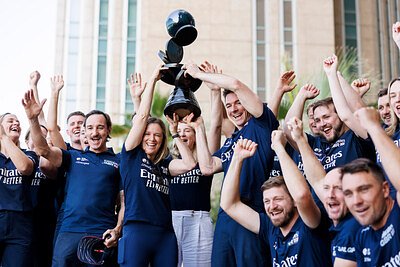
This week, the Emirates Great Britain SailGP Team (Emirates GBR) was crowned Impact League champion for the second consecutive year, a testament to a year-long campaign of purpose-driven initiatives. While the team also leads the on-water racing standings, this dual success highlights a paradigm shift in professional sports: the integration of sustainability not as a corporate sidebar, but as a core competitive element. As businesses across all sectors grapple with integrating ESG (Environmental, Social, and Governance) principles, SailGP’s model offers a compelling case study in how purpose can drive performance, innovation, and commercial value.
A New Blueprint for Purpose-Driven Competition
Launched in its second season, the Impact League is far more than a marketing initiative. It is a rigorously judged championship that incentivizes SailGP’s national teams to innovate and deliver tangible environmental and social projects. Unlike the broad sustainability programs of leagues like the NFL or the IOC, which often focus on event-level greening or organizational carbon footprints, SailGP has gamified positive impact. Teams earn points for projects across key focus areas—waste reduction, climate action, inclusivity, and breaking boundaries—creating a “podium for the planet.”
The credibility of the league is anchored by its independent and diverse judging panel. This isn't an internal review; it's an audit by global experts in sustainability, sport, and social justice. The panel includes figures like Kelly Simmons, former Director of the Women’s Professional Game at the FA; Sanjay Bhandari, Chair of anti-discrimination charity Kick it Out; and Rachel Kyte, a former Special Representative of the UN Secretary-General. This external validation ensures that the 48 project submissions are evaluated not just for their intent, but for their measurable scale, depth, and durability.
Fiona Morgan, SailGP Chief Purpose Officer, captured the essence of the achievement, stating, "What an achievement for the Emirates Great Britain Team winning the Impact League for the second year running — a standout example of their long-term commitment and passion across the team to drive meaningful change." This structure transforms athletes into advocates and their teams into incubators for social and environmental solutions, setting a benchmark that other sports leagues are now watching closely.
From Catamarans to Communities: The Tangible Impact
The true innovation of the Impact League lies in the real-world outcomes generated by the teams. Emirates GBR’s victory was built on a portfolio of impactful projects. Their expanded partnership with the Greig City Academy in London created pathways for underserved youth into the marine industry, culminating in athlete Kai Hockley securing a full-time position with the team. On the environmental front, the team tackled waste by rebranding existing kit for new sponsors, saving hundreds of items from landfill and preventing an estimated 7,000 kg of CO2e emissions. Perhaps most impressively, their collaboration with purpose partner Low Carbon led to the creation of a portable, off-grid power solution using solar and wind, which powered their entire team base and was shared as an open-source blueprint for other organizations.
Sir Ben Ainslie, Emirates GBR CEO and co-owner, emphasized the multifaceted approach: "I'm so proud of the team for winning the Impact League for the second year running. We've expanded our partnership with the Greig City Academy... put on foiling academies... and partnered with Goodwall and the 1851 Trust to provide STEM and climate education."
But the impact extends across the league. The runner-up, Mubadala Brazil, led by the Rolex SailGP Championship's first female driver, Martine Grael, focused on restoring Pombeba Island in Guanabara Bay. They employed local fishermen to remove over 4,000 kg of waste from the heavily polluted ecosystem. The team also championed gender equality by establishing a 50% female-led offshore leadership team and launching a female foiling clinic to accelerate pathways for Brazilian women in the sport.
Meanwhile, third-place finisher Northstar Canada won the Climate Action category for its ambitious eelgrass restoration project. In partnership with Dalhousie University, the team mobilized local youth sailors to plant 2,000 eelgrass shoots, restoring a critical marine habitat that sequesters carbon, protects coastlines, and supports biodiversity. These projects demonstrate how a global sports platform can be leveraged to drive localized, science-based environmental action.
The Business of Doing Good: Sustainability as Strategy
For business leaders and investors, the key takeaway from SailGP’s model is the powerful synergy between purpose and commercial success. The Impact League is not a cost center; it's a value driver. It attracts a new breed of purpose-driven sponsors eager to align their brands with authentic, measurable impact. The partnership between Emirates GBR and renewable energy company Low Carbon is a prime example—it’s not just a logo on a sail, but a genuine collaboration that produced an innovative, scalable clean energy solution.
This approach enhances brand reputation in an era of conscious consumerism. Fans are increasingly drawn to organizations that reflect their values, and the Impact League provides a compelling narrative that deepens engagement beyond the thrill of the race. It fosters a community around shared goals, inspiring a new generation of fans and participants who see sport as a vehicle for change. The league’s ambitious goal to engage 100,000 participants in its Next Generation youth programs by 2030 is a strategic investment in its future audience and talent pool.
Ultimately, the Impact League strengthens SailGP’s entire commercial proposition. It differentiates the league in a crowded sports market, creates compelling stories for broadcast partners, and offers sponsors a unique platform for ESG activation. By proving that sustainability can be a competitive advantage, SailGP demonstrates a forward-thinking business model where winning on the water and winning for the planet are inextricably linked.
As the teams prepare for the Mubadala Abu Dhabi Sail Grand Prix and the winner-takes-all $2 million final, the stakes are higher than ever. Yet, the existence of the Impact League ensures that regardless of who lifts the championship trophy, the sport itself—and the communities and ecosystems it touches—has already secured a victory. By embedding purpose into its DNA, SailGP is not just predicting the future of sport; it is actively building it, setting a new course for the entire world of professional athletics.