
- Over 80% of enterprise institutional knowledge is locked in unstructured formats
- AI models struggle with inconsistent, outdated, or fragmented unstructured data
- SageX aims to convert chaotic, multimodal enterprise data into structured, AI-ready intelligence
Experts agree that while AI model sophistication is important, the real barrier to scaling enterprise AI is ensuring data integrity and governance, making platforms like SageX critical for reliable AI deployment.
SageX Targets AI's Achilles' Heel: Unstructured Enterprise Data
NEW YORK, NY – February 11, 2026 – As enterprises race to embed artificial intelligence into their core operations, a persistent and costly bottleneck has emerged, not in the AI models themselves, but in the data they consume. Today, AI-native data platform SageX officially launched its solution, positioning itself as a foundational infrastructure layer designed to solve what many experts call the Achilles' heel of enterprise AI: the unstructured data problem.
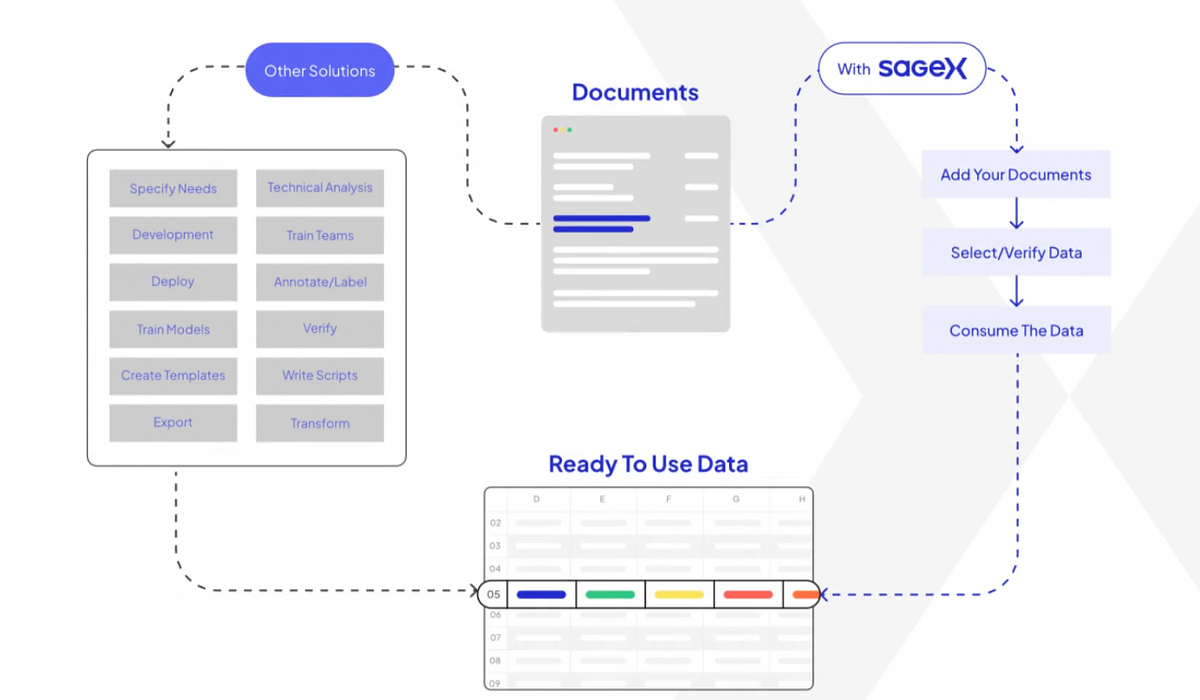
The company announced a platform that operates as a continuous “AI unstructured data translation layer,” designed to convert the vast sea of chaotic, multimodal information found in every organization into structured, governed, and AI-ready intelligence. The move addresses a critical pain point for businesses where, despite massive investments in AI, the majority of their institutional knowledge—estimated to be over 80 percent—remains locked away in formats that AI systems struggle to reliably interpret.
This trove of unstructured data includes everything from PDFs and legal contracts to customer support emails, screenshots, audio transcripts, and engineering logs. This information is often fragmented across disconnected systems, inconsistently labeled, and frequently outdated, creating a minefield for AI models that depend on high-quality, consistent inputs to function effectively.
The 'Garbage In, Garbage Out' Problem at Scale
The adage “garbage in, garbage out” has taken on new urgency in the era of generative AI. While advanced models demonstrate remarkable reasoning capabilities, their performance in production environments is directly tied to the quality of the data they are given. Enterprises are increasingly finding that retrieval-augmented generation (RAG) systems, which enhance AI models with proprietary data, are prone to “hallucinations” or providing incorrect answers when they surface stale or conflicting documents.
Similarly, autonomous AI agents designed to execute business workflows can fail in subtle but expensive ways when acting on incomplete or contradictory information. A workflow meant to automate contract review might miss a critical clause in a poorly scanned PDF, or a customer service bot might provide a faulty answer based on an outdated support ticket. This unreliability forces companies to maintain costly human-in-the-loop validation for compliance-sensitive processes, undermining the very efficiency AI promises to deliver.
“The industry has been fixated on model sophistication, but the real barrier to scaling AI is data integrity,” noted one industry analyst. “You can have the most advanced language model in the world, but if you feed it a decade's worth of disorganized, contradictory documents, you're building your AI house on a foundation of sand.”
This challenge has given rise to the need for a dedicated data infrastructure layer capable of continuously preparing and governing unstructured data for machine consumption—a role SageX aims to fill.
A Translation Layer for Enterprise Knowledge
Unlike traditional data preparation tools that perform one-time cleanup tasks, SageX is designed as a persistent piece of data infrastructure. The platform ingests unstructured and multimodal data from across an enterprise's various systems, from cloud storage to legacy databases.
Once ingested, the system employs advanced AI techniques, likely including a combination of natural language processing (NLP), computer vision, and multimodal AI, to extract context-aware structure aligned with specific business semantics. This goes beyond simple keyword extraction. It involves identifying key entities, understanding the relationships between them, and mapping this information into a coherent, structured format, such as a knowledge graph. This machine-readable graph can then represent the complex web of an organization's knowledge—linking a customer mentioned in an email to their contract stored as a PDF and their support history in a separate system.
The platform's continuous nature is central to its value proposition. It works to reconcile inconsistencies across different sources, ensuring that the AI has a single, authoritative version of the truth. It also maintains validation, data lineage, and freshness over time, automatically updating the structured intelligence as new information flows in. The resulting outputs—clean, structured, and context-rich data—are then delivered directly to downstream AI systems, enabling more reliable deployment of RAG pipelines, AI agents, and analytics platforms.
By creating this durable foundation, organizations can move away from building brittle, custom data pipelines for each individual AI use case and instead establish a single source of truth that supports multiple AI workloads simultaneously.
Shifting from Model Hype to Data Infrastructure
The emergence of platforms like SageX signals a broader maturation in the enterprise AI market. For years, the spotlight has been on building bigger and more powerful AI models. Now, the focus is shifting to the less glamorous but arguably more critical work of building the data infrastructure required to make those models effective and trustworthy in the real world. This trend, often called “data-centric AI,” posits that for most enterprise applications, improvements in data quality yield far greater returns than tweaks to model architecture.
Industry observers have highlighted the growing need for this dedicated AI data layer. Venture capital has followed suit, with significant investments flowing into companies that build the foundational tools for AI data management, quality, and governance. The success of generative AI has only accelerated this trend, as the demand for high-quality, contextual data to fuel RAG systems has exploded.
By positioning its platform at the foundation of the enterprise AI stack, SageX is making a strategic bet that as AI transitions from an experimental capability to core operational infrastructure, the ability to operationalize institutional knowledge at scale will become the primary driver of competitive advantage. The goal is to reduce the need for manual oversight while increasing the reliability and auditability of AI-driven decisions, a crucial step for deploying AI in regulated industries like finance and healthcare.
The Path to Production-Grade AI
By providing a more reliable data foundation, this new class of AI infrastructure aims to help enterprises finally move beyond isolated pilot programs and proof-of-concept deployments. The ultimate objective is to embed production-grade AI systems within core business processes, from contract intelligence and compliance workflows to customer support and enterprise search.
However, the path to widespread adoption is not without its challenges. Integrating a new foundational layer into complex and often fragile enterprise IT ecosystems requires careful planning and execution. Concerns around data governance, security, and privacy are paramount, as these platforms handle an organization's most sensitive information. Furthermore, the cost of implementation and the need for specialized talent to manage such systems remain significant considerations for many businesses.
Ultimately, the success of intelligent systems will depend less on the raw power of their models and more on the integrity of the data infrastructure that underpins them. As organizations globally accelerate their AI initiatives, they are discovering that unlocking the full potential of artificial intelligence requires them to first solve their foundational data problem.
Topics & Related
AI & Machine Learning
Fintech
Computer Vision
Generative AI
Artificial Intelligence
EBITDA
Related Company Pulse