
- Unified Data Fabric: CTERA Fusion Direct enables seamless bidirectional conversion between file and object storage, eliminating data silos.
- Zero-Copy Architecture: Patented technology (U.S. Patent 12,007,952) allows native mapping of file blocks to object storage without conversion, reducing latency and storage overhead.
- High-Performance AI Workloads: Supports S3 over RDMA for wire-speed throughput, optimizing data access for AI and HPC applications.
Experts agree that CTERA's Fusion Direct addresses a critical gap in enterprise data infrastructure by unifying file and object storage, enabling seamless AI-driven analytics and eliminating performance bottlenecks.
CTERA Aims to Unify Data for AI with New Fusion Direct Platform
NEW YORK, NY – March 11, 2026 – Intelligent data management firm CTERA today announced a significant architectural move aimed at dismantling one of the most persistent roadblocks in enterprise data infrastructure: the deep-seated divide between file and object storage. With the launch of CTERA Fusion Direct, the company is introducing a transformative federated data architecture designed to unify these two historically separate domains into a single, high-performance data fabric.
The launch addresses a fundamental challenge for modern enterprises. As organizations race to harness the power of artificial intelligence, they find their most valuable asset—unstructured data—often trapped in silos. Traditional Network Attached Storage (NAS) systems, which present data as files and folders, are optimized for human collaboration and legacy applications. In parallel, object storage has emerged as the hyper-scalable solution for machine-driven workloads, analytics, and cloud-native applications. Bridging these worlds has traditionally required complex gateways, costly data duplication, and performance-limiting translation layers, creating friction that slows innovation and inflates budgets.
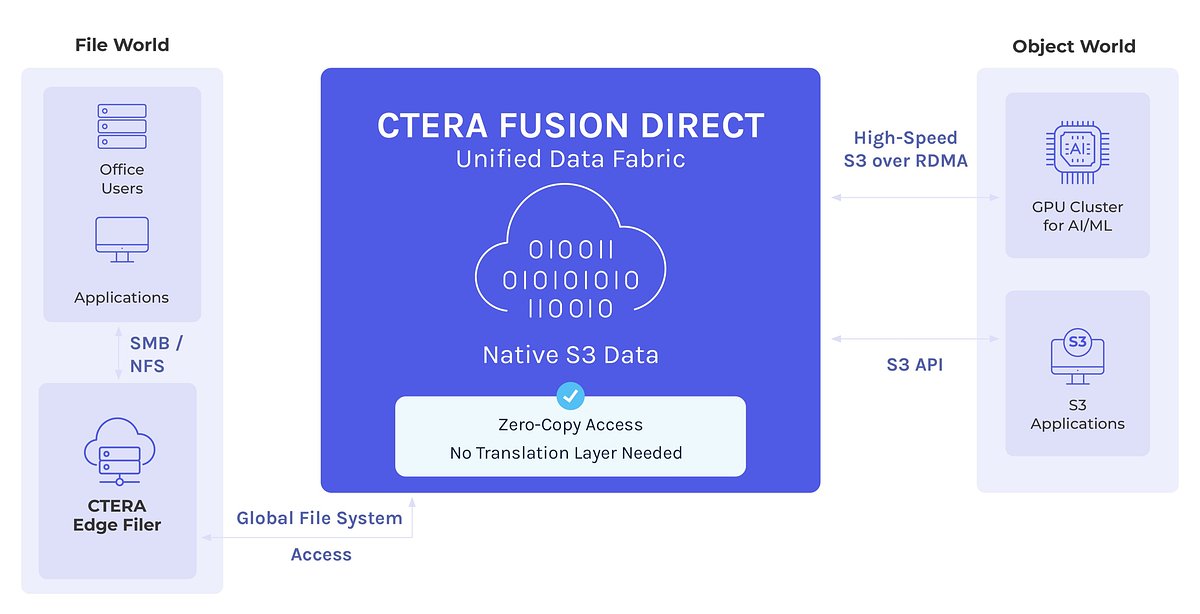
CTERA's new platform promises to erase this boundary, enabling data to be written as a file and read as an object, or vice versa, with full bidirectional capabilities. This creates a unified global namespace where data can seamlessly serve both human-centric applications over standard protocols like SMB and NFS, and machine-learning clusters over high-speed object protocols like S3.
Bridging the Great Data Divide
The struggle to integrate file and object storage is more than a technical nuisance; it represents a strategic barrier to progress in the AI era. Enterprises are collecting data at an unprecedented rate, yet much of it remains inaccessible to the very systems designed to analyze it. The architectural disparity means that data useful for a marketing team's collaborative work might be invisible or unusable to a data science team's AI training model without a cumbersome and slow extraction and transformation process.
This friction has been a major focus for industry analysts. "Enterprises are struggling to unlock the full value of their unstructured data. The irony is that the file systems that make data useful for people often make it inaccessible for modern AI and analytics engines," noted Karyn Price, Industry Director for ICT at Frost & Sullivan. She emphasizes that a platform capable of fluently speaking both languages—presenting data as files for users and as objects for machines—is essential for building a data foundation ready for AI's demands.
CTERA Fusion Direct is engineered to solve this by creating a unified fabric that spans from the edge to the cloud. The system allows organizations to attach existing object storage buckets directly to the data fabric, instantly making that data available as files across a global network of locations. This capability eliminates the need for massive data migration projects and allows organizations to activate distributed datasets without duplicating infrastructure, a critical advantage for global enterprises pursuing distributed AI initiatives.
Under the Hood: A Patented, Zero-Copy Architecture
What differentiates CTERA's announcement from other unified storage solutions is its architectural foundation. The company asserts that Fusion Direct is not another gateway or translation layer but a fundamentally new approach, backed by U.S. Patent 12,007,952, titled "System and method for direct object to file mapping in a global filesystem." This patent details a method for natively mapping file blocks to an object storage system without proprietary encapsulation.
At the core of this technology is the principle of native zero-copy access. When data is written to the CTERA Intelligent Data Platform as a file, it is immediately available as a standard S3 object without any conversion process. Conversely, existing S3 buckets can be attached as-is, making their contents instantly accessible as files across the enterprise. This process avoids data duplication, eliminates the latency inherent in file-to-object conversion, and prevents storage overhead from ballooning.
This design also directly addresses concerns around vendor lock-in and data sovereignty. Because data resides in standard S3 buckets, free from proprietary chunking schemes or wrappers, organizations maintain full control over their information assets. They can move their data between cloud providers or on-premises platforms without being tied to a specific vendor's ecosystem, ensuring a future-proof data strategy.
Performance Engineered for the AI Era
For AI and High-Performance Computing (HPC) workloads, raw performance is paramount. Training a large language model or running complex simulations requires feeding data to power-hungry GPUs at the highest possible bandwidth. Any bottleneck in the storage layer can leave expensive computational resources idle, driving up costs and extending project timelines. CTERA Fusion Direct was engineered with these demanding use cases in mind.
By exposing data as native objects, the platform supports high-performance standards such as S3 over RDMA (Remote Direct Memory Access). This allows AI clusters and GPU-Direct-enabled systems to bypass traditional CPU and network bottlenecks, reading and writing data at wire-speed throughput directly from the storage backend. The platform also enables high-speed file streaming, allowing applications that rely on file-based access, such as media editing suites, to work directly with massive datasets stored in object storage without lengthy downloads.
The value of this no-compromise approach is being recognized by industry partners. "Our customers are looking for the limitless scalability of object storage and the broad compatibility of traditional file access," said Amit Rawlani, Sr. Director of Technology Alliances & Solutions at Cloudian. "CTERA Fusion Direct is the first technology we’ve seen that delivers this without the performance trade-offs of a traditional gateway approach." He added that the combination of Cloudian's object storage with CTERA's platform provides a powerful solution to unify the enterprise data landscape.
Redefining a Crowded Data Fabric Market
The concept of a "data fabric" or "unified storage" is not new, and CTERA enters a competitive field populated by established players like NetApp and Pure Storage, as well as object storage specialists like Scality. Many vendors have long offered platforms that support multiple protocols. However, these solutions have often involved separate hardware, software gateways, or performance trade-offs that CTERA claims its new architecture avoids.
CTERA's differentiation hinges on its native, zero-copy integration that truly merges the two access paradigms at a foundational level, rather than simply layering one on top of the other. This focus on eliminating the translation layer itself is what positions Fusion Direct as a potential step-change for data-intensive industries like media, healthcare, and financial services.
“The primary roadblock to enterprise AI has not been a lack of data, but the inability to use it effectively," stated Oded Nagel, CEO of CTERA. He explained that the historical divide created friction that slowed companies down. "We've collapsed those silos. This fundamental shift in architecture unlocks the full potential of a customer's data, providing the unified data platform necessary to not just compete, but to lead in an economy increasingly driven by machine learning.” By removing this foundational barrier, the company hopes to empower organizations to finally leverage their complete data estate at the speed their AI ambitions demand.
Topics & Related
AI & Machine Learning
Fintech
Artificial Intelligence
Generative AI
Machine Learning
Data-Driven Decision Making
Revenue
AI & Software Platforms
Related Company Pulse