
- $45.7 billion: Projected valuation of the global robotaxi market by 2030
- 99.9%: Plug-in success rate of the Rocsys M1 system in live environments
- $1.7 million: Annual savings projected for a 50-bay depot using the M1 system
Experts agree that the Rocsys M1 system addresses a critical bottleneck in robotaxi scalability by automating depot charging, enabling 24/7 fleet operations and significantly improving cost efficiency.
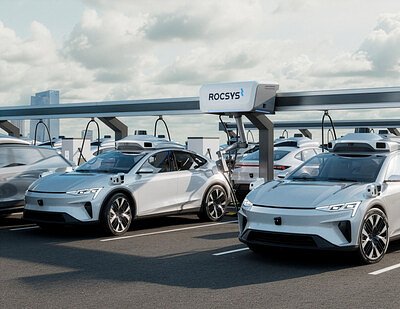
Rocsys Unveils Robotic Charger to Solve Robotaxi's Biggest Bottleneck
RIJSWIJK, Netherlands and PORTLAND, Ore. – April 29, 2026 – By Laura Harris
Rocsys, a leader in autonomous vehicle infrastructure, today unveiled its M1 system, the world's first multi-bay hands-free charging solution designed to tackle a critical hurdle in the race toward scalable robotaxi fleets. The announcement was coupled with a new $13 million Series A extension, bringing the company's total funding to $56 million and signaling strong investor confidence in its mission to automate the depot.
As the global robotaxi market accelerates toward a projected $45.7 billion valuation by 2030, operators face a significant, non-autonomous bottleneck: charging. While vehicles can navigate complex city streets without a driver, they still rely on human staff to be manually plugged in at the depot. This friction point introduces major costs, operational delays, and safety risks, fundamentally limiting the scalability and profitability of autonomous fleets. Rocsys aims to eliminate this barrier, transforming the depot into a seamless, fully automated ecosystem.
The Billion-Dollar Bottleneck
The promise of autonomous ride-hailing hinges on maximizing vehicle uptime and operational efficiency. However, as fleets expand from hundreds to thousands of vehicles, the logistics of manual charging become untenable. Each day, thousands of charging cycles must be initiated and completed by human workers, a repetitive process that directly contradicts the core principle of autonomy. This reliance on manual labor prevents a 24/7 operational model and creates a structural constraint on growth.
"Autonomous vehicles are growing rapidly, and infrastructure must keep pace," said Crijn Bouman, CEO and Co-Founder of Rocsys. "Without hands-free operations, autonomy stops at the depot." His statement captures the central challenge facing major players like Waymo and Cruise, whose vehicles can drive themselves to a charging station but still require a technician for the final connection.
The Rocsys M1 is engineered to be this "missing link." By fully automating the plug-in process, it enables fleet readiness around the clock, paving the way for robotaxi operators to transition from limited pilot programs to large-scale global deployments.
Engineering a Hands-Free Future
The Rocsys M1 is not just a single robotic arm but a sophisticated, intelligent system. Its modular, multi-bay architecture features an overhead rail-mounted robot that can service up to 10 parking bays. This design maximizes throughput while preserving valuable depot floor space, allowing for parallel activities like vehicle cleaning and inspection to occur simultaneously.
At the heart of the M1 is a combination of AI-enhanced computer vision and advanced motion intelligence, built upon a platform proven in demanding industrial environments like active ports. Trained on over six years of real-world data, the system can adapt to variations in lighting, weather, and vehicle positioning to achieve a plug-in success rate of over 99.9% in live environments.
Key to its commercial appeal is its universal interoperability. The M1's flexible, long-reach robotic arm is compatible with virtually any electric vehicle, charger type, and connector standard. This allows fleet operators to deploy the technology immediately across mixed fleets without costly vehicle retrofits or vendor lock-in—a significant advantage over proprietary solutions like wireless charging, which often require specific vehicle hardware.
The economic case is just as compelling. Rocsys projects that in a 50-bay depot, the M1 can deliver up to 75% higher operational efficiency from existing staff and generate annual savings of up to $1.7 million, offering a clear return on investment for fleet operators.
Investor Confidence and Strategic Alignment
The company's vision has attracted significant financial backing. The $13 million funding extension was led by Capricorn Partners, with notable participation from Scania Invest, the venture capital arm of the global transport giant. This investment underscores a strategic belief that enabling infrastructure is as crucial as the autonomous vehicles themselves.
Steven Lambert from Capricorn Partners noted the industry's shift, stating, "Robotaxis are entering an acceleration phase, where operational scaling becomes the defining challenge. Infrastructure will determine how quickly and efficiently this transition happens. Rocsys is building the system layer required to support that shift."
For Scania Invest, the investment aligns with its mission to support a more sustainable transport system. Automated charging is a key enabler not only for robotaxis but also for the future of autonomous electric trucks and logistics. Johannes Fors Källström from Scania Invest highlighted the company's proven reliability, a critical factor for maximizing uptime. "Their technical depth and growing operational track record position them well within this emerging segment of autonomous vehicle servicing," he said.
Beyond Charging: The Vision for the Autonomous Depot
Rocsys positions the M1 as the cornerstone of a much broader platform designed for full depot autonomy. The system integrates with the Rocsys Portal for operational visibility and offers APIs for integration with customer IT systems, all supported by remote monitoring and expert field service.
Looking ahead, the company envisions its technology platform extending beyond charging to other essential depot tasks. As Crijn Bouman explained, the platform is "designed to extend beyond charging to automated interior cleaning and inspection." This ambition paints a picture of a future where vehicles enter a depot and undergo a full suite of services—charging, cleaning, and diagnostics—without any human intervention before returning to service.
The company's claims are bolstered by a major, albeit unnamed, deal with a leading robotaxi operator, confirming market validation for the M1 even before its large-scale rollout, which is scheduled to begin in 2027. While competitors explore different avenues like wireless charging, Rocsys is providing a practical, interoperable solution poised to solve today's scaling challenges. As the industry watches the first M1-powered depots come online, it will be a clear signal that the era of true, end-to-end vehicle autonomy is finally arriving.