
- $267 million in total funding secured by ROBOTERA since 2023
- 600+ units of robots cumulatively delivered by the company
- 14.4 km/h top speed of the L7 humanoid robot
Experts view ROBOTERA's advancements as a significant leap in humanoid robotics, positioning China as a major contender in the global market with commercially viable, versatile robots that bridge lab innovation and real-world applications.
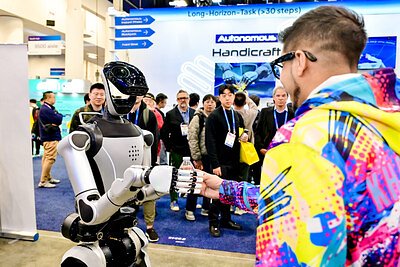
RobotEra's Humanoid Leap Signals China's Rise at CES 2026
LAS VEGAS, NV – January 08, 2026 – The floors of the Consumer Electronics Show (CES) have long been a stage for the future, but this year, the spotlight shines brightly on a new generation of machines that walk, talk, and work among us. Beijing-based ROBOTERA has seized this moment, showcasing a formidable lineup of humanoid and dexterous robots that underscores China's accelerating ambition in the global race for embodied intelligence. With its flagship L7 bipedal robot, the Q5 service bot, and the XHAND1 manipulator, the company is not just presenting hardware; it's promoting a vision of practical, commercially viable robotics ready to move beyond the lab.
At the heart of ROBOTERA's presentation is its "Hexa-Core" concept, a design philosophy emphasizing strength, agility, precision, stability, durability, and adaptability. While many companies make similar claims, ROBOTERA is backing them with impressive on-site demonstrations and, more importantly, a growing list of high-profile customers and real-world deployments that suggest these are more than just buzzwords.
A New Benchmark for Chinese Humanoids
The undisputed star of ROBOTERA's booth is the L7, a full-size bipedal humanoid robot that represents a significant milestone. The company claims it is the first robot of its kind in China to seamlessly combine large-scale dynamic motion with fine manipulation. Standing 171 cm tall and weighing 70 kg, the L7 boasts 55 degrees of freedom and a payload capacity of 20 kg, allowing it to perform tasks that demand both power and grace.
While other Chinese competitors have made headlines, they often excel in one domain at the expense of another. For instance, Unitree's H1 is a record-holder for running speed, emphasizing dynamic mobility, while Fourier Intelligence's GR-1 possesses manipulation capabilities but may not integrate them as fluidly with high-speed locomotion. The L7, in contrast, is demonstrated performing complex actions like breakdancing and running at up to 14.4 km/h while also being capable of ultra-low-latency teleoperation for delicate tasks. This integrated approach, building on the company's previous work with its chopstick-wielding STAR1 model, appears to validate its claim and sets a new benchmark in the domestic market.
Its adaptability is another key selling point. The L7 can be deployed as a full bipedal system or as a stationary upper-body configuration, reducing integration costs and broadening its potential applications from industrial automation to complex research platforms. This versatility is crucial in a market that is still defining the most valuable use cases for humanoid robots.
From Lab to Logistics: The Commercialization Push
Beyond the headline-grabbing L7, ROBOTERA's exhibit highlights a pragmatic focus on commercialization. The company's broader portfolio demonstrates a clear strategy to address immediate market needs across service and industrial sectors. To date, ROBOTERA reports it has cumulatively delivered over 600 units, a significant figure that grounds its advanced research in tangible market traction.
The Q5, a wheeled humanoid platform, is positioned to redefine service robotics. With 44 degrees of freedom, it is designed for natural human interaction, demonstrated at CES by smoothly delivering gifts and squatting to retrieve objects. Its slim, refined design makes it suitable for deployment in highly interactive commercial environments like retail floors and exhibition halls, where many of ROBOTERA's early units are already operating.
Perhaps most indicative of the company's industry penetration is the XHAND1, a fully direct-drive, five-fingered dexterous hand. With 12 active degrees of freedom, a grip force of 80 N, and an impressive lift capacity of 25 kg, it far surpasses the payload of many well-known competitors like the Shadow Dexterous Hand. Its direct-drive mechanism promises superior response time and precision, critical for professional-level manipulation. The credibility of the XHAND1 is bolstered by its adoption by a roster of leading robotics firms, including Skild AI and Humanoid AI, and top-tier research institutions such as MIT, UC Berkeley, and ByteDance Seed, confirming its value as a tool for cutting-edge development.
Investor Confidence and the 'Hexa-Core' Philosophy
ROBOTERA's rapid ascent is fueled by formidable financial backing. Since its founding in August 2023 as an incubation from Tsinghua University, the company has secured approximately $267 million in funding across several rounds. This includes a massive Series A+ round of nearly $140 million led by Geely Capital, with participation from major players like Alibaba and Lenovo. Such substantial investment from automotive and tech giants signals strong confidence in ROBOTERA's vertically integrated approach, which spans from foundational AI models to hardware manufacturing.
This funding allows the company to aggressively pursue its "Hexa-Core" philosophy in practice. The strength and agility are evident in the L7's dynamic feats. The precision is showcased by the XHAND1's delicate control. The stability is fundamental to the L7's bipedal balance, while the adaptability is embodied by the Q5's suitability for service roles and the L7's modular configurations. Finally, durability is being proven through hundreds of units already deployed in global retail, logistics, and exhibition settings, a crucial test for any hardware moving from prototype to product.
Navigating a Crowded and Accelerating Market
ROBOTERA is entering a global humanoid robotics market that is expanding at an exponential rate. Total shipments are projected to have increased more than fivefold in 2025 alone, with some analysts forecasting a market value exceeding $38 billion by the decade's end. China, in particular, has become the epicenter of this boom, dominating global shipments in 2025 and fostering over 150 startups in the space, driven by strong government support for "embodied intelligence" as a national priority.
This rapid growth is powered by breakthroughs in AI, including multimodal language models that allow robots to better understand and interact with their environment, as well as pressing economic drivers like global labor shortages. However, the industry still faces significant hurdles. High upfront costs, ensuring reliability in unpredictable environments, and solving the immense challenge of collecting sufficient training data remain barriers to mass adoption.
Industry analysts predict an inflection point for the humanoid market between 2026 and 2027, when many of these cost, safety, and ROI issues are expected to be largely resolved. With its strong financial backing, a clear focus on commercialization, and a technologically advanced product suite, ROBOTERA is positioning itself not just to participate in this transformation, but to be one of the key players shaping the future of human-robot collaboration.