
- Launched on May 19, 2026 in San Francisco, CA
- AI translation system supports real-time voice translation and multilingual subtitles
- Industry research in 2026 highlights challenges with latency, dialects, and cultural context in AI translation
Experts view RoamChat's AI-powered global connection platform as a potentially transformative tool for cross-cultural communication, but caution that its success hinges on overcoming significant technical and safety challenges.
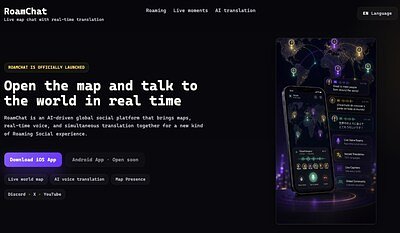
RoamChat's AI 'Babel Fish' Aims to Connect a World of Strangers
SAN FRANCISCO, CA – May 19, 2026 – In a social media landscape dominated by algorithmic feeds and short-form video, a new startup is betting on a fundamentally different human impulse: the curiosity to talk to a stranger. RoamChat launched today, introducing a platform that eschews passive scrolling in favor of spontaneous, real-time voice conversations with people across the globe, powered by a sophisticated artificial intelligence translation engine.
The app, described by its creators as a new form of "Roaming Social," presents users not with a feed of content, but with a live global map. Each glowing dot on the map represents a person, online and ready to talk. With a single tap, a user in Brazil can instantly strike up a conversation with someone in Singapore, or a student in Japan can discuss music with a peer in South Korea, all without a shared language.
"Our goal is to make the world feel smaller," the RoamChat team stated in their launch announcement. "If language barriers disappear, social networking itself changes. People no longer need to stay inside their own language communities."
This ambitious vision aims to pivot the very purpose of social networking away from content consumption and back toward live, human-to-human interaction.
The AI-Powered Promise of Global Connection
At the heart of RoamChat is its AI simultaneous translation system. The company claims the technology supports real-time voice translation, on-screen multilingual subtitles, and two-way interpretation, allowing two people to speak their native tongues as if they were using a universal translator from science fiction. The system is designed to handle the complex task of translation seamlessly in the background, preserving the natural flow of conversation.
This technological promise is the core of RoamChat's appeal. While AI translation tools like Google Translate and DeepL have become remarkably accurate for text, achieving near-instantaneous, nuanced voice translation during a live, spontaneous conversation remains a significant technical challenge. Industry research in 2026 shows that while AI models have made great strides, issues with latency, understanding regional dialects, and capturing subtle cultural context are still major hurdles.
As a newly launched platform, RoamChat's technology has yet to be independently tested or reviewed at scale. Its ability to deliver on the promise of a truly seamless "AI Babel Fish" will be the ultimate test of its technical foundation. Success would represent a major leap forward in consumer-facing AI applications, potentially unlocking a new era of global communication. Failure to deliver a smooth experience could quickly frustrate users and relegate the app to a novelty.
An Antidote to Social Media Fatigue?
RoamChat is making a deliberate break from the established social media formula. Where platforms like TikTok and Instagram are optimized for algorithmic engagement and endless content consumption, RoamChat is built around presence and interaction. The company is wagering that users are growing weary of the passive, and sometimes isolating, experience of scrolling through feeds.
The platform's "roaming" concept encourages exploration and serendipity over curated perfection. This positions it as a potential competitor not just to established social giants, but also to the wave of audio-centric apps that came before it. While Clubhouse pioneered the live audio space, it was largely focused on scheduled, room-based discussions among groups. Discord, while offering robust voice channels, is primarily organized around pre-existing communities and shared interests.
RoamChat’s unique selling proposition is the combination of its global, stranger-to-stranger connection model with the powerful enabler of AI translation. It also enters a space adjacent to language-exchange apps like HelloTalk, but with a crucial difference in intent. Whereas those apps are for the specific purpose of learning a language, RoamChat’s mission is simply communication for its own sake, aiming to facilitate connection rather than instruction.
The platform’s appeal may lie with a growing demographic of digital nomads, remote workers, and globally-minded individuals seeking more authentic international connections. The question remains whether the pull of spontaneous conversation can compete with the powerful, dopamine-driven feedback loops of today's dominant social platforms.
The Promise and Perils of Connecting Strangers
While the potential for fostering unprecedented cross-cultural understanding is immense, RoamChat's model also opens a Pandora's box of safety, privacy, and ethical challenges. Facilitating spontaneous, anonymous voice chats on a global scale presents a monumental moderation task.
Privacy is an immediate concern. The live map feature, while central to the app's discovery process, raises questions about location data security and user anonymity. Furthermore, the very nature of an AI translation service requires processing vast amounts of sensitive voice data. Users will need transparent answers on how their conversations are handled: Are they recorded? Is the data used to train AI models? How is it protected from breaches?
Beyond privacy, the potential for misuse is significant. Anonymity can embolden bad actors, making the platform a potential vector for harassment, hate speech, and abuse. Moderating live audio across dozens of languages and cultural contexts is exponentially more complex than flagging text or video content. Without robust, easily accessible tools for reporting and blocking users, and a clear, enforceable moderation policy, the platform could quickly become a toxic environment.
Protecting vulnerable users, particularly minors, from predatory behavior will be paramount. The company has not yet detailed its strategies for age verification, content moderation, or user safety, and these elements will be critical to building the trust necessary for mainstream adoption.
RoamChat's mission is simple and profound: "To allow any two people in the world to communicate freely, anytime." Yet, the platform's journey has just begun. Its ultimate success will depend not only on the sophistication of its AI but on its ability to build a resilient and safe community, proving that technology can indeed shrink the world without sacrificing the security and respect of its users.