
- Wi-Fi 6 projected to account for nearly 80% of all Wi-Fi product shipments by 2025
- Global Edge AI market expected to grow from $25 billion in 2025 to over $140 billion by 2034
- Choo Choo the Dragon: Interactive AI reading companion with on-device processing for privacy and efficiency
Experts agree that the smart home industry is shifting toward edge-based intelligence, prioritizing privacy, efficiency, and local processing over cloud dependency, as demonstrated by Riselink's innovations and industry-wide adoption of standards like Matter.
Riselink’s Vision: A Faster, Private Smart Home Powered by Edge AI
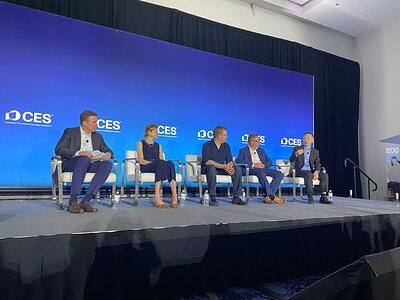
LAS VEGAS, NV – January 08, 2026 – The future of the smart home is being rewritten, not in the distant cloud, but right inside the devices that populate our living spaces. At a featured CES 2026 panel, Dr. Pengfei Zhang, CEO of Riselink Technologies, laid out a transformative vision for a more responsive, private, and reliable connected home, signaling a significant industry pivot away from cloud dependency.
Sharing the stage with senior executives from Bosch, ecobee, and Amazon Devices, Dr. Zhang argued that the current model, which outsources intelligence to remote servers, is ill-equipped for the next wave of smart home adoption. His proposed alternative is built on a foundation of on-device intelligence, robust local connectivity, and extreme power efficiency—a blueprint designed to earn back consumer trust and unlock the true potential of ambient computing.
"The future smart home will not be cloud-dependent by default," Dr. Zhang stated during the panel discussion. "It will be Matter-ready, intelligent at the edge, and designed around real-world constraints like power, latency, and privacy." This declaration sets the stage for a fundamental architectural shift, moving the brains of the operation from centralized data centers back to the edge, where the data is generated.
A New Architecture for Intelligence
At the core of this new paradigm are three technological pillars that Riselink champions: dual-band Wi-Fi 6, ultra-low-power system design, and Edge AI. This combination is not merely an upgrade but a complete reimagining of how smart devices should operate.
The first pillar, Dual-Band Wi-Fi 6, addresses the growing congestion in home networks. With the average home expected to house dozens of connected devices, from high-bandwidth streaming boxes to low-data sensors, the need for a more efficient wireless standard is critical. Wi-Fi 6, with its superior capacity and features like Orthogonal Frequency Division Multiple Access (OFDMA), is designed to handle this device density without faltering. Market analyses confirm this trajectory, with Wi-Fi 6 projected to account for nearly 80% of all Wi-Fi product shipments by 2025, becoming the de facto standard for new deployments. Its ability to manage both high-throughput and low-latency applications makes it the essential nervous system for a truly smart environment.
The second pillar, ultra-low-power design, tackles one of the most practical barriers to a fully connected home: the power cord. For smart devices to become truly ubiquitous, they must be untethered. Riselink's focus on system-on-chip (SoC) architectures that can operate for years on a single battery is a crucial enabler. This efficiency is achieved through hardware-level optimizations and features like Wi-Fi 6's Target Wake Time (TWT), which allows devices to "sleep" for extended periods, conserving energy without losing connectivity. This innovation paves the way for a new class of "install-and-forget" sensors and controllers that blend seamlessly into the home.
The final and most transformative pillar is Edge AI. By embedding artificial intelligence processing directly onto the chip, devices can analyze data locally instead of sending it to the cloud. This shift is gaining massive momentum across the tech industry, with the global Edge AI market projected to soar from around $25 billion in 2025 to over $140 billion by 2034. The benefits are threefold: near-instantaneous response times by eliminating cloud latency, enhanced reliability as devices can function without an internet connection, and a profound improvement in user privacy.
Redefining Trust in a Connected World
The rise of the smart home has been shadowed by persistent consumer anxiety over data privacy. High-profile data breaches and concerns about corporate surveillance have bred a healthy skepticism of always-listening devices and cloud-connected cameras. Dr. Zhang’s emphasis on Edge AI directly confronts this issue, positioning local processing as a foundational element for building user trust.
"By processing voice, vision, and sensor data locally on the chip, RiseLink enables advanced intelligence while keeping sensitive user data inside the home," Dr. Zhang explained. This privacy-first approach means that personal conversations, video feeds, and behavioral patterns are not continuously uploaded to remote servers for analysis. For the end-user, this translates into a tangible guarantee of privacy that cloud-based systems often struggle to provide.
This move toward local control is strongly supported by the industry-wide adoption of the Matter protocol. Championed by the Connectivity Standards Alliance and backed by giants like Amazon, Google, and Apple, Matter is a unified standard designed to ensure that devices from different brands can communicate securely and reliably. A key feature of the Matter standard is its support for local network operation, which perfectly complements the Edge AI philosophy. A "Matter-ready" device, as described by Dr. Zhang, is one that not only speaks a common language with other gadgets but is also capable of intelligent, private operation within the secure confines of the home network.
From Concept to Reality: Choo Choo the Dragon Leads the Charge
To demonstrate that this vision is not just theoretical, Riselink unveiled a compelling real-world application of its technology: Choo Choo the Dragon. This interactive AI reading companion for children serves as a flagship example of privacy-first edge intelligence in a consumer product.
Powered by a Riselink Edge-AI processor, Choo Choo engages children in natural, real-time conversations to support interactive storytelling and learning. Unlike many connected toys that rely on cloud services for voice recognition and response generation, all of Choo Choo's conversational processing happens directly on the device. This local-first architecture ensures that a child's conversations remain private and are never sent to an external server, addressing a major point of concern for parents in the ed-tech market.
Furthermore, the on-device processing allows for near-instantaneous responses, creating a fluid and natural interaction that keeps a child engaged. "The integration of high-performance Wi-Fi 6 with on-device AI is redefining how people interact with smart environments," Dr. Zhang noted. Choo Choo the Dragon is a powerful proof point, showing that intelligent, responsive, and deeply personal experiences do not have to come at the cost of privacy or power efficiency.
A Crowded Field and a Unified Goal
Riselink Technologies is a key innovator in this space, but it is not alone in pushing the boundaries of edge computing. The semiconductor industry is in the midst of a major race to develop more powerful and efficient Edge AI chips, with behemoths like NVIDIA, Intel, and Qualcomm investing heavily in platforms for IoT and smart devices. This competitive landscape validates the importance of the trend and accelerates the pace of innovation.
The composition of the CES panel itself—featuring leaders from appliance maker Bosch, smart thermostat pioneer ecobee, and smart home titan Amazon—underscores a broad industry consensus. While each company has its own ecosystem and strategy, their collective presence on a stage dedicated to edge intelligence and interoperability signals a shared recognition that the future is local. The fragmented, cloud-dependent smart home of the past is giving way to a more cohesive, secure, and intelligent ecosystem.
The convergence of these powerful trends—robust Wi-Fi 6 connectivity, the Matter interoperability standard, and the rapid advancement of on-device AI—is setting a new course for the entire consumer electronics industry. The vision articulated at CES 2026 is one where the home becomes a truly intelligent partner, one that is not only helpful and responsive but also, crucially, trustworthy.