
- $14 million project cost for the 2026 Reflecting Pool rehabilitation
- 500,000 gallons per week of water leaked before the 2009-2012 reconstruction
- 20% profit margin for the contractor, higher than typical federal project margins (6%-12%)
Experts would likely conclude that while advanced coatings offer promising solutions for infrastructure preservation, the Reflecting Pool project highlights the challenges of balancing technological innovation with political, environmental, and economic realities.
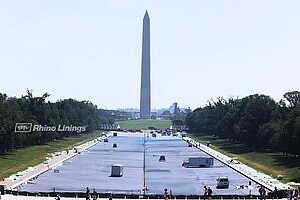
Reflecting on a Landmark: A Story of Coatings, Costs, and Controversy
GREENVILLE, TX – June 18, 2026
This week, Rhino Linings Corporation, a global name in industrial coatings, announced its role in the recent rehabilitation of the Washington D.C. Reflecting Pool. In a press release, the company detailed how its advanced waterproofing systems were used to preserve one of America’s most iconic landmarks. It’s the kind of corporate news that usually flashes across the wire—a straightforward story of a public-private partnership succeeding in shoring up a piece of national heritage. But the story of the Reflecting Pool, much like its famously murky water, is far from clear.
Beneath the surface of this announcement lies a more complex narrative involving a former President's aesthetic vision, a controversial no-bid contract, and a stubborn environmental problem that technology has, so far, failed to solve. It’s a case study that reveals how even the most advanced materials can get tangled in the realities of politics, procurement, and biology.
A High-Tech Facelift
According to Rhino Linings, the project was a showcase for modern infrastructure preservation. The company, founded in 1988 and known for pioneering spray-on truck bedliners, has grown into a global supplier of high-performance polyurea, polyurethane, and epoxy coatings for everything from industrial tanks to military vehicles. For the Reflecting Pool, its mission was to provide a seamless, durable barrier against water intrusion and environmental wear.
"Projects of this significance reinforce the important role that advanced protective coating technologies play in preserving critical infrastructure," said Pierre Gagnon, President & CEO at Rhino Linings Corporation, in the company’s statement. "Our focus is always on delivering solutions that help extend service life, reduce maintenance requirements, and protect valuable assets for future generations."
The technology is indeed impressive. The process involved spraying an elastomeric coating that, according to reports, cures in a matter of seconds. This creates a flexible, waterproof membrane designed to seal leaks and bridge cracks in the pool's concrete basin. The specific product, a custom “American flag blue” coating, was chosen to fulfill a directive from former President Donald Trump, who initiated the project this past April to address leaks and what he termed a “filthy” and “disgusting” algae problem.
This application is a prime example of a growing market. The global protective coatings industry, valued in the tens of billions, is projected to grow at a steady clip, fueled by precisely these kinds of infrastructure rehabilitation projects. Companies like Rhino Linings are positioning themselves as key partners in the fight against decay, offering material science as a solution to extend the life of aging assets.
An Icon with a History of Problems
The Reflecting Pool has long been a maintenance headache for the National Park Service. The vast, shallow basin is a perfect incubator for algae, especially in Washington's warm, humid summers. Its structural integrity has also been a persistent issue. Before a major $30.7 million reconstruction between 2009 and 2012, the pool was leaking approximately 500,000 gallons of water per week.
That earlier project was a massive undertaking, replacing the old asphalt bottom with reinforced concrete and installing a new water system that draws from the Tidal Basin, saving millions of gallons of municipal water annually. Yet, even with that overhaul, leaks and cosmetic issues have remained. The 2026 project, with a price tag exceeding $14 million, was intended to be the final fix.
Rhino Linings' technology was applied to seal the concrete bottom, sides, and expansion joints. In theory, this would solve the leakage issue while the new blue surface and a new “nanobubble ozone” system would combat the algae. However, the project's execution and its immediate aftermath have raised serious questions.
The Murky Waters of Procurement
Beyond the technical specifications, the business side of the project drew scrutiny from the start. The nearly $15 million contract was awarded on a no-bid basis to a Virginia-based company, Atlantic Industrial Coatings. This move, which bypassed standard federal review processes, was justified by citing an exemption for urgent situations. Observers noted that the contractor had reported ties to the former President's golf club.
Further analysis of the contract revealed an “inflated” profit margin of 20% for the contractor, a figure significantly higher than the typical 6%-12% seen in federal projects. This, combined with the project’s high-profile political backing and aesthetic-driven goals, shifted the narrative from one of routine maintenance to one of potential political favoritism and questionable public spending.
While Rhino Linings acted as a supplier of materials, not the primary contractor, its product is now inextricably linked to this controversial and costly endeavor. The story is no longer just about the performance of a protective coating, but about the ecosystem in which such projects exist.
An Unsolved Problem
The ultimate measure of success for any infrastructure project is performance. And here, the verdict was delivered swiftly and unsparingly by nature itself. Within days of the project's celebrated completion in early June, the Reflecting Pool's new blue bottom was obscured by a vivid green algae bloom. Satellite data reportedly showed that algae levels were among the highest recorded for June in at least five years.
While officials from the Department of the Interior described the bloom as a “normal startup process” involving residual matter, the public saw a familiar problem returning with a vengeance despite a multi-million-dollar fix. As one Smithsonian expert noted, the pool's fundamental characteristics—warm, shallow, and stagnant—make it an ideal environment for algae, a problem that a coat of paint, no matter how advanced, cannot easily solve.
This outcome places the project in a harsh light. It serves as a stark reminder that our nation’s infrastructure challenges are deeply complex. The American Society of Civil Engineers (ASCE) gave the U.S. a “C” on its latest infrastructure report card, highlighting a staggering investment gap projected to reach $3.7 trillion over the next decade. The Reflecting Pool is a microcosm of this larger crisis: a cherished public asset suffering from chronic issues, where proposed solutions can become mired in politics, questionable economics, and the stubborn realities of the natural world.