
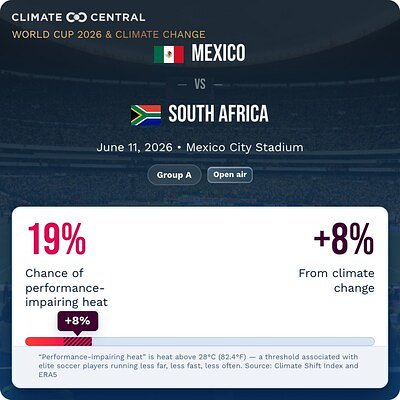
- 97 of 104 matches face increased risk of performance-impairing heat (>28°C).
- 26 games have a climate change-increased heat risk by ≥10 percentage points.
- 70% chance of extreme heat in Uruguay vs. Spain match (37 points higher due to climate change).
Experts agree that climate change is significantly altering the 2026 World Cup, posing unprecedented risks to player performance, safety, and the tournament's operational integrity.
Red Card on Reality: The 2026 World Cup's Climate Change Reckoning
PRINCETON, NJ – June 03, 2026 – As the world gears up for the 2026 FIFA World Cup, the familiar metrics of team rankings and player statistics are being overshadowed by a far more sobering dataset. A rigorous new analysis from the non-profit research group Climate Central reveals a formidable, unseen opponent that will be present at nearly every match: performance-impairing heat, made significantly more likely by climate change. The findings present a critical challenge not just to the integrity of the game, but to the operational resilience and business model of large-scale global events in a warming world.
The report is not an abstract forecast; it is a granular, match-by-match risk assessment. It concludes that 97 of the 104 scheduled games across the United States, Mexico, and Canada now face an increased probability of encountering conditions that actively diminish player output and endanger safety. This isn't about athletes needing to “tough it out.” This is about a systemic environmental shift that is fundamentally rewriting the rules of engagement for a multi-billion-dollar global spectacle.
The Quantifiable Threat: Beyond Just a Hot Day
For leaders focused on execution and quantifiable risk, the Climate Central analysis provides a stark baseline. The core of the research hinges on a specific, data-backed threshold: 82.4°F (28°C). Previous sports science research has repeatedly identified this temperature as a tipping point where the physical output of elite football players begins to demonstrably decline.
Above this mark, the impacts are measurable. Studies show players experience a significant reduction in total distance covered, particularly in high-intensity sprints. Recovery times between those sprints lengthen, and even cognitive functions like decision-making and pass accuracy can be impaired. As Professor Mike Tipton of the University of Portsmouth notes, “Playing in temperatures above 28°C changes the game - affecting tactics, tempo and overall quality. We see reduced intensity, less sprinting and potentially fewer chances being created.”
The scale of the risk is unprecedented for a World Cup. Nearly half of the tournament’s matches have at least a 50% likelihood of experiencing these conditions. For 26 of those games, climate change has directly inflated that probability by at least 10 percentage points. The most alarming case is the June 26 match in Guadalajara between Uruguay and Spain, which now faces a staggering 70% chance of performance-impairing heat—a risk that is 37 percentage points higher than it would have been in a world without human-caused climate change. As meteorologist John Toohey-Morales points out, for athletes like midfielders who run over six miles per match in high-intensity bursts, “these elite athletes will likely be slowed by hotter temperatures which are being boosted by climate change.”
Rewriting the Playbook: From Tactics to Tournaments
The implications ripple from the pitch to the planning committees. On the field, the beautiful game risks becoming a slower, more cautious version of itself. Coaches will be forced to adopt more conservative, possession-based tactics that minimize physical exertion. The thrilling, end-to-end action and high-pressing strategies that define modern football may become untenable, replaced by a strategic battle against exhaustion. Norwegian national team player Morten Thorsby, set to play in the tournament, articulates this concern perfectly: “When heat impacts sprinting, recovery, and overall intensity, it changes the way football is played - and not for the better.”
This isn't a random weather pattern; it's an attributable shift. Climate Central’s methodology uses attribution science to compare our current climate with a counterfactual, pre-industrial world, quantifying the direct influence of fossil fuel emissions. This allows us to see precisely how much climate change has loaded the dice for extreme heat at each venue. As Shel Winkely, a meteorologist at Climate Central, puts it, “The World Cups of the past won't happen again — not because the players have changed, but because the planet has.” The strategic challenge for the sport is no longer just about outplaying an opponent, but about outlasting the environment.
The Operational Gauntlet: FIFA's High-Stakes Adaptation
For FIFA and the host cities, the report transforms climate change from a corporate social responsibility speaking point into an urgent operational crisis. The execution of the 2026 World Cup is now a real-time test of a massive organization's ability to implement a resilient, human-centered strategy under pressure. In response, organizers are deploying a series of adaptation measures. These include scheduling more matches in the evening in hotter cities and mandating hydration breaks for all 104 matches.
Perhaps the most significant tool is a potential postponement rule based on the wet-bulb globe temperature (WBGT), a more comprehensive measure of heat stress that accounts for humidity, wind, and solar radiation. A proposed threshold of 32°C (89.6°F) WBGT could trigger match delays. While these measures are necessary, they are fundamentally reactive and introduce their own set of complex challenges. Postponements create logistical chaos for broadcasters, fans with travel plans, and tournament scheduling. Hydration breaks, while vital, interrupt the flow of the game.
These adaptations also carry significant hidden costs. Retrofitting stadiums, enhancing medical staff and resources, and implementing city-wide cooling centers for fans all place a substantial economic burden on hosts. The question for leaders is whether these short-term fixes are sufficient for a long-term, escalating problem, or if a more fundamental reimagining of when and where global sporting events are held is required.
The Unseen Stakeholders: Fans, Economies, and Future Games
The focus on player performance masks a wider circle of risk. For the millions of fans traveling to matches, many of whom will be in open-air stadiums or crowded fan zones, the health risks are equally severe. Heat exhaustion and heat stroke are serious threats, particularly for the elderly, children, and those with pre-existing health conditions. This places an immense strain on local healthcare systems and demands a level of public safety planning far beyond typical event management.
The fan experience itself is at stake. A slower, less dynamic game on the pitch and dangerously uncomfortable conditions in the stands could diminish the very spectacle that drives the tournament's global appeal and economic engine. As former professional player Alex Jacobs observed, “Heat is not new. But extreme heat... might just be a difference maker in this summer's edition of the biggest sporting event on the planet.” The 2026 World Cup is shaping up to be that difference maker, a high-profile case study demonstrating how climate change is no longer a future problem, but a present and tangible threat to our most cherished global traditions.