
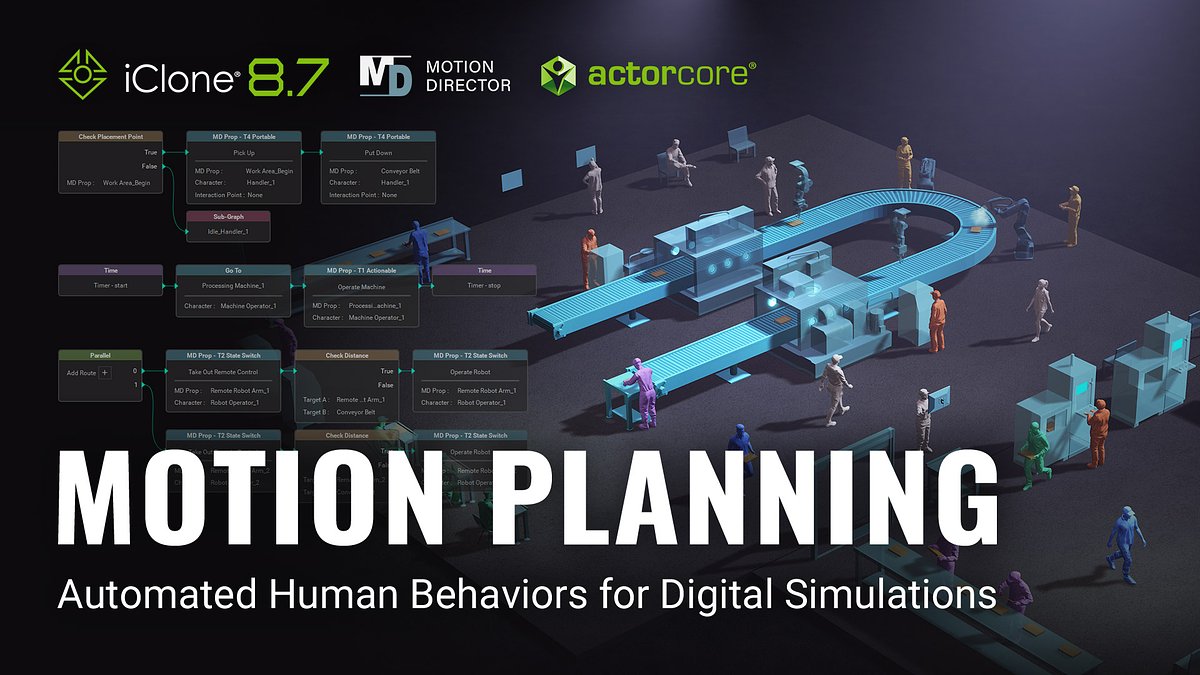
- Motion Planning: New modular logic layer for orchestrating actions of digital humans at scale, using an intuitive visual node-graph editor.
- Video Mocap: AI-powered tool that converts standard video footage into editable 3D animation, eliminating the need for expensive motion capture suits.
- Industry Adoption: Technology adopted by major players including NVIDIA, Google, BMW, Ford, and Samsung for digital twins, autonomous vehicle simulation, and pedestrian traffic analysis.
Experts would likely conclude that Reallusion's new AI models significantly advance digital twin technology by accurately modeling human behavior, bridging a critical gap between simulation and real-world performance.
Reallusion's New AI Models the Human Factor in Digital Simulations
SAN JOSE, CA – January 29, 2026 – Reallusion Inc. today announced a significant expansion of its software suite, launching a complete human-centric simulation solution designed to address one of the most persistent challenges in digital twin technology: accurately modeling human behavior. With the introduction of its new Motion Planning and Video Mocap tools, the company aims to move beyond idealized digital models and empower industries to simulate how people actually work, move, and interact within complex environments.
For years, simulation pipelines have excelled at modeling facilities, machinery, and logistics with high fidelity. However, the human element—often the most critical and variable driver of real-world performance—has remained a glaring blind spot. Variations in operator cycle times, differences in work sequences, and the nuanced ways people navigate their environment can have a material impact on everything from manufacturing throughput to workplace safety. Until now, these human factors have typically been simplified into predictable, uniform paths, creating a gap between the simulation and reality.
Reallusion's latest release directly confronts this gap, connecting its extensive character and animation tools into a cohesive workflow that puts human operations at the center of the simulation.
A Modular and Scalable Logic for Human Behavior
The cornerstone of the new offering is Motion Planning, a modular logic layer that orchestrates the actions of digital humans at scale. Instead of relying on complex scripting, Motion Planning utilizes an intuitive visual node-graph editor. This allows engineers and designers to build, review, and modify complex human behaviors by connecting logical blocks, much like creating a flowchart. This visual approach makes it possible to design and manage large-scale scenarios involving hundreds of digital people performing interconnected tasks across different areas.
With this system, teams can create reusable building blocks for common actions, link separate zones like production lines and transport routes into a single continuous flow, and rapidly iterate on process changes. The ability to run repeatable before-and-after comparisons allows for quantifiable validation of layout updates or new operational procedures.
Complementing this logic engine is the new Video Mocap feature, a tool that dramatically lowers the barrier to creating realistic human motion. This technology uses advanced AI to convert footage from any standard video camera—including a smartphone—into editable 3D animation. It eliminates the need for expensive motion capture suits and specialized hardware, allowing companies to capture the actual work sequences and movements of their own operators. The captured motion data integrates directly into Reallusion's iClone software, where it can be refined and edited, addressing common issues like foot-sliding or depth misalignment that plague many standalone AI mocap services.
Redefining the Competitive Landscape
With these additions, Reallusion is positioning itself as a uniquely focused player in a market dominated by industrial giants like Siemens and Dassault Systèmes, and versatile game engines like Unity and Unreal Engine. While enterprise solutions from Siemens (Tecnomatix) and Dassault (DELMIA) offer powerful ergonomic and human task simulation, they are often part of much larger, more complex PLM systems with steep learning curves and significant costs.
On the other end, game engines provide immense flexibility and stunning visual fidelity but typically require substantial custom development and engineering to build the kind of scalable, logic-driven human simulation that Reallusion now offers out of the box. Reallusion's key differentiator is its integrated, human-first workflow. The solution is supported by ActorCore, which the company describes as the industry's largest asset ecosystem for simulation-ready digital humans, props, and motions. This allows teams to stand up complex scenarios quickly without building every asset from scratch.
By combining an accessible motion capture method, a vast library of ready-made assets, and a scalable logic system specifically for human behavior, the company offers a compelling, agile alternative for industries looking to incorporate high-fidelity human factors into their digital transformation efforts.
Industry Adoption and Digital Twin Integration
The practicality of this human-centric approach is already being validated by major industry players. Reallusion's technology has been adopted by brands including NVIDIA, Google, BMW, Ford, and Samsung for use cases spanning digital twins, autonomous vehicle simulation, and pedestrian traffic analysis. The latest updates have been evaluated by manufacturing leaders Foxconn and Delta Electronics to support factory and plant planning, where simulating realistic worker paths and handoffs is crucial for credible process validation.
Further demonstrating its versatility, the workflow was also evaluated by the Berlin-based CG/AI studio relative.berlin for an immersive VR experience project for the German government, highlighting its utility beyond industrial applications.
Crucially, Reallusion's ecosystem is not a walled garden. The company has embraced open standards by providing robust support for Universal Scene Description (USD) workflows. This ensures that assets and animations can be smoothly transferred to and from other platforms, most notably NVIDIA Omniverse, a leading platform for building and collaborating on digital twins. The dedicated iClone Connector for Omniverse allows teams to seamlessly integrate their human-centric simulations into larger, multi-faceted digital twin projects, enabling a holistic view that combines human behavior with machine and environmental data in a collaborative, real-time environment.
To help new users get started, Reallusion is also providing content packs that accelerate industrial scenario development. These packs include ready-made factory scenarios for assembly, production, and maintenance, along with dozens of interactive machines, tools, and worker motions. These resources help teams move from a proof-of-concept to repeatable, scalable simulations faster, providing a practical starting point for companies looking to finally solve for the human variable.