
- Price Drop: 20% discount on RayNeo Air 4 Pro AR glasses, reducing price from $299 to $239.20 for Prime Day.
- Market Share: RayNeo holds a 23.7% share of the global AR glasses market (Q1 2026).
- Display Specs: First consumer AR glasses with HDR10 support, 200,000:1 contrast ratio, and AI-powered upscaling.
Experts would likely conclude that RayNeo's Prime Day pricing strategy is a calculated move to accelerate mass adoption of AR technology by leveraging its market leadership and TCL ecosystem advantages.
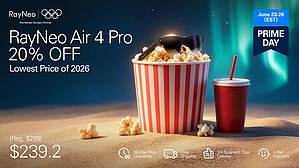
RayNeo's Prime Day Gambit: Is This AR's Mass Market Moment?
LOS ANGELES, CA – June 22, 2026 – In the world of consumer electronics, a price drop is rarely just a price drop. It’s a signal, a strategic maneuver designed to capture attention, market share, or both. RayNeo’s announcement of a 20% discount on its flagship Air 4 Pro AR glasses for Amazon’s Prime Day event is a textbook example of such a move, but one with implications that ripple far beyond a simple four-day sale.
By slashing the price of what it calls the “world’s first HDR10-enabled AR glasses” from $299 to $239.20, RayNeo is making a calculated bid to transform augmented reality from a niche enthusiast category into a mainstream entertainment staple. This isn't merely a promotion; it's a deliberate attempt to define the market on its own terms, leveraging a leadership position to accelerate mass adoption and challenge the very concept of a traditional screen.
The Sub-$250 Private Cinema Arrives
For the average consumer, the proposition is compelling and straightforward. The RayNeo Air 4 Pro offers a private, cinema-scale viewing experience that can be carried in a pocket. The device functions as a plug-and-play wearable display, connecting via a simple USB-C cable to a vast ecosystem of devices including iPhones, Android phones, PCs, Macs, and the latest gaming consoles like the PS5 and Nintendo Switch 2. Crucially, this is achieved without the friction of a companion app, a subscription fee, or a proprietary operating system.
The experience it promises is one of immersion. Dual 0.6-inch MicroLED projectors, one for each eye, generate a crisp 1920 x 1080 resolution image that simulates a massive 201-inch screen viewed from six meters away. For gamers, the 120Hz refresh rate ensures fluid motion, while the advertised 1,200-nit peak brightness aims to make content viewable in a variety of lighting conditions. By packaging this capability into a 76-gram frame and offering it at a promotional price point competitive with a mid-range tablet or a high-end monitor, the company is directly targeting consumers seeking a more portable and personal way to consume media, whether on a plane, in a dorm room, or on the living room couch.
Beyond the Hype: Unpacking the Display
The technical specifications underpinning the Air 4 Pro are central to RayNeo’s premium positioning. The headline feature is its status as the first consumer AR glasses to support HDR10. This standard allows for a significantly higher contrast ratio and a wider color gamut, theoretically producing deeper blacks and more vibrant, lifelike images. The glasses boast an impressive 200,000:1 contrast ratio, a figure that promises to make HDR-mastered films and games pop with newfound depth.
Interestingly, the device doesn't rely solely on native HDR content. A custom Vision 4000 chip, co-developed with Pixelworks, provides real-time AI-powered upscaling that converts standard dynamic range (SDR) content to HDR. It also facilitates on-the-fly 2D-to-3D conversion. While the HDR10 support is a notable first, some independent hands-on evaluations suggest the company's own AI-powered upscaling is so effective that it delivers a comparably stunning visual experience on non-HDR content. This intelligent processing, combined with TÜV SÜD certification for flicker-free dimming, demonstrates a focus on visual quality that goes beyond a single specification. The premium experience is rounded out by a 4-speaker spatial sound system co-developed with the high-end audio firm Bang & Olufsen, ensuring the audio is as immersive as the visuals.
A Calculated Play for Market Dominance
This aggressive pricing strategy is more than a seasonal promotion; it's a strategic salvo in the war for the future of personal displays. According to data from Counterpoint Research, RayNeo already captured the top spot in the global AR glasses market in the first quarter of 2026, securing a commanding 23.7% share. This Prime Day deal is a classic incumbent move: leveraging a position of strength to commoditize the entry point for high-quality AR, thereby expanding the user base while simultaneously raising the competitive barrier for rivals like Xreal and Viture.
By pushing a high-spec device below the $250 threshold, the company makes it significantly harder for competitors to compete on price without sacrificing features or margin. It's a move designed to consolidate its leadership and accelerate the network effects that come with a larger installed base of users. The inclusion of discounts on Batman-themed limited editions is another shrewd tactic, broadening the appeal beyond pure technophiles to collectors and pop culture fans, further embedding the product in the consumer landscape.
The Power of the TCL Ecosystem
RayNeo’s confidence to execute such a strategy stems directly from its position within the TCL global electronics empire. This affiliation is not a minor detail; it is the engine behind the company’s market power. Being part of the TCL family provides immense advantages in research and development, supply chain logistics, and manufacturing scale that smaller, venture-backed startups cannot easily replicate. This vertical integration allows for cost efficiencies that can be passed on to the consumer in the form of aggressive pricing, as seen in this Prime Day push.
Furthermore, TCL’s status as an Official Worldwide Olympic Partner lends RayNeo a level of brand legitimacy and global marketing reach that is invaluable in an emerging tech category. This association elevates the brand from a gadget maker to a player on the world stage. This Prime Day, RayNeo isn't just moving units; it's leveraging the full weight of its corporate parentage to redraw the map for the entire consumer AR industry.