
- 4x Increase in Feature Recognition: The AI system now recognizes 20 distinct features, up from 5, enhancing its ability to analyze 3D models. - $150 Billion Market Projection: The global industrial AI market is expected to grow from $43 billion in 2024 to over $150 billion by 2030. - Real-Time DFM Analysis: The platform provides instant, interactive feedback on manufacturability, reducing design-to-production delays.
Experts view RapidDirect’s AI-driven Digital Manufacturing Brain as a transformative tool that enhances design-for-manufacturability analysis, streamlines workflows, and positions the company as a leader in global digital manufacturing innovation.
RapidDirect’s AI Brain Aims to Reshape Global Manufacturing
SHENZHEN, China – March 31, 2026 – In a move that signals a significant leap forward in digital manufacturing, China-based RapidDirect has deployed a powerful AI-driven upgrade to its Instant Quote platform. Dubbed the “Digital Manufacturing Brain,” the new engine automates complex design-for-manufacturability (DFM) analysis, providing engineers with real-time, interactive insights that aim to erase the traditional line between a 3D model and a production-ready asset.
This “Tech-First” initiative addresses a critical bottleneck in product development: the slow, often iterative process of ensuring a design is viable for production. By embedding an intelligent analytical layer directly into the quoting process, the company is not just accelerating timelines but fundamentally altering the relationship between designer and factory, positioning itself as a formidable innovator on the global stage.
An Engineer's New AI Co-Pilot
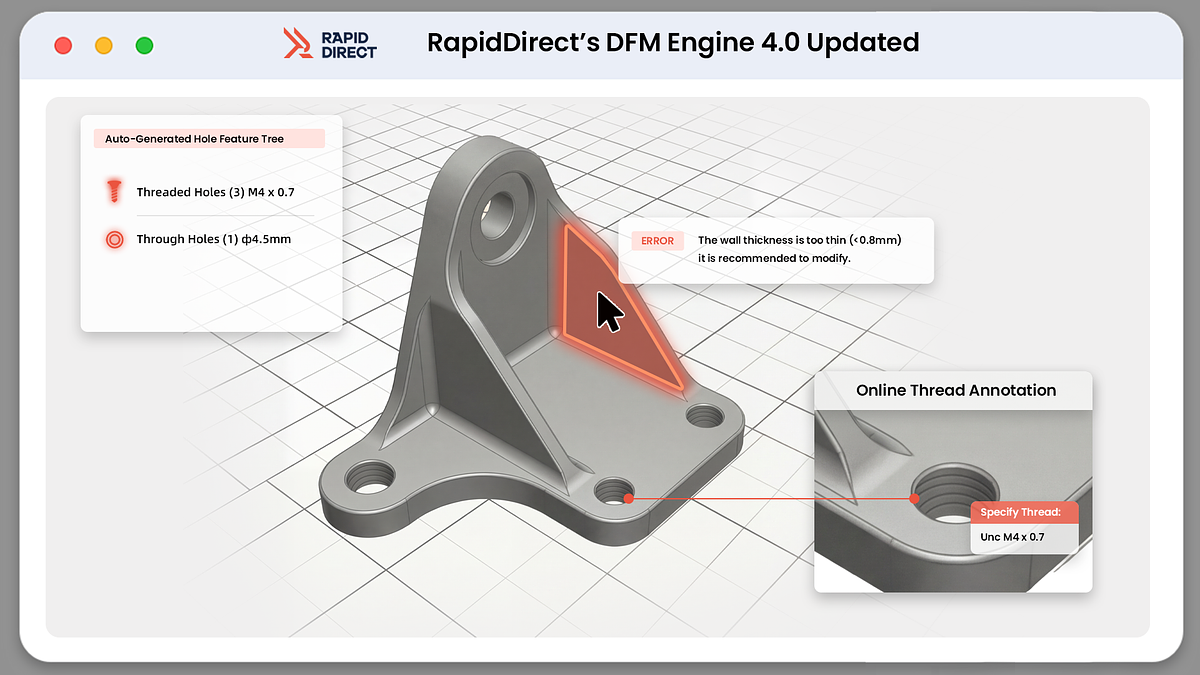
At the core of the upgrade is a transformative user experience. Where engineers once submitted designs and awaited feedback reports, they now receive instant, dynamic analysis. The platform’s “upload-to-identify” capability leverages sophisticated algorithms to scan 3D models and immediately flag potential manufacturing risks. Issues like walls that are too thin for CNC machining or features that create production bottlenecks are highlighted directly on the user’s 3D model in a high-fidelity viewer, providing clear, visual feedback before an order is even placed.
This immediate interaction is powered by a dramatic expansion of the system’s intelligence. RapidDirect has increased its automated feature recognition capabilities fourfold, from five distinct features to twenty. This allows the AI to generate an “Auto-Generated Hole Feature Tree,” which deconstructs complex geometries into a structured, easily understandable format. This breakthrough simplifies communication not only for the designing engineer but also for procurement teams who may lack deep technical expertise.
Further streamlining the workflow is a new feature for Online Manual Annotation. Users can now mark specific requirements, such as threads, directly onto the 3D model. This collaborative tool, which can also be used by RapidDirect’s senior manufacturing engineers, effectively eliminates the need for separate 2D technical drawings for many common features, reducing documentation overhead and minimizing the risk of misinterpretation.
Raising the Bar in a Competitive Field
The digital manufacturing space is fiercely competitive, with established players like Protolabs and Fictiv offering their own robust automated DFM systems. These platforms have been instrumental in providing designers with quick feedback on manufacturability. However, RapidDirect’s “Digital Manufacturing Brain” seeks to differentiate itself through the depth and interactivity of its analysis.
The emphasis on a fourfold increase in recognized features and the creation of structured data trees suggests a move beyond simple risk flagging toward a more holistic, intelligent design partnership. While competitors provide critical DFM checks, RapidDirect is positioning its tool as a comprehensive analytical engine that understands geometric intent on a deeper level.
This intelligence extends to the company’s backend operations. The new platform enables the instant export of comprehensive DFM reports and the automated generation of 2D engineering drawings from 3D models. While these tools are currently empowering RapidDirect’s internal teams to deliver quotes and feedback with unprecedented speed, the company has announced plans to roll them out for direct customer use in future iterations. This signals a strategic vision where the entire documentation and procurement workflow becomes a seamless, one-click process.
Forging More Resilient Supply Chains
The impact of this technology extends far beyond an individual engineer’s desktop. In an era defined by supply chain volatility, the ability to accelerate development cycles and reduce manufacturing errors has become a critical business imperative. By enabling engineers to “get it right the first time,” AI-powered DFM tools directly contribute to more agile, cost-effective, and resilient operations.
The market for such solutions is expanding rapidly. The global industrial AI market, valued at over $43 billion in 2024, is projected by analysts to exceed $150 billion by 2030. This growth is fueled by the pressing need for manufacturers to increase efficiency, reduce operational costs, and navigate the complexities of global production. Technologies that can mitigate schedule risks and empower confident, rapid development are no longer a luxury but a necessity.
This aligns perfectly with the company's stated mission. “Our vision is to eliminate the friction that historically slows down the path from idea to reality,” said Leon Huang, CEO at RapidDirect. “By deploying this 'Digital Manufacturing Brain,' we aren't just giving our customers a quote; we are giving them a partner in the design process that ensures every part is production-ready from the moment it is uploaded.”
A Symbol of China's High-Tech Ambition
RapidDirect’s announcement is also a significant event in the context of global technology competition. The company proudly frames the upgrade as a “native Chinese innovation,” positioning itself alongside global digital manufacturing giants. This move reflects a broader national strategy within China to transition from being the world’s factory to a global leader in high-tech innovation.
Initiatives like the “AI+ Action” plan and a concerted effort to deepen the integration of AI with manufacturing are central to China's economic policy. The government aims to leverage artificial intelligence to boost industrial competitiveness and move its manufacturing base up the global value chain. By developing and deploying a sophisticated industrial AI platform, RapidDirect is not only advancing its own business but also embodying the goals of this national ambition.
This development challenges the long-standing dominance of Western firms in industrial software and advanced manufacturing services. As native Chinese companies like RapidDirect continue to innovate at a rapid pace, they are reshaping the competitive landscape, offering global customers new options and driving the entire industry toward a more connected and intelligent future. This shift suggests that the next generation of manufacturing breakthroughs may increasingly originate from technology hubs far beyond Silicon Valley.