
- 20,000 Municipalities: Prophetic's AI can interpret zoning codes from over 20,000 U.S. municipalities with 99% accuracy.
- 3,000 Parcels: One customer increased annual parcel evaluations from 100–200 to over 3,000 in its first year using the platform.
- $3.18 Million: The platform secured this amount in seed funding in 2025.
Experts agree that while AI significantly accelerates land acquisition by automating zoning analysis, human expertise remains crucial for navigating political and strategic complexities in real estate development.
Prophetic AI Tool Remaps Real Estate with Intent-Based Search
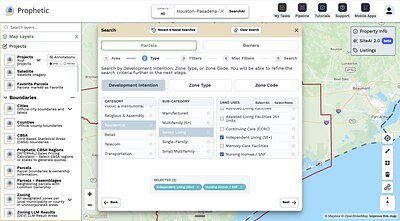
PORTLAND, Ore. – March 18, 2026 – Prophetic, an AI-powered real estate intelligence firm, today announced a significant expansion of its platform that could fundamentally alter how developers find and acquire land. The new feature, "SearchAI Intentions," allows users to search for viable building sites based on what they want to build—from a hotel to a data center—rather than navigating the labyrinthine world of municipal zoning codes.
The update promises to replace a traditionally manual, time-consuming, and error-prone process with an AI-driven search that identifies suitable parcels across all 50 states. For an industry grappling with housing shortages and the urgent need for new infrastructure, the ability to rapidly pinpoint development opportunities could represent a major leap forward.
From Zoning Codes to Development Dreams
For decades, the first step in any real estate development project has been a tedious and costly exercise in translation. Land acquisition teams have had to manually decipher thousands of pages of local zoning ordinances to convert their vision—be it a multifamily apartment complex or a new industrial warehouse—into a list of permissible zoning classifications.
This process often involves weeks spent navigating disparate county GIS systems, cross-referencing dense legal documents, and toggling between multiple data platforms before a single parcel can be properly evaluated. Industry analysis reveals this manual research can be incredibly expensive, with consultant fees for zoning analysis reaching over $300 per hour in some markets, not including the internal cost of employee time. The risk of human error is also substantial, with misinterpretations potentially leading to costly redesigns or even project abandonment.
"Developers have always had to translate their vision into zoning codes before they could even start searching," said Oliver Alexander, CEO and Founder of Prophetic, in a statement. "SearchAI Intentions now understands development intent."
Prophetic's new system flips the script. Instead of forcing developers to become zoning experts, it allows them to simply select from over 120 development categories. These range from residential housing and senior living communities to specialized commercial uses like telecommunications towers, energy storage facilities, and medical clinics. The platform then does the heavy lifting, identifying parcels where that specific project type is permitted.
The Engine Room: How AI is Decoding 20,000 Municipalities
The technology powering this capability is Prophetic's proprietary ZoneAI engine. The company claims its AI can read, interpret, and extract regulations from the zoning codes of over 20,000 U.S. municipalities with 99% accuracy. For each potential site it identifies, the platform provides a direct link to the specific section of the municipal code, giving developers the confidence to act on the results.
While the "99% accuracy" claim is bold, it reflects a growing trend in the proptech sector where companies like ArchiWise and Atria are also deploying AI to automate zoning analysis. However, real estate and urban planning experts caution that while AI is a powerful tool for data aggregation and rule-checking, it is not infallible. Zoning codes are often filled with ambiguities that require nuanced human interpretation, and AI models cannot account for the political dynamics of planning commissions or neighborhood opposition, which can make or break a project regardless of what the code says.
Effective implementation, according to industry analysts, involves a partnership between human and machine. AI can screen thousands of parcels in minutes to eliminate non-starters, freeing up experienced land use professionals to focus their expertise on the most promising candidates and navigate the complex strategic and political dimensions of development.
The efficiency gains are nonetheless dramatic. Prophetic reports that one customer, The Gove Group, increased its annual parcel evaluation from a range of 100–200 to over 3,000 in its first year using the platform. "Before Prophetic, a dedicated land acquisition professional might analyze about a hundred parcels per year," Alexander noted. "Today, individual users on the platform regularly exceed 5,000 parcels per month."
A Catalyst for Critical Infrastructure and Housing
The potential impact of this acceleration extends far beyond developer profit margins. By drastically shortening the initial land search, the technology could help address some of the nation's most pressing needs. This is validated by Prophetic's partnership with D.R. Horton, the largest homebuilder in the United States, which is deploying the platform nationwide to speed up land decisions and help close a national housing deficit estimated at nearly 4.7 million homes.
The launch of SearchAI Intentions significantly expands this potential impact beyond the residential sector. The inclusion of over 120 development types opens the door for accelerated deployment of other critical infrastructure. For example, the boom in artificial intelligence is creating unprecedented demand for energy, making data center site selection a paramount concern. AI-driven platforms can analyze power availability, fiber optic routes, and zoning for these energy-intensive facilities, a task that has become a critical bottleneck.
Similarly, the tool can identify viable sites for renewable energy projects, industrial logistics hubs to streamline supply chains, and a wide array of senior living facilities—from independent living to skilled nursing—to serve an aging population. By directly answering the question "where can I build this project?", the technology empowers developers in these specialized sectors to move faster and more efficiently.
The Evolving Role of the Real Estate Professional
Tools like SearchAI Intentions signal a fundamental shift in the nature of work for real estate professionals. By automating the most tedious and data-intensive aspects of land acquisition, the platform allows developers, brokers, and builders to elevate their focus from granular rule-checking to high-level strategic decision-making.
Instead of spending weeks sifting through regulations, acquisition teams can now spend their time analyzing market dynamics, negotiating deals, and managing project feasibility. This human-AI collaboration enables firms to not only penetrate their existing markets more effectively but also to confidently explore expansion into entirely new development sectors and geographic regions.
The platform, which secured $3.18 million in seed funding in 2025, aims to be more than just a search tool. It positions itself as a comprehensive decision platform that unifies zoning, environmental, and parcel data into a single, actionable workflow. "Most tools give you layers of parcel data and expect you to figure out the rest," Alexander stated. "Prophetic answers the question developers, brokerages, home builders, and more actually ask: where can I build this project?"
As AI continues to integrate into every facet of the economy, the real estate industry, long reliant on manual processes and local expertise, is on the cusp of a major transformation. By translating human intent directly into viable opportunities, Prophetic's latest innovation is a clear indicator of a future where technology does not replace the developer, but empowers them to build faster, smarter, and on a scale previously unimaginable.