
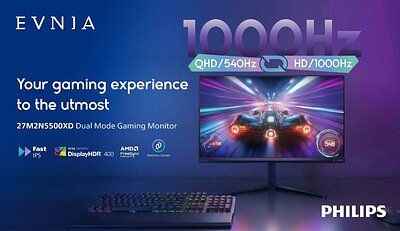
- 1000Hz Mode: The monitor offers an unprecedented 1000Hz refresh rate in HD (720p) mode for competitive gaming.
- Dual-Mode Capability: Switches between 1000Hz HD and 540Hz QHD modes for versatility.
- 2000:1 Contrast Ratio: Significantly higher than typical IPS displays, enhancing visual depth.
Experts agree that while the 1000Hz refresh rate pushes the boundaries of competitive gaming, its practical benefits will depend on hardware advancements and human perceptual limits, making the dual-mode flexibility a standout feature for serious gamers.
Philips Evnia's 1000Hz Monitor: The Future of Gaming or Overkill?
SINGAPORE – January 29, 2026 – The relentless pursuit of speed in competitive gaming has reached a new, almost dizzying milestone. Philips, through its gaming-focused brand Evnia, today officially launched the 27M2N5500XD, a monitor that shatters the refresh rate ceiling with a staggering 1000Hz mode, a figure that was purely theoretical just a few years ago. Marketed as the world's first true 1000Hz dual-mode gaming monitor, the release challenges the conventions of display technology and poses a critical question to the esports world: how fast is too fast?
The 27-inch display is built around a revolutionary concept: offering gamers two distinct, optimized experiences accessible via a simple shortcut. For the professional and aspiring esports athlete, it offers an HD (720p) mode running at an unprecedented 1000Hz. For those seeking a blend of speed and visual fidelity, it provides a QHD (2560x1440) mode at a blistering 540Hz. This launch isn't just about a single product; it's a statement on the future of gaming hardware, where the long-standing compromise between resolution and refresh rate may finally be coming to an end.
The New Frontier of Refresh Rates
In the world of competitive first-person shooters like Valorant and CS:GO, victory is measured in milliseconds. A higher refresh rate, which dictates how many times per second the image on the screen is updated, provides a smoother, clearer picture. This allows players to track fast-moving opponents more accurately, react quicker to enemy movements, and perceive game events with less motion blur. The jump from 60Hz to 144Hz was a revelation for competitive play, and the subsequent move to 240Hz and 360Hz became the standard for the professional circuit.
The Evnia 27M2N5500XD's 1000Hz mode aims to make those previous benchmarks look sluggish. Philips Evnia claims the technology makes "moving targets and bullet trajectories crystal-clear," effectively eliminating motion blur. For a professional player, even a marginal gain in visual information can be the difference between winning and losing a crucial duel. However, the move to such an extreme refresh rate also ignites the debate over diminishing returns. While the difference between 60Hz and 144Hz is immediately obvious to most users, the perceptible benefit of each subsequent jump becomes smaller. Whether the human eye and brain can truly process and benefit from the leap between 500Hz and 1000Hz will be a subject of intense scrutiny and testing within the esports community.
Furthermore, displaying 1000 frames per second requires a computer that can render 1000 frames per second. Even at a reduced 720p resolution, this represents a monumental task for today's most powerful graphics cards and CPUs, let alone the game engines themselves. This positions the monitor as a forward-looking investment, a piece of hardware that may be waiting for the rest of the ecosystem to catch up.
A 'No-Compromise' Solution? The Dual-Mode Advantage
Perhaps the most compelling feature of the Evnia 27M2N5500XD isn't just the 1000Hz number, but the versatility offered by its dual-mode capability. By allowing users to switch between an ultra-fast HD@1000Hz mode and a sharp QHD@540Hz mode, Philips is catering to the reality of the modern gamer who plays more than one type of game. A competitive player can switch to the 1000Hz mode for their tournament practice, prioritizing raw speed above all else. When they want to relax with a graphically rich, story-driven RPG, they can switch to the 540Hz QHD mode to enjoy stunning visuals without sacrificing an exceptionally smooth experience.
This flexibility addresses a major purchasing dilemma for high-end consumers. Previously, buying a monitor often meant choosing between a high-resolution panel for immersive single-player games or a lower-resolution, high-refresh-rate panel for competitive titles. The Evnia 27M2N5500XD proposes a future where that choice is no longer necessary. By integrating this functionality with a quick-access shortcut, the monitor allows for on-the-fly adaptation, making it a powerful all-in-one solution for dedicated gaming enthusiasts.
Navigating a Crowded Battlefield
While Philips Evnia's claim of a "true 1000Hz panel" is a powerful marketing tool, it enters a market where competitors are racing toward the same goal. Philips' own sister brand, AOC, recently announced a monitor with nearly identical specifications, suggesting a shared panel technology. Other brands like AntGamer have also unveiled displays pushing past the 1000Hz mark, albeit at different resolutions. This flurry of activity indicates a clear industry trend toward ultra-high refresh rates.
The competitive landscape is also diversifying its technological approaches. ASUS, for instance, is promoting its G-Sync Pulsar technology, which aims for an effective 1000Hz of motion clarity on a 1440p panel without requiring a native 1000Hz refresh rate. Meanwhile, the rise of dual-mode functionality is not exclusive to Evnia; manufacturers like ASUS and LG have already introduced OLED monitors that can switch between 4K at a lower refresh rate and 1080p at a higher one. Philips Evnia's strategy is to win this race by pushing the refresh rate number to its current zenith, planting its flag at the 1000Hz peak and forcing competitors to respond.
Beyond Speed: AI, Color, and Connectivity
To justify its position as a flagship product, the 27M2N5500XD is equipped with more than just raw speed. The monitor is built on a fast IPS panel, which notably features a 2000:1 contrast ratio—significantly higher than the 1000:1 typical of most IPS displays—promising deeper blacks and more vibrant images. This is complemented by a 0.3ms response time and VESA DisplayHDR 400 certification, ensuring visuals are not only fast but also rich and detailed. With color gamut coverage of 100% sRGB and 96% DCI-P3, the monitor is also a capable tool for content creators who demand color accuracy.
Evnia has also integrated a suite of features under its "AI + Health" banner. These include software- and hardware-based low blue light modes for eye comfort during long sessions, as well as gaming-specific enhancements. The AI-powered Stark Shadow Boost brightens dark areas of the screen to reveal hidden enemies, while the Smart Crosshair ensures the reticle remains visible against any background. Connectivity is thoroughly modern, with a DP2.1 port providing 80Gbps of bandwidth and an HDMI 2.1 port, ensuring the monitor can handle the massive data throughput required for its highest performance modes on both PC and consoles.
With the launch of the 27M2N5500XD, Philips Evnia has thrown down the gauntlet, setting a new and audacious benchmark for gaming displays. While its ultimate utility will depend on the evolution of supporting hardware and the tangible benefits felt by professional players, its dual-mode functionality makes a strong case for its relevance to a broader audience of serious gamers. It's a bold step into the future, signaling that the race for display supremacy is not just about hitting higher numbers, but about creating smarter, more versatile technology for everyone who plays.