
- Price: $15,000, significantly undercutting competitors like CEAD ($270,000) and Compound Dynamics ($145,000–$300,000).
- Material Cost Savings: Up to 90% reduction compared to traditional filament-based systems.
- Build Volume: 800x800x800mm, enabling large-scale industrial printing.
Experts would likely conclude that the Peopoly Giga 800 represents a disruptive innovation in industrial 3D printing, democratizing access to large-scale additive manufacturing by drastically reducing both capital and operational costs while maintaining high performance and security standards.
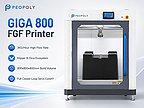
Peopoly’s Giga 800: The $15K Printer Crashing the Industrial Market
HONG KONG – May 14, 2026 – Peopoly, a company known for pushing the boundaries of accessible 3D printing, has today unveiled a machine that could fundamentally reshape industrial manufacturing. The new Giga 800 is a Fused Granular Fabrication (FGF) 3D printer that combines a colossal 800x800x800mm build volume with a jaw-dropping starting price of $15,000, aiming to bring industrial-grade pellet printing to the masses.
By feeding raw industrial plastic pellets directly into its extruder, the Giga 800 promises to slash material costs by up to 90% compared to traditional filament-based systems. This innovation bridges the vast chasm between desktop simplicity and the high cost and complexity of industrial-scale production. The machine is designed for print farms, design studios, and agile engineering teams that have long been locked out of the market for large-format additive manufacturing by six-figure price tags.
"Our goal was to take the desktop ease of use that everyone is accustomed to and scale it up to industrial sizes," said a spokesperson for Peopoly. "The Giga 800 is the next step in the manufacturing revolution. It allows for the rapid creation of truly massive parts like composite molds, automotive fixtures, and large architectural models without the prohibitive costs usually associated with this scale."
Shattering the Six-Figure Price Barrier
The Giga 800's most immediate impact is its aggressive price point. The world of large-format FGF printing has traditionally been an exclusive club. Competitors like CEAD offer systems starting around $270,000 (€250,000), while other industrial solutions from companies like Compound Dynamics can range from $145,000 to over $300,000. Even large-format filament printers from established players like BigRep often carry price tags exceeding $65,000. At just $15,000, the Peopoly Giga 800 doesn't just undercut the competition; it creates an entirely new market segment.
This disruption is compounded by the profound savings on materials. FGF technology bypasses the need for filament, a processed and marked-up form of plastic. Instead, it uses the same raw pellets that feed injection molding machines, which are widely available and dramatically cheaper. Research and industry data confirm that pellets can cost between 60% and 90% less than their filament counterparts. For a print farm or service bureau consuming hundreds of kilograms of material per month, this reduction in operational cost is transformative, making the Giga 800's return on investment incredibly compelling.
This dual-pronged assault on cost—both in capital expenditure and ongoing material expenses—democratizes access to a technology previously reserved for Fortune 500 corporations. Small to medium-sized enterprises can now realistically consider bringing large-scale prototyping and production in-house, accelerating innovation and reducing their reliance on external suppliers.
Engineering for Industrial-Grade Performance
Achieving a low price point is meaningless without the performance to back it up, an area where Peopoly has focused significant engineering effort. Printing large objects at high speed creates immense inertia, which can overwhelm traditional stepper motor systems and lead to print failures. To combat this, the Giga 800 employs a heavy-duty, closed-loop servo CoreXY motion system. Unlike stepper motors, which operate on blind faith, closed-loop servos provide continuous positional feedback, instantly correcting any deviation. This guarantees zero layer shifts and ensures the flawless precision required for 24/7 industrial production.
Peopoly has also tackled one of the biggest historical challenges of pellet printing: its reputation for being messy. The high-flow nature of pellet extruders often leads to severe oozing and stringing, resulting in poor surface finish and costly post-processing. The Giga 800 addresses this head-on by integrating active mechanical retraction with the sophisticated Pressure Advance feature in its Klipper firmware. This system intelligently manages pressure inside the extruder, delivering crisp, clean prints with a quality that rivals high-end Fused Deposition Modeling (FDM) machines.
To flatten the notoriously steep learning curve of industrial printing, Peopoly has partnered with the Siraya Tech material science team. This collaboration provides users with rigorously tested, pre-configured material profiles, ensuring out-of-the-box reliability and allowing operators to achieve successful prints without months of trial and error.
A New Standard for Secure Manufacturing
In an era of increasing concerns over intellectual property and data security, the Giga 800 offers a compelling solution for high-stakes industries. While many industrial machines are pushing for cloud integration, Peopoly has focused on creating a secure, self-contained system. The printer runs on open-source Klipper firmware, providing a fully auditable, "Zero-Trust" environment.
Crucially, the machine is completely air-gap ready. This means it can be operated securely without any connection to the internet, ensuring that proprietary designs, sensitive client data, and printing parameters never leave the facility. This feature is not just a convenience but a critical requirement for users in the defense, aerospace, advanced R&D, and automotive sectors, where a data leak could be catastrophic. By providing a secure, isolated production environment, the Giga 800 meets a vital need that many of its more expensive, cloud-connected competitors overlook.
Reshaping Production and Supply Chains
The convergence of the Giga 800's speed, scale, and cost-efficiency has the potential to fundamentally alter manufacturing workflows. With a maximum flow rate of 3kg of polymer per hour, the machine can transform what were once five-day, multi-part assemblies into single, seamless overnight jobs. This capability dramatically accelerates the prototyping process and makes on-demand manufacturing of large end-use parts a practical reality.
This technology could catalyze a shift toward localized manufacturing, empowering businesses to produce large tools, fixtures, and molds on-site, thereby reducing their dependence on fragile global supply chains. For custom fabrication services and print farms, the Giga 800 unlocks new business models centered around rapid, cost-effective production of large-scale items that were previously impossible to offer at a competitive price.
Following a history of making advanced technologies more accessible with its Moai resin printers and high-speed Magneto X, Peopoly's launch of the Giga 800 appears to be a calculated and logical next step. Currently available to commercial partners through an Early Adopter program, the printer is more than just a new piece of hardware; it is a direct challenge to the established order of industrial manufacturing, promising to put the power of large-scale production into the hands of more creators than ever before.