
- 80% higher energy density than current lithium-ion batteries, enabling longer EV ranges.
- 1,200 km (745 miles) range achieved in real-world testing with Factorial's 106 Ah cells.
- $1.1 billion valuation for Factorial through SPAC deal, with up to $376 million in capital for commercialization.
Experts would likely conclude that this partnership marks a significant step toward commercializing solid-state batteries, combining Factorial's innovative technology with Philenergy's manufacturing expertise to overcome key scalability challenges in the EV battery market.
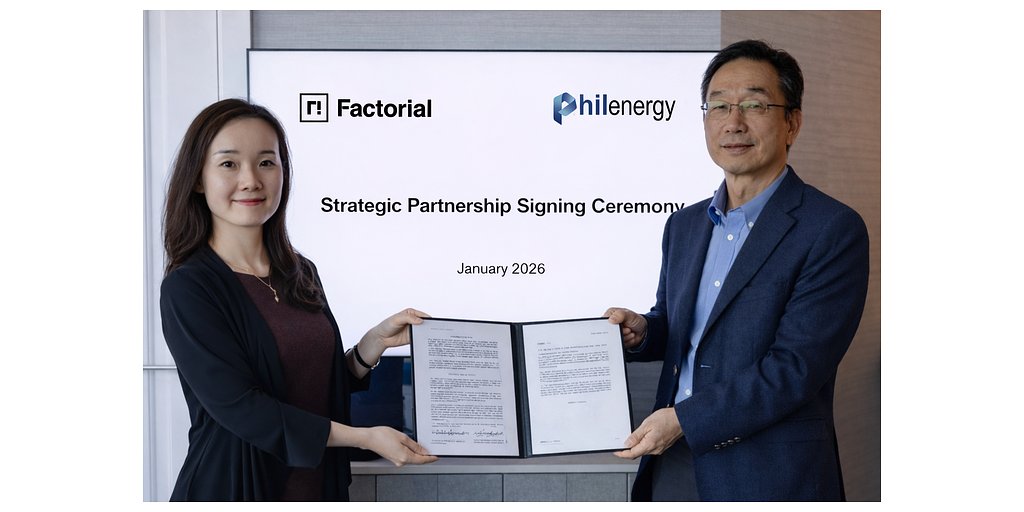
Factorial Taps Korean Giant to Mass Produce Solid-State Batteries
BOSTON & SEOUL – February 26, 2026 – In a strategic move poised to accelerate the arrival of next-generation electric vehicles, U.S. solid-state battery developer Factorial Inc. has signed a Memorandum of Understanding (MOU) with Philenergy, a leading South Korean battery equipment provider. The collaboration aims to solve the single biggest challenge facing advanced battery technology: scaling from the laboratory to mass production.
This partnership will see Factorial’s groundbreaking Solstice™ solid-state battery platform integrated with Philenergy’s world-class manufacturing infrastructure. While many companies have demonstrated promising battery chemistries in a lab, the path to producing millions of units reliably and cost-effectively has been a formidable barrier. By joining forces, Factorial and Philenergy are directly confronting this industrial challenge, signaling a pivotal shift from pure research and development toward commercial reality.
From Lab Breakthrough to Factory Floor
The core of the agreement focuses on leveraging Philenergy's expertise to build out the manufacturing capacity for Factorial's technology. For years, the promise of solid-state batteries—which replace the flammable liquid electrolyte in conventional lithium-ion cells with a solid material—has been hampered by the complexities of high-volume manufacturing. These new materials require extreme precision and entirely new production techniques.
Philenergy brings a formidable arsenal of advanced manufacturing capabilities to the table. This includes automated laser notching for precise component cutting, high-speed precision stacking systems, and proprietary Roll-to-Roll (R2R) technologies designed to improve productivity and reduce costs. The South Korean firm’s modular factory architecture is engineered for capital efficiency and rapid deployment, a crucial advantage in the fast-moving battery industry.
"The companies that win in next-generation batteries won't just have breakthrough technology – they'll have production partners experienced in battery manufacturing and capable of delivering at scale," said Siyu Huang, CEO of Factorial, in a statement. "Philenergy brings proven production expertise and infrastructure that matches the ambition of Solstice™.”
This partnership aims to bypass the traditional, slow-moving development of fixed production lines, potentially allowing Factorial to reach volume manufacturing far faster than its competitors while maintaining the rigorous quality control demanded by its advanced battery architecture.
The Solstice™ Performance Advantage
The strategic importance of this manufacturing deal is underscored by the significant performance gains offered by Factorial's technology. The Solstice™ platform, built on the company's proprietary FEST® (Factorial Electrolyte System Technology), promises a step-change in battery performance.
Factorial claims its cells deliver up to 80% higher energy density than today's lithium-ion batteries. This translates directly to longer driving ranges for electric vehicles. Real-world testing has already produced stunning results; a modified Mercedes-Benz EQS equipped with Factorial's 106 Ah cells achieved over 1,200 kilometers (approximately 745 miles) on a single charge. Stellantis, another key automotive partner, has validated 77 Ah cells demonstrating an impressive energy density of 375 Wh/kg and a cycle life of over 600 cycles.
Beyond range, Solstice™ offers critical safety and operational improvements. The batteries maintain stable operation at temperatures as high as 90°C (194°F), significantly reducing the risk of thermal runaway and potentially simplifying the complex and heavy cooling systems required in current EVs. The platform also boasts a faster formation process and utilizes a novel dry cathode architecture, which eliminates hazardous solvents and reduces the energy-intensive steps common in conventional battery manufacturing.
“The Solstice™ platform represents one of the most advanced solid-state architectures in the industry, combining high energy density with manufacturability,” noted Kim Kwang-il, CEO of Philenergy. “We are proud to support Factorial’s vision and contribute our manufacturing capabilities to help bring this breakthrough technology to global markets.”
Navigating a Crowded and Competitive Field
Factorial's move to secure a manufacturing pathway comes at a critical time in the global battery race. The market is bustling with competitors, including QuantumScape, Solid Power, and ProLogium, all vying to commercialize solid-state technology. Major industrial incumbents like Samsung SDI and Toyota are also investing billions, with Samsung targeting mass production in 2027 and Toyota aiming for vehicle integration around the same time.
In this high-stakes environment, the collaboration between a U.S. technology leader and a South Korean manufacturing powerhouse carries geopolitical significance. It highlights a strategic alignment to build resilient, diversified supply chains for critical energy components outside of a single dominant region. By combining American innovation with Korea's renowned manufacturing prowess, the partnership represents a powerful model for competing on the global stage.
Backed by Automotive and Financial Heavyweights
Factorial’s path is not just paved by its technology and manufacturing plans, but also by the powerful consortium of partners it has assembled. The company has secured deep collaborations and significant investments from some of the world's largest automakers, including Mercedes-Benz, Stellantis, Hyundai Motor Company, and Kia Corporation. These are not just research agreements; they involve joint development, vehicle-level integration, and the delivery of B-sample cells for real-world road testing. This deep-seated validation from industry giants provides a clear route to market and a built-in customer base.
Further fueling its ambitions, Factorial is in the process of going public through a business combination with Cartesian Growth Corporation III, a special purpose acquisition company (SPAC). The deal, which values Factorial at approximately $1.1 billion, is expected to provide up to $376 million in capital to fund its commercialization and scale-up efforts. This combination of technical validation, strategic partnerships, and substantial funding places Factorial in a strong position to execute on its ambitious vision.
The MOU with Philenergy is the latest and perhaps most crucial piece of this puzzle, creating a tangible link between Factorial’s advanced technology and the industrial might required to reshape the future of transportation and energy storage.