
- PCIe Gen5 SSD speeds: Up to 14,000 MB/s read and 13,000 MB/s write
- Market growth: PCIe Gen5 SSD market projected to expand at a CAGR of 41.2% from 2024 to 2033
- DDR5 speeds: 6,400 MT/s, nearly double DDR4 bandwidth
Experts would likely conclude that Patriot's ACPI brand is strategically positioning itself in the industrial AI edge market with high-performance, ruggedized hardware that addresses critical speed and reliability demands, though success will depend on navigating global supply chain challenges.
Patriot's ACPI Brand Unleashes Gen5 SSDs for Industrial AI Edge
By David Patterson
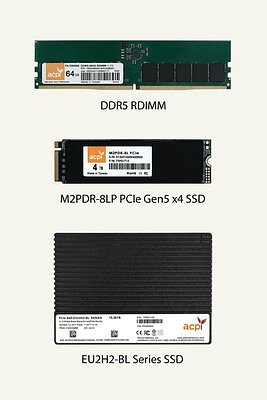
NUREMBERG, Germany – March 09, 2026 – As the industrial world pivots towards a future dominated by artificial intelligence and autonomous systems, Patriot Memory is making a significant play for the high-stakes embedded market. At the Embedded World 2026 conference, the company's industrial brand, ACPI, unveiled a new lineup of hardware engineered to handle the immense data loads of next-generation applications, including a blazing-fast PCIe Gen5 SSD and ruggedized DDR5 memory modules.
The announcement highlights a critical industry shift: the migration of data-heavy processing from centralized cloud data centers to the industrial edge. From smart factories and 5G infrastructure to autonomous vehicles, the demand for real-time decision-making is pushing the limits of conventional hardware. ACPI's new portfolio, featuring the M2PDR-8LP PCIe Gen5 SSD and wide-temperature DDR5 RDIMMs, is designed to be the foundational technology for this new era of decentralized intelligence.
The Insatiable Demand for Speed at the Edge
The core of ACPI's announcement is a direct response to the exponential growth in data generated by AIoT (Artificial Intelligence of Things) and edge devices. The new M2PDR-8LP M.2 2280 SSD is a testament to this, leveraging the PCIe Gen5 x4 interface to achieve staggering sequential read and write speeds of up to 14,000 MB/s and 13,000 MB/s, respectively. This level of throughput is not merely an incremental improvement; it is a necessity for applications like real-time machine vision, high-frequency sensor data logging, and localized AI model training.
This performance leap is timed perfectly with market trends. The market for PCIe Gen5 SSDs is projected to explode from USD 3.4 billion in 2024 to over USD 51 billion by 2033, expanding at a compound annual growth rate (CAGR) of 41.2%. This growth is overwhelmingly driven by AI workloads that require immediate access to vast datasets. By 2025, industry analysts predict that nearly 40% of all AI-centric storage deployments will utilize the PCIe 5.0 standard, underscoring the critical need for the bandwidth it provides.
Complementing the storage solution are ACPI's new industrial DDR5 RDIMM modules, which push mainstream speeds to 6,400 MT/s—nearly double the bandwidth of the previous DDR4 generation. As Gartner predicts that 30% of new industrial control systems will incorporate AI-edge inference by 2025, the ability for these systems to process information without bottlenecks becomes paramount. The combination of high-speed memory and storage is essential for creating a balanced system capable of feeding the data-hungry processors at the heart of modern edge servers and industrial PCs.
Engineered for Extremes: Beyond Data Center Reliability
While raw performance numbers are impressive, they are meaningless in industrial settings if the hardware cannot withstand the harsh realities of the physical world. Unlike climate-controlled data centers, edge devices often operate in environments with extreme temperatures, vibration, and unstable power. It is here that ACPI aims to differentiate its offerings with a focus on industrial-grade reliability.
The DDR5 RDIMM modules are rated for wide-temperature operation, functioning flawlessly from a frigid -40°C to a sweltering +85°C. This resilience is non-negotiable for outdoor 5G base stations, un-crewed agricultural equipment, or factory floor machinery. To ensure data integrity under these conditions, the modules incorporate side-band Error-Correcting Code (ECC) and a Registered Clock Driver (RCD), mechanisms that detect and correct memory errors while supporting large, stable memory capacities.
Thermal management is a primary concern for high-speed storage, especially in the compact, often fanless enclosures of embedded systems. The M2PDR-8LP Gen5 SSD tackles this with a low-profile graphene heatsink and sophisticated thermal throttling algorithms. This combination is designed to dissipate heat effectively and ensure sustained performance without damaging the drive, even in restricted airflow environments. Furthermore, ACPI’s EU2H2-BL enterprise SSD series, available in capacities up to 15.36TB, includes enterprise-level Power Loss Protection (PLP). This feature uses onboard capacitors to ensure that any data in transit is safely written to the NAND flash during a sudden power outage, preventing data corruption in mission-critical applications.
A Strategic Play in a Volatile High-Tech Market
Patriot Memory's focused push into the industrial sector through its ACPI brand is a calculated strategic move. The company is positioning itself against established industrial component suppliers like Micron, Innodisk, and Western Digital in a market that is both lucrative and fraught with challenges. The announcement is not just about new products; it's about claiming a stake in the foundational hardware layer of the next industrial revolution.
However, this ambition unfolds against a backdrop of significant supply chain turbulence. The global demand for memory, supercharged by the AI boom, is creating structural scarcity. Major manufacturers are reallocating production capacity from conventional DDR5 memory to higher-margin High Bandwidth Memory (HBM) for AI accelerators. This industry-wide shift has created a supply crunch, with lead times for critical memory components stretching to 32-40 weeks or more and prices experiencing extreme volatility.
Navigating this environment will be as crucial to ACPI's success as the technical specifications of its products. The ability to secure a stable supply of NAND flash and DRAM chips will be a key competitive advantage. For system integrators and industrial customers, ACPI's launch represents both an opportunity and a consideration; the new hardware offers the performance they desperately need, but its availability and cost will be subject to the powerful macroeconomic forces shaping the entire semiconductor industry. By launching these advanced solutions, Patriot Memory is signaling its readiness to compete in this demanding arena, providing the tools necessary for innovation at the industrial edge, provided it can master the complex global supply chain.