
- $300 million: Path Robotics has raised this amount in funding to date from investors like Tiger Global and Drive Capital.
- 400,000 welders: The projected shortage of skilled welders in the U.S. by 2024, according to industry analysts.
- Quadruped mobility: Rove combines high-precision welding with a four-legged robot, enabling navigation of complex, unstructured environments.
Experts view Rove as a groundbreaking solution to the labor crisis in welding-intensive industries, offering a scalable way to automate field welding tasks while enhancing worker safety and productivity.
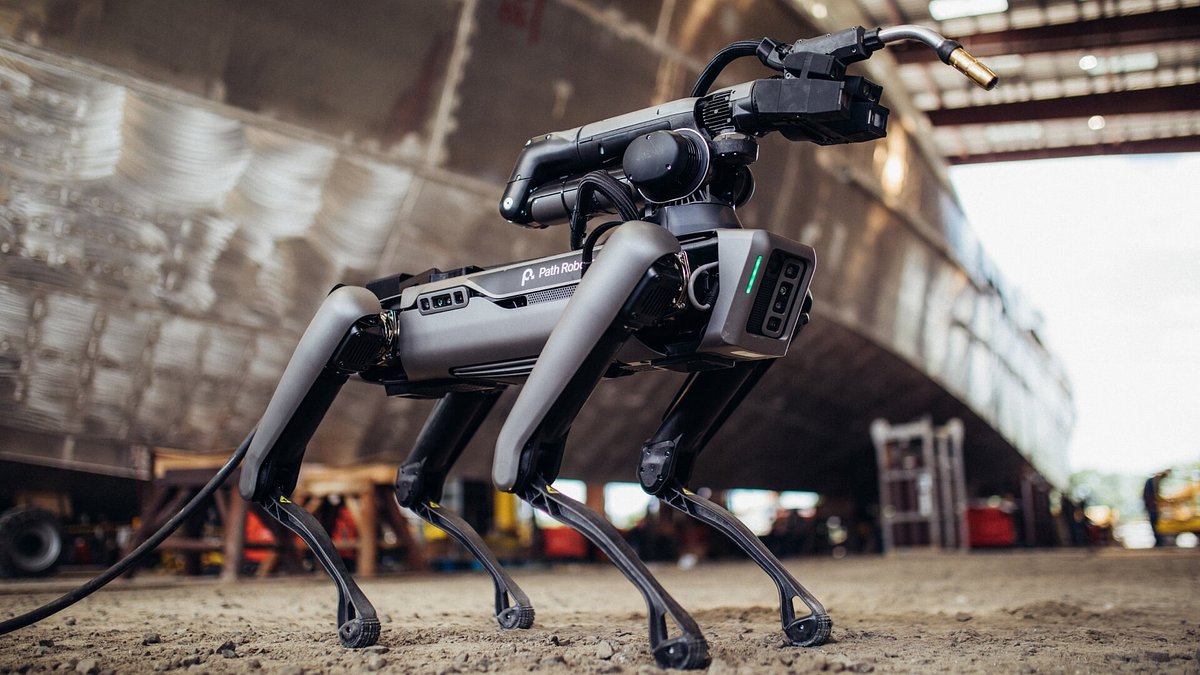
Path Robotics Unveils Rove, an AI-Powered Quadruped Welder
COLUMBUS, OH – April 16, 2026 – In a move poised to reshape the landscape of heavy industry, Path Robotics today announced the launch of Rove™, a mobile robotic welding system that brings advanced automation out of the factory and into the field. The new system combines the company’s proprietary Obsidian™ physical AI model with a nimble, four-legged quadruped robot, creating a solution designed to tackle welding tasks on massive, immovable structures common in shipbuilding, heavy construction, and large-scale fabrication.
For decades, welding automation has been confined to fixed, highly controlled cells where parts are brought to the robot. Rove inverts this paradigm, enabling the robot to autonomously navigate complex environments and bring intelligent welding directly to the workpiece. This breakthrough addresses a critical bottleneck in industries that have been largely unable to leverage automation due to the sheer size and variability of their projects, a challenge now compounded by a severe and growing shortage of skilled human welders.
“Obsidian has proven that physical AI can solve some of the hardest welding challenges inside the cell,” said Andy Lonsberry, CEO and co-founder of Path Robotics, in a statement. “Rove is a significant next step and one our customers have been seeking. Manufacturers can now deploy Obsidian wherever welding is needed – across large assemblies, production sites, and in environments where moving the part isn’t an option.”
A New Breed of Industrial Automation
The core innovation behind Rove is the successful fusion of high-precision welding with a mobile, legged platform—a feat long considered an engineering impossibility due to the inherent instability of such robots. Path Robotics claims its Obsidian physical AI is the key to overcoming this challenge. The system uses a sophisticated combination of computer vision and machine learning to perceive its environment, understand complex weld geometries in real-time, and adapt its path and parameters on the fly.
Unlike traditional robots that blindly follow pre-programmed instructions, Rove can compensate for the inconsistencies and imperfect fit-ups that are unavoidable in large-scale manufacturing. This ability to “see, think, and adapt” allows it to perform high-quality welds even on a platform that is actively balancing on uneven terrain. This represents a significant leap from existing mobile automation, which typically relies on wheels or tracks and struggles in the unstructured, obstacle-rich environments found in shipyards and construction sites.
Path Robotics, founded in 2018, has steadily built its reputation and financial backing, having raised more than $300 million to date from major investors including Tiger Global and Drive Capital. The company's existing robotic welding cells are already deployed across North America, but the launch of Rove marks a major expansion of its capabilities, targeting a segment of the manufacturing world previously untouched by advanced automation.
Tackling a Critical Labor Crisis
The timing of Rove’s debut could not be more critical. Industries reliant on welding are facing a dire labor crisis. The American Welding Society and other industry analysts have projected a shortage of approximately 400,000 welders in the U.S. by 2024, a deficit that stifles growth, delays critical infrastructure projects, and undermines efforts to reshore manufacturing. As the existing workforce ages into retirement, fewer young workers are entering the trade to replace them, creating an unsustainable gap.
Rove is positioned as a direct response to this crisis. By automating the physically demanding, repetitive, and often dangerous tasks of welding, the system can significantly amplify the productivity of the existing workforce. This allows skilled human welders to transition to higher-value roles such as quality oversight, complex repair work, and system supervision, rather than spending their days in strenuous and hazardous conditions. The introduction of such technology is seen as essential for maintaining, and ultimately increasing, domestic production capacity in vital sectors.
From Shipyards to Construction Sites
The immediate impact of Rove is expected to be felt most acutely in the shipbuilding industry. Saronic Technologies, a leader in developing autonomous maritime vessels, has been announced as one of the first early adopters to evaluate the system for its advanced shipbuilding operations in Franklin, Louisiana. The production of modern ships involves welding thousands of feet of seams on enormous, complex assemblies—a perfect use case for a mobile, intelligent welder.
“Building the next generation of autonomous vessels means rethinking not just how ships operate, but also how they're made,” commented John Morgan, Head of Manufacturing at Saronic. “Rove represents the kind of intelligent, adaptable tooling we need to bring shipyard operations into the modern era—we look forward to seeing what Rove can do and are excited to partner with Path Robotics as we scale production of the next generation of autonomous vessels.”
Beyond shipbuilding, the potential applications for Rove are vast. In heavy construction, it could be deployed to weld structural steel on skyscrapers or bridges. In the energy sector, it could work on large tanks, pipelines, and power plant components. In each case, the robot’s ability to navigate challenging terrain and adapt to real-world conditions promises to boost efficiency, improve weld quality and consistency, and enhance worker safety.
Navigating the Future of Field Robotics
The deployment of autonomous robots like Rove into dynamic field environments also introduces new considerations. While the technology promises to remove human workers from immediate dangers—such as toxic fumes, arc radiation, and working in confined spaces or at heights—it also necessitates robust new safety protocols to manage human-robot interaction in unpredictable settings. Ensuring the robot can operate safely and reliably around personnel and other moving equipment will be a primary focus for early adopters.
Furthermore, the logistics of supporting a fleet of robotic welders in the field present a new set of challenges. Maintaining a consistent supply of power, shielding gas, and welding wire to mobile units, as well as ensuring the hardware is robust enough to withstand outdoor environmental conditions, will be crucial for widespread adoption. These operational hurdles are a key part of the evaluation process for partners like Saronic.
Path Robotics will be offering a first-hand look at the new system in action. The company plans to demonstrate Rove at the Sea-Air-Space 2026 maritime expo in National Harbor, Maryland, from April 19–22, giving industry leaders and defense stakeholders a chance to see the future of industrial welding firsthand.