
- 20-30% staffing losses in federal statistical agencies since 2024, leading to data delays and cancellations.
- $152 million program for seniors left unassessed due to 'messy' data at HUD.
- Key datasets discontinued, including Billion Dollar Disasters and Food Security Survey.
Experts agree that the decay of public data infrastructure poses a critical threat to democracy, requiring urgent modernization and investment to restore trust and evidence-based governance.
Our Data Infrastructure is Crumbling. Can We Rebuild a Shared Reality?
BELLEVUE, WA – June 09, 2026 – The systems that hold our modern world together are often invisible until they fail. We take for granted that roads will be paved, electricity will flow, and water will be clean. But what about the data? What happens when the shared factual foundation of our society—the vast streams of public information that guide everything from disaster response to school funding—begins to erode?
This is the question at the heart of a new national campaign, “The Data We Depend On,” launched today by USAFacts, the nonpartisan civic organization founded by former Microsoft CEO Steve Ballmer. The campaign makes a bold and unsettling argument: our national data infrastructure is failing, and its decay represents a crisis as urgent as any crumbling bridge. “A functioning democracy requires a shared factual foundation. It's as essential as our roads and electricity grids,” said USAFacts President Lauren Woodman. “When that data is outdated or incomplete, we lose civic participation from the Americans who could be shaping their government and communities. This campaign is our call to Congress to act.”
Timed ahead of the 2026 midterm elections, the initiative is a multi-front effort to drag a seemingly technical issue into the public square. It features an open letter to Congress, mobile visual displays touring major cities, and a comprehensive policy roadmap, all designed to rally public pressure for investment in the systems that produce and disseminate government data.
The Silent Decay of Public Fact
The central claim from USAFacts—that the quality and availability of public data have declined—is not hyperbole. It is a reality substantiated by a growing chorus of government watchdogs, academic institutions, and federal auditors. While the organization points to a decline since 2024, the structural weaknesses have been developing for years, a slow-motion decay now reaching a critical point.
Reports from the American Statistical Association (ASA) have documented the strain. A 2025 analysis highlighted significant staffing losses across federal statistical agencies, with some losing 20-30% of their personnel. Coupled with budgets that have failed to keep pace with inflation for over a decade, the result has been predictable: “product delays, suspensions, and cancellations as well as reductions in data scope and detail.”
The consequences are not abstract. Since 2025, researchers and the public have noted the disappearance or degradation of crucial datasets. The federal government reportedly stopped publishing its data on Billion Dollar Disasters, a key metric for understanding the escalating economic cost of climate change. The annual Food Security Survey was terminated. The Department of Homeland Security ended public access to its foundational infrastructure data. Even when data is still collected, it is often incomplete; the Health and Human Services Department’s 2024 survey on drug use, for example, omitted vital information broken down by race and ethnicity, hampering efforts to address health disparities.
This trend is echoed in the steady drumbeat of reports from the Government Accountability Office (GAO). In just the past year, the GAO has flagged systemic data failures across the government. It found the Department of Housing and Urban Development unable to assess a $152 million program for seniors due to “messy” data. It revealed that federal systems for tracking trillions in procurement spending are outdated, with no modernization plans in sight. It highlighted “persistent gaps” in federal spending transparency, backlogged information requests, and missing program inventories that limit oversight and public trust. The system isn't just fraying; in many places, it has already snapped.
A Blueprint for a Data-Driven Future
Identifying a problem of this magnitude is one thing; solving it is another. To that end, USAFacts has not come empty-handed. Alongside the campaign, the organization released “A Vision for a National Data Ecosystem that America Deserves,” an in-depth policy report co-authored with the Center for Open Data Enterprise (CODE) and informed by over 150 data experts.
This roadmap aims to modernize a federal data system that was largely designed in a pre-internet, pre-AI era. “The U.S. federal data system is meant to serve the American people, and it must be updated for the 21st century,” said Richard Coffin, Chief Research and Advocacy Officer at USAFacts. “AI is changing the way people seek out information on everything from their taxes to their kids’ schools. It’s critical that our public data resources reflect the way people are using technology today.”
The report’s vision rests on two core principles, which have been distilled into direct calls to action for Congress: “Use data to legislate” and “Fix the data when it falls short.” The first is a plea for evidence-based policymaking, urging lawmakers to make data a standard part of defining problems, comparing options, and measuring outcomes. The second is a re-framing of the issue itself. When data is slow, fragmented, or inaccessible, it should be treated as a failure of public infrastructure, one that erodes not only decision-making but also public trust.
A Civic Crusade in an Election Year
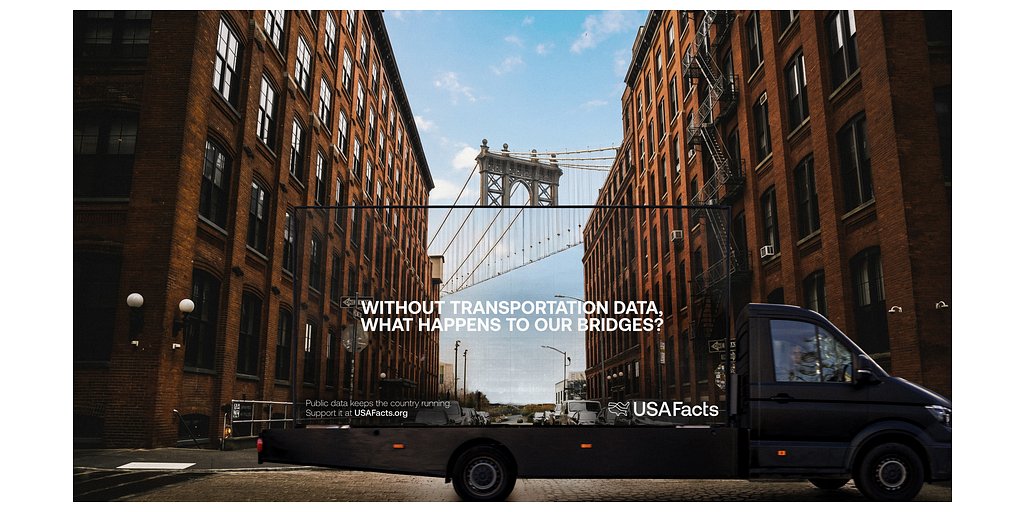
To prevent its message from being lost in the Washington noise, the campaign is employing tactics more common to a political race than a policy debate. Custom-built mobile displays, dubbed “The Fact Fleet,” will tour New York, Los Angeles, D.C., and Miami, using stark visuals of broken roadways and disappearing schools to illustrate the tangible impacts of data loss. It’s a deliberate attempt to make the invisible visible, connecting a spreadsheet deficit to a pothole on Main Street.
The campaign's political nature is overt. The open letter to Congress, which Steve Ballmer is co-signing, aims to collect 100,000 public signatures by the end of July, with a goal of one million by the 2026 midterms. By collecting zip codes, the organization can demonstrate constituent support directly to lawmakers in their home districts, turning a national issue into a local concern.
This strategic timing is no accident. With forecasts suggesting a highly contested battle for control of Congress, the campaign seeks to inject data integrity into the political conversation. In an era where public anger over the local impact of AI data centers can become a major political liability for incumbents, the idea that the government’s own data infrastructure is failing may find a surprisingly receptive audience.
Ultimately, “The Data We Depend On” is a high-stakes test. It wagers that an abstract concept—the structural integrity of public information—can be made real, urgent, and politically salient. In a fractured public square, where the very notion of a shared set of facts is under assault, the effort is more than a call for better bookkeeping. It is an attempt to repair the foundational trust between the citizen and the state, one dataset at a time. The question is whether anyone is still listening for the facts.