
- $22/day: Average child care fee in Ontario, far above the promised $10/day target.
- $1.95 billion: Projected funding shortfall for Ontario's CWELCC program by 2026/27.
- 10,000: Estimated shortage of qualified child care educators in Ontario.
Experts agree that Ontario's failure to fully fund and implement the CWELCC agreement is worsening the child care crisis, deepening the gender pay gap, and undermining economic growth.
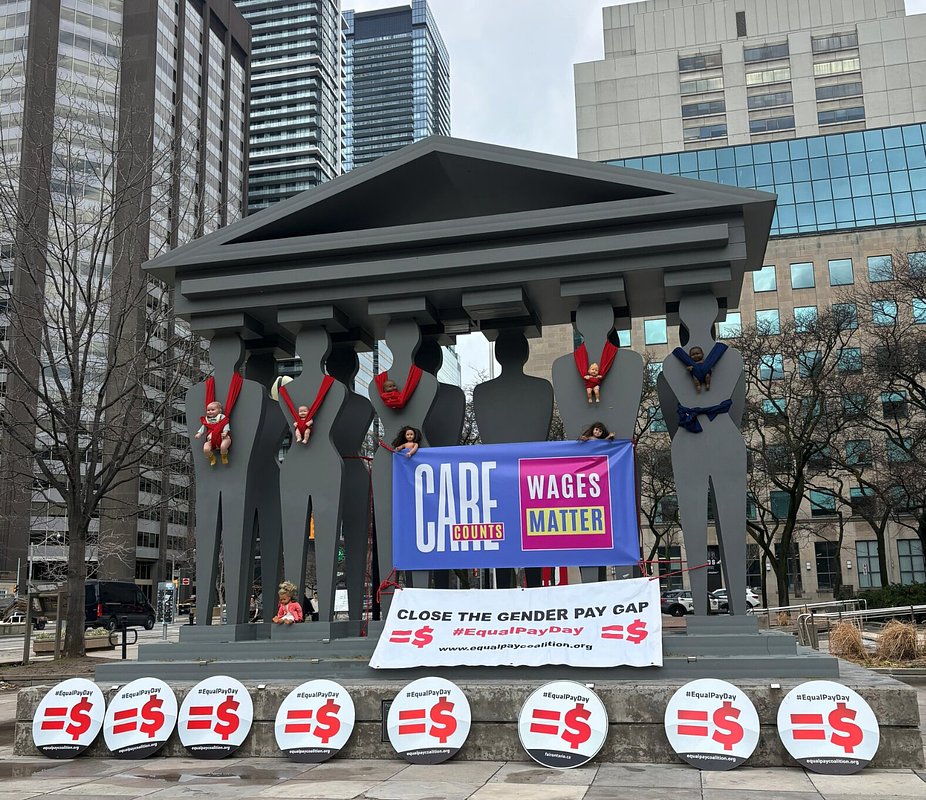
Ontario's Child Care Crisis: Broken Promises Deepen Gender Pay Gap
TORONTO, ON – April 14, 2026 – On a day symbolizing the long road women travel to earn the same as men, advocates are charging that Ontario's stalled child care plan is actively widening the gender pay gap. The Equal Pay Coalition, joined by unions, parents, and community groups, used Equal Pay Day to launch a blistering critique of the provincial government, demanding it fully fund the child care system and address the low wages driving an exodus of educators.
Under the banner "CARE COUNTS-WAGES MATTER," a rally gathered at Toronto's Pillars of Justice, highlighting a system advocates describe as being in a state of crisis. The central grievance is the province's failure to deliver on the Canada-Wide Early Learning and Child Care (CWELCC) agreement, a federal-provincial partnership that promised to lower parent fees to an average of $10-a-day by March 2026. In Ontario, however, fees remain stuck at an average of $22 a day, leaving it far behind the six other provinces and territories that have already met the affordability target.
“Child care is the backbone of our economy. Without the care of the workers, the economy doesn’t work,” stated Fay Faraday, Co-Chair of the Equal Pay Coalition. “But Ontario’s child care system remains too expensive for parents and it vastly underpays child care workers, driving a staffing shortage in Ontario that causes waitlists to grow.”
A System in Crisis: Broken Promises and Mounting Shortfalls
The coalition's claims are strongly supported by a damning October 2025 special report from Ontario's Auditor-General. The report painted a stark picture of mismanagement and underfunding, projecting a staggering $1.95 billion funding shortfall for the CWELCC program by the 2026/27 fiscal year if the province's course remains unchanged. This financial gap is the backdrop for a cascade of failures across the system.
The province is not on track to meet its own targets for creating new child care spaces. The Auditor-General found Ontario was short 12,000 spaces from its December 2025 goal, with nearly 70,000 families unable to access care—a figure that has tripled since 2019. Shockingly, the report also revealed that 27% of all licensed child care spaces in the province sat empty, primarily due to a severe shortage of qualified staff.
The provincial budget, released on March 26, 2026, did little to quell the growing alarm. While the government signed a one-year, $3.6 billion extension of the federal agreement, advocates were quick to point out that it contained no significant new provincial investment to address the core issues. Critically, it once again failed to establish a provincial wage grid for educators.
“The 26 March 2026 provincial budget continues to fail both parents and child care workers,” said Jan Borowy, Co-Chair of the Equal Pay Coalition. “It utterly failed to deliver the much-needed expansion of funding to fully support care workers, women and their families. Most critically, the budget’s lack of new funding means child care workers’ wages remain discriminatorily low.”
The Human Cost: Underpaid Educators and Sidelined Parents
The crisis is felt most acutely by the predominantly female workforce of early childhood educators (ECEs) and the parents, largely mothers, who rely on their services. The staffing shortage, which the Auditor-General estimates at 10,000 needed educators, is a direct result of chronically low wages.
The median wage for a Registered Early Childhood Educator (RECE) in Ontario was less than $25 per hour in 2024. This stands in stark contrast to the legally entitled pay equity compliant wage grid of $35 to $45 per hour, which advocates say is necessary to recognize the skill and importance of the profession. This wage gap is not just a number; it represents a systemic devaluation of care work.
“Inequities in both paid and unpaid care work are one of the root causes of the gender pay gap”, said Amber Straker of the Association of Early Childhood Educators Ontario. “That is why this Equal Pay Day we say CARE COUNTS-WAGES MATTER to highlight the urgent need to protect and expand child care services, and ensure Ontario educators are fully valued and paid what they are legally entitled to.”
The low pay fuels a cycle of high turnover, burnout, and recruitment challenges, leaving centres unable to operate at full capacity. For parents, this translates into endless waitlists and the constant anxiety of finding reliable care. The high fees force many, especially mothers, to make impossible choices between their careers and caring for their children, directly contributing to the broader gender pay gap that Equal Pay Day is meant to highlight.
The Economic Drag of Inaction
While the social cost is clear, the government's inaction also defies economic logic. A 2024 report from the Centre on the Future of Work demonstrated that investments in child care deliver powerful economic returns. Studies show that every dollar invested can boost GDP by as much as $2.80, create more jobs than an equivalent investment in construction, and largely pay for itself through increased tax revenues from newly employed parents.
Since 2019, the national child care program has already added over 50,000 jobs and boosted Canada's GDP by over 1%. By failing to fully invest, Ontario is leaving significant economic growth on the table. Furthermore, the province is not meeting its obligations as a funding partner. The CWELCC agreement is premised on the federal government and provinces sharing costs. However, analyses from the Financial Accountability Office and the City of Toronto show Ontario is paying far less than its fair share, contributing only about 26% of costs compared to the federal government's 49%.
A Tale of Two Canadas: How Ontario Lags Behind
Ontario's struggles are not universal across the country, a fact that makes the province's position all the more frustrating for advocates. Ontario is one of only three provinces that has refused to implement a sectoral wage grid for educators. Meanwhile, seven other provinces, including Manitoba and Prince Edward Island, have established wage grids and are seeing improved staff retention and morale as a result.
This policy divergence is a key reason why other jurisdictions have successfully lowered fees while Ontario has not. The failure to professionalize the workforce through fair compensation is a primary bottleneck preventing the system's expansion.
“What would change if the men who shaped our societies also shared the daily responsibility of care?” asked Carolyn Ferns of the Ontario Coalition for Better Child Care. She questioned what would happen if leaders understood that care work is essential and ensured those in the sector are paid decently.
This perceived lack of understanding is underscored by the government's silence. The Equal Pay Coalition reported that its April 8 request for a meeting with four key ministers responsible for the child care file has gone unanswered. As parents and educators rally for a system that works, the provincial government's failure to engage, fund, and follow through on its promises leaves the backbone of Ontario's economy under threat.