
- €1.5 billion: Investment by China COSCO Shipping in the Port of Piraeus since 2008, transforming it into one of the busiest Mediterranean ports.
- 2006: Year the China-Greece comprehensive strategic partnership was formally established.
- 2018: Greece formally joined China's Belt and Road Initiative (BRI).
Experts view the China-Greece partnership as a strategic model for economic and cultural cooperation, though it remains a complex balancing act for Greece within the EU and NATO frameworks.
China & Greece: 20 Years of Partnership, from Ports to Soft Power
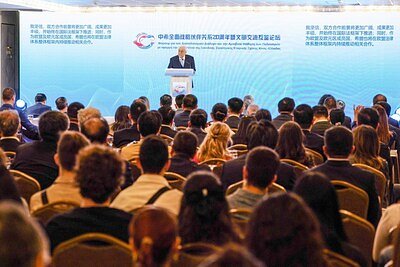
ATHENS, Greece – May 08, 2026 – Dignitaries and representatives from China and Greece convened in Athens this week to commemorate a significant milestone: the 20th anniversary of their comprehensive strategic partnership. A forum themed "The Beauty of Harmony: Coexistence through Integration" served as the centerpiece of the celebration, moving beyond diplomatic pleasantries to explore the deep economic and cultural threads that now bind the two ancient civilizations. The event, jointly hosted by Xinhua News Agency, the Chinese Embassy in Greece, and the Alliance for Cultural Heritage in Asia, underscored a relationship that has evolved dramatically, from foundational agreements to becoming a pivotal, and at times controversial, element in the landscape of EU-China relations.
Speaking at the opening ceremony, former Greek President Prokopis Pavlopoulos described the anniversary as an "important milestone," highlighting that the two nations have achieved fruitful results in trade and investment while deepening a partnership centered on civilizational dialogue. This sentiment was echoed by Lyu Yansong, editor-in-chief of Xinhua News Agency, who noted the partnership has "continued to deepen under the strategic guidance of the two heads of state." He referenced Chinese President Xi Jinping's call for building a world where "the light of civilization illuminates the right path for human progress," positioning the Sino-Greek relationship as a model for such an endeavor.
A Partnership Forged in Strategy and Crisis
The comprehensive strategic partnership was formally established in January 2006, when then-Greek Prime Minister Kostas Karamanlis visited Beijing. The agreement was designed to elevate bilateral relations beyond sporadic contacts, creating a framework for intensified cooperation in politics, trade, and culture. It laid out ambitious goals, including boosting investment and positioning Greece as a primary gateway for Chinese goods into the Balkans and the wider European market. In return, Greece reaffirmed its long-standing adherence to the "one-China" policy.
However, the partnership's true test and turning point came during Greece's sovereign debt crisis. As European partners imposed severe austerity measures, Chinese investment provided a critical economic lifeline. This period solidified China's role not just as a trading partner, but as a key strategic investor in the Greek economy. Former Greek Foreign Minister George Katrougalos alluded to this enduring bond at the forum, stating that "the friendship between Greece and China has endured and grown stronger," especially as the international order undergoes profound changes.
The Piraeus Precedent: A Gateway to Europe
Nowhere is the impact of this partnership more visible than at the Port of Piraeus. Often hailed as the flagship project of China's Belt and Road Initiative (BRI) in Europe, which Greece formally joined in 2018, the port's transformation has been remarkable. China COSCO Shipping's involvement began in 2008 with a concession for two container terminals and culminated in its acquisition of a majority stake in the Piraeus Port Authority (PPA) in 2016. The subsequent investment, totaling over €1.5 billion, has catapulted Piraeus into the ranks of the busiest ports in the Mediterranean.
The port now serves as the European terminus of the "China-Europe Land-Sea Express Route," a critical trade corridor that significantly shortens the time for goods to travel from Asia to Central and Eastern Europe. George Katrougalos noted that the BRI has brought "tangible development benefits to Greece," a claim supported by the port's increased container throughput, creation of local jobs, and enhanced role as a regional logistics hub. The success of Piraeus has become a powerful symbol of the economic potential of Sino-Greek cooperation.
Beyond Economics: Cultural Dialogue and Soft Power
While infrastructure and trade have dominated headlines, the Athens forum deliberately emphasized the cultural dimension of the partnership. This focus on "intercultural dialogue and mutual learning" represents a sophisticated soft power strategy that complements China's economic footprint. A key moment was the release of a new report by the Xinhua Institute, the news agency's think tank, titled "The Theory of Cultural Empowerment: China's Cultural Consciousness in Marching Toward High-Quality Development."
Lyu Yansong of Xinhua stressed that media outlets shoulder "unique social responsibilities" as a bridge for people-to-people communication. He pledged to work with Greek partners to "actively carry forward the common values of humanity" and promote dialogue. This push for cultural exchange builds on a long history of mutual admiration between two of the world's most influential ancient civilizations. By framing the relationship through a lens of shared heritage and mutual respect, China aims to foster deeper affinity and understanding, creating a more favorable environment for its strategic and economic goals.
Navigating Geopolitical Tides: Athens' Balancing Act
The deepening of Sino-Greek ties has not been without controversy, particularly within the European Union. For years, Greece's close relationship with Beijing fueled a "Trojan Horse" narrative in Brussels, with critics fearing that China was using its economic leverage to undermine EU unity. These concerns were amplified when Greece, on separate occasions, blocked EU statements critical of China's human rights record and its actions in the South China Sea. As a full member of the China-CEEC cooperation mechanism (formerly "17+1"), Greece further positioned itself as a key hub for Chinese engagement in the region.
More recently, however, analysts have observed a "normalization" of the relationship. As the Greek economy has recovered, its dependency on Chinese capital has lessened. Concurrently, pressure from EU and NATO allies has encouraged Athens to adopt a more balanced approach. A notable example is Greece's decision to partner with Ericsson for its 5G network, moving away from China's Huawei. This reflects the complex reality for Athens: it must navigate its commitments as an EU and NATO member while continuing to cultivate a valuable economic and strategic partnership with Beijing.
Charting the Future: Digital, Green, and Smart Horizons
Looking forward, the partnership is set to evolve into new, high-tech domains. Chinese Ambassador to Greece Fang Qiu announced at the forum that the two nations will "strengthen strategic alignment" and advance cooperation in areas like digital infrastructure, the green transition, and smart manufacturing. This signals a move beyond traditional infrastructure and logistics into sectors that will define the 21st-century economy.
This future-oriented agenda aims to promote what the ambassador called "mutual empowerment in culture, trade and economy." As China pushes for "high-quality development" and Greece seeks to modernize its economy, collaboration in green energy, digital services, and advanced manufacturing presents a logical next step. The next decade of the China-Greece partnership will likely be defined by how effectively the two countries can translate these ambitions into concrete projects, continuing their two-decade journey of strategic integration.