
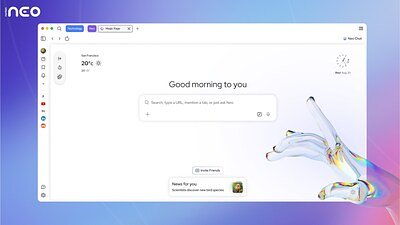
- Norton Neo is an AI-native browser launched globally for free by Norton, part of Gen Digital.
- The browser integrates Norton Web Shield for real-time blocking of malicious websites, trackers, and phishing attempts.
- Norton aims to differentiate itself with 'zero-prompt' AI that works proactively in the background.
Experts would likely conclude that Norton Neo's AI-native approach and focus on security and privacy could disrupt the browser market, but its success will depend on overcoming user inertia and proving its claims of safety and performance.
Norton's AI Gambit: Can Safety Disrupt the Browser Wars?
MOUNTAIN VIEW, CA – December 02, 2025 – The digital landscape has a new contender, and it’s aiming to redefine the very window through which we view the web. Today, cybersecurity stalwart Norton, part of Gen Digital, globally launched Norton Neo, an AI-native browser available for free to all users. The launch marks a significant strategic pivot, moving beyond traditional security software to challenge established giants like Google Chrome and Microsoft Edge on their own turf. In an era where artificial intelligence is being rapidly woven into every facet of our online lives, Norton is betting that a browser built from the ground up with security and privacy at its core is not just a novelty, but a necessity.
The browser market, long a settled territory, has become a hotbed of innovation, with AI as the primary accelerant. But as features multiply, so do concerns about data privacy and user trust. Norton aims to address this tension directly. "Many AI browsers promise intelligence, but few deliver safety," stated Howie Xu, Chief AI and Innovation Officer at Gen, in the official announcement. "Only Norton could build a browser that harnesses the power of AI for good while protecting you from malicious AI threats."
The New Battlefield: AI in the Browser
The race to integrate AI has transformed the browser from a simple gateway to the internet into an intelligent co-pilot. Google Chrome, the undisputed market leader, has embedded its Gemini AI for tasks like tab organization, writing assistance, and natural language history searches. Microsoft has gone all-in on its Copilot assistant in Edge, offering sophisticated content summarization and contextual help. Other players like Opera, with its Aria AI, and the privacy-focused Brave, with its Leo assistant, have also staked their claims, each offering a unique spin on AI-powered productivity.
Most of these innovations, however, are additions to existing frameworks. They are powerful features retrofitted onto browsers that were designed for a different era. Norton Neo’s proposition is fundamentally different. By building an "AI-native" browser from scratch, the company claims to have re-architected the experience around the dual pillars of intelligence and security. This isn't just about adding an AI chatbot into a sidebar; it's about creating a proactive environment that anticipates user needs while actively safeguarding their digital footprint. The question is whether this ground-up approach can offer a compelling enough advantage to lure users away from the deeply entrenched ecosystems of Google and Microsoft.
A Proactive Guardian for Your Digital Life
What truly sets Norton Neo apart is its philosophy of "zero-prompt" AI. While competitors require users to actively engage with an AI assistant, Neo is designed to work quietly in the background, offering help before you even ask. It automatically groups cluttered tabs by topic, identifies key points in long articles for quick summarization, and suggests calendar reminders based on your browsing activity. The goal is to reduce cognitive load and digital noise, making the web feel less overwhelming.
This proactive intelligence is coupled with a feature that directly addresses the paramount concern of the AI era: data privacy. Neo’s "Configurable Memory" gives users granular control over what the browser remembers. Through a simple chat interface, you can instruct Neo to retain details for a specific project, remember your favorite news sites, or forget everything about a particular session. All stored memories are transparently displayed in the settings, where they can be edited or deleted at will. This user-centric control is a stark contrast to the often-opaque data collection practices of other tech giants.
Underpinning this entire experience is Norton's decades-long expertise in cybersecurity. The browser integrates Norton Web Shield, which actively blocks malicious websites, trackers, and sophisticated phishing attempts in real-time. By fusing its security legacy with forward-looking AI, Norton is creating a fortified environment that aims to make users feel safe exploring the full potential of the web, without constantly looking over their digital shoulder.
The Strategic Play: From Antivirus to AI Gateway
Releasing a sophisticated browser for free might seem counterintuitive for a company like Gen Digital, which relies on a subscription-based model for its revenue. However, the strategy behind Norton Neo is a calculated long-term play. In the modern digital economy, the browser is the primary gateway to a user's entire online life. By offering a compelling, free browser, Norton isn't just giving away software; it's establishing a powerful top-of-funnel for its entire ecosystem.
Norton Neo serves as a daily touchpoint with the Norton brand, building trust and demonstrating its value proposition in a tangible way. Users who come to rely on Neo for a safer, smarter browsing experience are far more likely to consider purchasing other products from the company's suite, such as its full antivirus protection, VPN services, or identity theft monitoring. It's a classic freemium strategy deployed on a massive scale, designed to expand its user base and deepen brand loyalty.
This move also represents a critical evolution for a legacy cybersecurity firm. As operating systems and web platforms build more security features in, the value of standalone antivirus software is being questioned. By taking ownership of the browser experience, Norton is moving up the value chain, shifting its focus from protecting the device to securing the user's holistic digital journey. It's a pivot from a defensive posture to an offensive one, shaping the environment rather than just reacting to threats within it.
Hurdles on the Horizon: Adoption, Performance, and Trust
Despite its innovative approach, Norton Neo faces a steep climb. The browser market is notoriously sticky; user inertia is a powerful force, and the seamless integration of Chrome with Google services and Edge with Windows presents a formidable barrier to entry. Early hands-on reviews, while praising the concept, have noted some initial performance issues and a learning curve with the new interface—common hurdles for any new software release, but critical to overcome quickly.
Furthermore, the claim of being a "safe AI" will inevitably come under intense scrutiny. While the Norton brand carries significant weight in security, it will need to earn trust in the AI space. This will likely require transparent communication about its underlying AI models and, eventually, validation from respected third-party security labs to back up its privacy-first promises. The broader industry remains divided, with some, like the CEO of Vivaldi, vocally criticizing what they see as "force-fed AI" that compromises user autonomy.
Ultimately, the success of Norton Neo will hinge on its ability to deliver a demonstrably better and safer experience. It must be more than just a secure browser; it must be a great browser—fast, intuitive, and genuinely helpful. The global launch is only the first step. Now, Norton must prove to millions of users that its vision for a smarter, safer internet is not just a promise, but a reality worth switching for.