
- 10,000+ attendees: The sold-out event at Dubai’s Coca-Cola Arena drew over 10,000 fans.
- 17 million views: The event generated over 17 million organic views across social platforms in the week following the event.
- 5-star safety rating: The Nissan Magnite holds a 5-star safety rating from the Global NCAP.
Experts would likely conclude that Nissan's CarJitsu Showdown successfully disrupted traditional automotive marketing by blending combat sports with brand engagement, creating a high-risk, high-reward strategy that resonated with audiences and demonstrated the Magnite's durability in an innovative way.
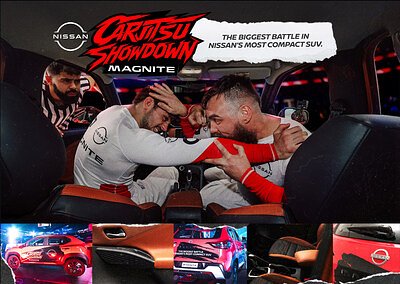
Nissan's CarJitsu: A Wild Marketing Stunt or an Industry Revolution?
DUBAI, UAE – March 19, 2026 – In a city known for spectacle, Nissan Middle East may have just set a new standard. Inside Dubai’s sold-out Coca-Cola Arena, before a crowd of over 10,000 cheering fans, two professional grapplers contorted, struggled, and fought for submission. Their arena wasn't a mat or an octagon; it was the front cabin of a Nissan Magnite compact SUV. The inaugural 'Nissan CarJitsu Showdown' was a bizarre, high-octane fusion of combat sports and automotive marketing, leaving many to wonder if they were witnessing a brilliant new future for brand engagement or the industry's most audacious publicity stunt yet.
From Niche Sport to Center Stage
The concept of fighting inside a car is not a Nissan invention. The event leveraged a genuine, if unconventional, combat sport known as CarJitsu. Conceived in 2020 by Russian martial artist Vik Mikheev, CarJitsu was born from a desire to apply the principles of Brazilian Jiu-Jitsu to practical, real-world self-defense scenarios, such as a carjacking. Competitors use seatbelts for chokes, headrests for leverage, and the vehicle's cramped confines to their strategic advantage.
Before Nissan brought it to a stadium, CarJitsu was a viral phenomenon, with videos of matches racking up millions of views on social media. By adopting this existing niche sport, Nissan tapped into a ready-made audience and a concept that was already proven to be compellingly watchable. The choice of venue was also deeply strategic. The press release highlighted the event’s connection to the "national sport of the UAE," a claim that holds significant weight. While football is the most popular sport and falconry holds deep cultural roots, the UAE has officially adopted and heavily promotes Brazilian Jiu-Jitsu as a national sport, with the UAE Jiu-Jitsu Federation fostering talent and hosting major international competitions. By aligning with a derivative of Jiu-Jitsu, Nissan grounded its seemingly outlandish event in a context of national pride and athletic legitimacy, transforming it from a mere marketing gimmick into a celebration of a recognized sport.
Disrupting the Dealership Model
The CarJitsu Showdown represents a radical departure from the staid conventions of automotive marketing. For decades, the industry has relied on polished television commercials, glossy magazine spreads, and the controlled environment of the showroom floor. Nissan, in collaboration with its agency TBWA\RAAD, intentionally shattered that model. The event was a live-fire exercise in the agency's signature "Disruption®" methodology, a strategic approach designed to challenge market norms and create new categories of brand experience.
"Together with Nissan, we sought to evolve the approach to traditional automotive storytelling," said Derek Green, Chief Creative Officer at TBWA\RAAD, in a statement. "The first Nissan CarJitsu Showdown turned the Magnite's interior into a live arena where every move and hold highlighted the vehicle's strength and surprising roominess." This philosophy is about creating cultural moments rather than just advertisements. Instead of telling customers the Magnite is spacious and durable, Nissan put the vehicle at the heart of an unscripted, high-stakes drama and let the audience draw its own conclusions. It is a high-risk, high-reward strategy that prioritizes authentic engagement over a controlled corporate message. The sold-out arena and massive online buzz suggest the gamble paid off, potentially setting a new benchmark for how brands connect with consumers in an age of content saturation.
The Magnite: Trial by Combat
At the center of the spectacle was the Nissan Magnite, a vehicle competing in the fiercely contested compact SUV segment. The event was billed as a "high-pressure stress test" for the car's ergonomics, interior space, and structural durability. As fighters grappled, their bodies slammed against door panels, strained against seatbelts, and pushed the limits of the cabin's interior volume. Every moment of the fight was a visual and visceral demonstration of the vehicle's attributes.
Nissan's claim of "class-leading roominess" is a common marketing boast, but the CarJitsu showdown provided a unique form of validation. Spectators could literally see two athletic adults maneuvering and competing in a space typically occupied by a single driver or passenger. The vehicle’s structural integrity was also on full display. The Magnite holds a 5-star safety rating from the Global NCAP, a testament to its occupant protection in a crash. The event, however, demonstrated a different kind of durability—the ability to withstand the internal, chaotic forces of a combat sport. "By utilizing the Magnite as the arena for the CarJitsu Showdown, we allowed the vehicle's interior space and build quality to be demonstrated in an authentic environment that captured the imagination of thousands of spectators," explained Abdulilah Wazni, Nissan Middle East's Director of Marketing, Brand and Customer Experience. The fight transformed abstract engineering specifications into a tangible, exciting narrative.
Crafting a Viral Entertainment Juggernaut
The success of the CarJitsu Showdown was not accidental; it was meticulously engineered to go viral. Nissan created a powerful cocktail of combat, celebrity, and content, ensuring its appeal stretched far beyond the typical automotive audience. The presence of global sports icons like heavyweight boxing champion Anthony Joshua, football legend Mario Balotelli, and the ubiquitous social media personality Hasbulla instantly lent the event a global-level credibility and amplified its reach across different fan bases. Their attendance turned a corporate event into a must-see pop culture moment.
The numbers speak for themselves. The press release noted over 17 million organic views across social platforms in the week following the event, a figure bolstered by the Pro League Network's (PLN) own success in popularizing CarJitsu content. By partnering with a network that already commanded millions of views for the sport, Nissan ensured it was reaching an engaged and receptive audience. Furthermore, the decision to broadcast the showdown globally on Prime Video and the PLN Network transforms a one-night event into a durable piece of branded entertainment. This strategy ensures the marketing impact will continue long after the fans have left the arena, positioning Nissan not just as a car manufacturer, but as a creator of exciting, innovative content that resonates with a new generation of consumers.