
- 60% reduction in security breaches for customers using Nile's zero-trust architecture
- 99%+ reduction in IT support tickets for organizations adopting Nile's platform
- $73 billion projected market size for Zero Trust Network Access by 2032
Experts agree that Nile's zero-trust NaaS solution represents a significant advancement in securing campus networks against AI-era threats, offering both enhanced security and operational efficiency.
Nile Unveils Zero-Trust NaaS to Combat AI-Era Network Threats
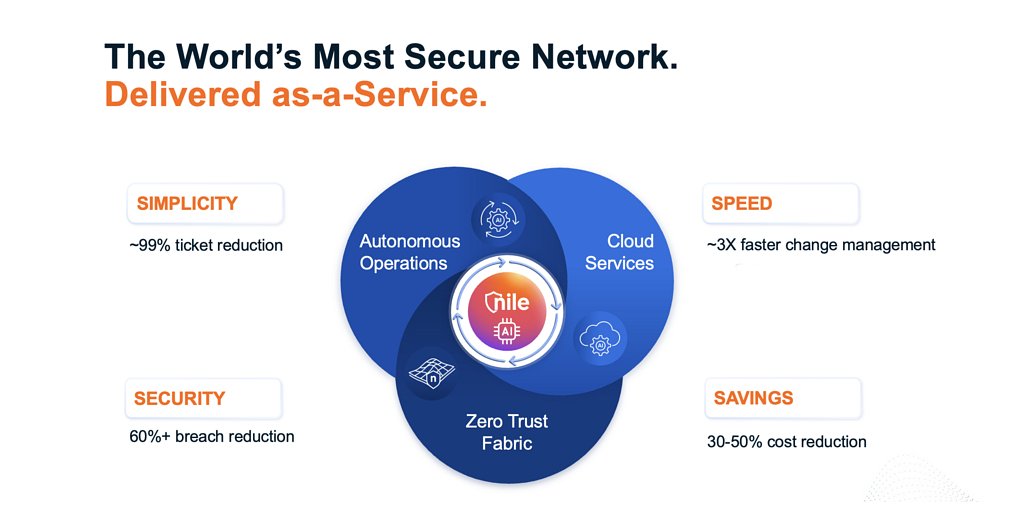
SAN JOSE, CA – March 19, 2026 – Nile, a provider in the growing Network-as-a-Service (NaaS) market, has announced a significant expansion of its security capabilities, aiming to bring "datacenter-class" protection to vulnerable branch and campus environments. The new features, built on a foundational zero-trust architecture, are designed to dramatically shrink the network attack surface and have reportedly helped customers contain security breaches by over 60%.
The announcement comes as organizations grapple with increasingly sophisticated cyber threats, many amplified by AI, and struggle with the operational complexity of legacy network infrastructure. By embedding advanced security directly into its cloud-delivered network service, Nile is positioning itself as a blueprint for the next generation of secure, simplified enterprise connectivity.
A New Blueprint for Zero-Trust at the Edge
At the core of Nile's announcement is a reinforcement of its 'secure-by-design' philosophy, a stark contrast to the bolt-on security solutions common in traditional networking. The company is rolling out an industry-first zero-trust fabric with embedded identity-based micro-segmentation. This architecture moves beyond the legacy "castle-and-moat" security model, which is increasingly ineffective as network perimeters dissolve with remote work and the proliferation of IoT devices.
Instead, Nile’s approach enforces a "default deny" policy, where no user or device can communicate without explicit authentication and authorization. This is a core tenet of the Zero-Trust Architecture (ZTA) framework promoted by standards bodies like the National Institute of Standards and Technology (NIST). With the global Zero Trust Network Access market projected to soar towards $73 billion by 2032, the industry is clearly shifting in this direction, and Nile aims to be at the forefront of this transformation for campus networks.
A key innovation is the new "Segment-of-1" architecture, which isolates every single device—from laptops and servers to IoT sensors and cameras—into its own secure micro-segment. This technique is designed to virtually eliminate the threat of lateral movement, a common tactic used by attackers to spread malware like ransomware across a network after an initial breach. By limiting the "blast radius" to a single device, a compromise is contained before it can become a catastrophe. The company asserts this design also thwarts entirely new attack vectors like the recently disclosed AirSnitch vulnerability.
"Leveraging Nile's Zero Trust based architecture has significantly strengthened our security posture," said Dean Lochkovic, COO at People Driven Technology. "Its built-in host isolation and micro-segmentation capabilities provide advanced lateral security to effectively reduce malware propagation and lower risk for business operations.”
Slashing Complexity and Costs for IT
Beyond the security enhancements, a central part of Nile’s value proposition is its promise to simplify network operations and deliver predictable cost savings. The company claims that organizations adopting its platform have seen a staggering 99%+ reduction in IT support tickets and a threefold increase in the speed of change management, boosting overall business velocity.
These operational gains stem from two key areas. First, the platform's autonomous operations engine automates routine tasks like configuration, patching, and monitoring, freeing IT teams from the daily grind of network maintenance. Second, the NaaS model shifts the financial burden from a large, upfront capital expenditure (CapEx) for hardware to a predictable, subscription-based operational expense (OpEx), with reported cost savings of 30-50%.
Nile also highlights the native integration of identity-based access control directly into the network fabric. This eliminates the need for complex and costly standalone Network Access Control (NAC) appliances, a move the company claims can reduce associated costs by 30-70%. By unifying wired and wireless networks, along with IT and IoT device management, under a single cloud-based service, the platform aims to deliver what many overburdened IT departments crave: simplicity.
"Nile brought together security and simplicity, seamlessly allowing us to scale our business with confidence while offering an excellent employee and guest experience," commented Ravi Saraogi, Co-Founder and President of Uniphore. He noted that the operational simplicity allows his IT team to "focus on strategic initiatives compared with any traditional approach.” Independent customer reviews on platforms like Gartner Peer Insights echo this sentiment, with users frequently praising the "hands-off" nature of the service and high recommendation rates.
Navigating a Crowded NaaS Landscape
Nile is making its push in an increasingly competitive market. The NaaS sector is populated by a mix of cloud-native giants like Cloudflare, Secure Access Service Edge (SASE) specialists such as Perimeter 81 and Cato Networks, and traditional networking stalwarts like Cisco and HPE Aruba, who are adapting their own offerings.
Nile's strategy for differentiation rests on its clean-slate, campus-focused approach. While many competitors focus on securing the Wide Area Network (WAN) or remote access, Nile has zeroed in on the complex and often-insecure Local Area Network (LAN) of campus and branch offices. Analysts note that Nile appears to be among the first to bake a comprehensive, easily managed zero-trust model directly into a campus NaaS solution from the ground up.
"Organizations are rethinking the traditional network as security and operations become inseparable," stated Vinu Thomas, President and COO at partner firm Driven. "Nile’s Secure Network-as-a-Service platform...gives customers a simpler and more secure way to operate modern infrastructure." This integrated vision is what Nile is betting on to capture market share.
This strategic focus is further emphasized by a company-wide brand refresh, including a new logo and website, all designed to underscore its security-forward identity. The company plans to showcase these changes and its new capabilities at the upcoming RSAC 2026 conference in San Francisco.
Preparing Networks for the AI Revolution
The timing of Nile's announcement aligns with the dual role AI is playing in cybersecurity. As noted by Brandon Butler, an IDC Senior Research Manager for Enterprise Networks, "AI is rapidly emerging as a powerful force multiplier for both cyber attackers and defenders." AI-powered attacks are growing in sophistication, while organizations are simultaneously looking to leverage AI for their own operations, often creating "shadow AI" workloads that strain and expose network vulnerabilities.
Nile's CEO, Pankaj Patel, sees the company's architecture as the answer to this new paradigm. “With AI becoming an enabler as well as disruptor, and organizations of all sizes struggling with lean IT, Nile’s Secure NaaS architecture with zero trust, autonomous operations and cloud service is becoming the de-facto standard for next-generation network deployments,” he said.
By providing a fully managed, autonomously operated, and inherently secure network foundation, the platform aims to give organizations the stability and visibility needed to safely adopt AI technologies. The promise of 100% visibility across all users, devices, and things is particularly crucial in an environment where unmanaged AI tools and IoT devices can appear on the network without IT's knowledge. This comprehensive approach to secure connectivity is positioned not just as a solution for today's problems, but as a necessary framework for the future of enterprise networking.
Topics & Related
Software & SaaS
AI & Machine Learning
Generative AI
Digital Transformation
Artificial Intelligence
AI & Software Platforms
Related Company Pulse