
- 2026 Launch: Mauritius formally launches its national AI strategy in April 2026.
- Ethical Framework: The FAIR Guidelines (Fairness, Accountability, Inclusiveness, Integrity, and Responsibility) guide AI adoption.
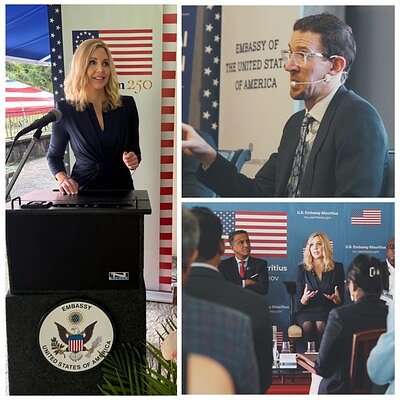
- Expert Collaboration: 25-year veteran Monica Zent leads discussions on AI enablement and LegalTech integration.
Experts agree that Mauritius's ethical, people-centered approach to AI, supported by international partnerships, sets a strong precedent for responsible technological development in emerging economies.
Mauritius Charts AI Future with U.S. Support & Legal Tech Expertise
PORT LOUIS, Mauritius – April 20, 2026 – As Mauritius formally launches an ambitious national strategy to establish itself as a regional, ethics-led hub for Artificial Intelligence, a pivotal series of events co-hosted by the U.S. Embassy has brought leading American expertise to the forefront of the island nation’s technological transformation. The collaboration highlights a growing trend of international partnership in shaping the future of responsible AI development.
At the center of these discussions was Monica Zent, a 25-year veteran of legal innovation and the Managing Director of the Law Innovation Agency. Zent was an invited expert speaker, addressing Mauritian government officials and global corporate executives on the critical steps required for successful AI enablement, from readiness and literacy to governance and the integration of LegalTech.
The events follow the recent launch of Mauritius's National Artificial Intelligence (AI) Strategy and its accompanying FAIR Guidelines—a framework standing for Fairness, Accountability, Inclusiveness and Integrity, and Responsibility. This national push signifies a major step in the country's journey toward an innovation-driven digital economy, explicitly grounding its technological ambitions in ethical and people-centered principles.
A National Blueprint for Ethical AI
Mauritius’s new strategy marks a significant evolution from its previous 2018 initiative, which drew criticism for an overemphasis on economic potential at the expense of societal and ethical considerations. The updated framework, developed with technical support from the United Nations Development Programme (UNDP), directly addresses these concerns. It provides a comprehensive roadmap for the transparent and safe adoption of AI across priority sectors, including manufacturing, healthcare, fintech, and public services.
Hosted by Craig Halbmaier, Chargé d'Affaires at the U.S. Embassy Mauritius, the discussions were designed to translate this national strategy into actionable plans for the organizations that will drive its success. "The U.S. Embassy Mauritius is proud to support responsible, inclusive digital transformation and to strengthen business ties between the United States and Mauritius," said CDA Halbmaier, underscoring the diplomatic significance of the collaboration.
The initiative is not merely about technological advancement but also about addressing pressing national challenges, such as declining productivity and an aging population. By fostering a robust AI ecosystem, the Mauritian government aims to enhance innovation and competitiveness, positioning the nation as a leader not just in the Indian Ocean region, but across the African continent.
The Legal Architects of the AI Revolution
The successful integration of AI is not solely a technical challenge; it is fundamentally a matter of governance, policy, and trust. This was the core message delivered by Monica Zent, whose extensive background includes founding the pioneering alternative legal services provider (ALSP) ZentLaw and creating patented AI legal technologies over a decade ago.
In a session titled, "Designing an AI Roadmap: Why AI Enablement is Critical for Today's Organization," Zent, alongside panelists including Dr. Avinash Ramtohul, Mauritius's Minister of Information Technology, Communication and Innovation, provided a blueprint for organizations to navigate their AI journey. The discussion focused on best practices for moving from initial assessment and readiness to full-scale deployment and governance.
Another panel, "The Key Role of the Legal Team in Leading AI Adoption," targeted Chief Legal Officers from global brands with a presence in the region. Zent and co-panelists, including Hon. Gavin Glover, the Attorney General of Mauritius, and Joel Lambert, Head of Legal at Mauritius Commercial Bank, offered strategies to empower legal departments to spearhead AI adoption. This positions the legal function not as a reactive compliance checkpoint, but as a proactive strategic leader in an organization's technological evolution.
"The AI transformation of public and private sector organizations broadly, as well as the legal sector specifically, is truly global in nature, and it is an honor to be a part of this important international dialogue," Zent stated. Her agency, the Law Innovation Agency, is a collective of seasoned operators focused on shaping policy at the intersection of AI, law, and technology for a global clientele.
Fostering Global Partnerships for Inclusive Innovation
The collaboration between Mauritius, the U.S. Embassy, and experts like Zent exemplifies a crucial shift towards a more inclusive, decentralized model of technological innovation. It challenges the notion that cutting-edge development is confined to traditional tech hubs like Silicon Valley.
Joanna Chen, Economic Officer at the U.S. Embassy, highlighted the shared spirit of innovation between the two nations. "As the State Department joins Freedom 250, an historic celebration of the 250th anniversary of the United States, we are focused on America's legacy of innovation, something we share in common with Mauritius," she remarked. Chen praised Zent for bringing her "decades of expertise, deep insights and best practices... to help corporate and institutional teams in this region unlock the benefits of this transformative technology."
The diverse array of panelists, which also included Jonathan Ane, CEO of the digital transformation firm Kulana, demonstrated a holistic, multi-stakeholder approach. Bringing together government ministers, top legal minds, financial sector leaders, and international AI strategists ensures that the nation's AI development is robust, commercially viable, and aligned with public interest.
From Strategy to Implementation: The Road Ahead
With a clear national strategy and a framework for ethical governance now in place, the focus in Mauritius shifts to implementation. The insights shared during the U.S. Embassy events provide a practical toolkit for the nation’s public and private sector leaders. For the legal community, the message was clear: legal teams must develop AI literacy and lead the charge in establishing governance policies that build trust and mitigate risk, thereby accelerating adoption.
The Mauritian government's commitment is further cemented by budgetary allocations for an AI Innovation Start-Up Programme and funds to equip ministries with AI tools. These initiatives, combined with the launch of a Regional AI Marketplace to connect solution providers with businesses and public institutions, are designed to create a self-sustaining ecosystem for innovation.
As Mauritius moves forward, its journey offers a compelling model for other nations. By prioritizing ethical governance from the outset and fostering strong international partnerships for knowledge exchange, the country is not just adopting AI—it is actively shaping a future where technology serves to create a more productive, inclusive, and equitable society. This collaborative approach, blending local ambition with global expertise, provides a powerful blueprint for navigating the complex but promising frontier of artificial intelligence.