
- 1,000,000 technician positions needed by 2028 to meet demand (TechForce Foundation)
- 5,000 open technician positions at Ford dealerships alone (Ford CEO Jim Farley)
- 12.8 years: average age of light vehicles on the road (S&P Global Mobility)
Experts agree that addressing the technician shortage requires a strategic shift from reactive hiring to a financially driven talent acquisition framework that aligns workforce needs with shop profitability.
New Playbook Tackles Auto Industry's Crippling Technician Shortage
OCEANSIDE, CA – January 21, 2026 – For millions of car owners, the check engine light has become a harbinger of a new kind of dread: a multi-week wait for a service appointment. Behind the overflowing appointment books and frustrated customers lies a deepening crisis in the automotive industry—a severe and worsening shortage of skilled technicians. Now, a new book is reframing the issue, arguing that the solution lies not just in HR departments but at the heart of a shop's financial strategy.
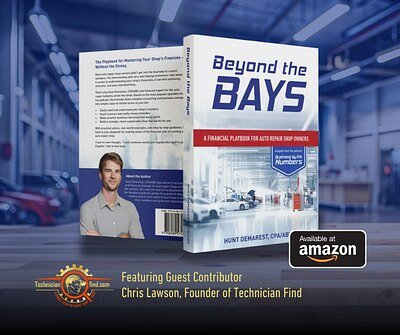
Christopher T. Lawson, an automotive hiring expert and founder of Technician Find, is featured in 'Beyond the Bays: A Financial Playbook for Auto Repair Shop Owners,' the new book by CPA Hunt Demarest. Lawson's contribution in Chapter 5 details a proactive hiring framework designed to help independent shop owners escape the cycle of empty bays and lost revenue, connecting the dots between talent acquisition and the bottom line.
An Industry Under Pressure
The numbers paint a stark picture of an industry struggling to keep up. According to the TechForce Foundation, the automotive sector will need to fill nearly one million new technician positions by 2028 to meet demand. This staggering figure is driven by a wave of retiring baby boomers and a high attrition rate that sees half of all entry-level technicians leave the trade within their first two years, as reported by the Auto Care Association.
The problem is not confined to small independent shops. In a November 2025 call with investors, Ford CEO Jim Farley highlighted the scale of the issue, noting his company's dealerships had 5,000 open technician positions—what he described as "a bay with a lift and tools and no one to work in it." This industry-wide deficit has pushed average service wait times to two weeks or more in many areas.
This staffing crisis collides with another powerful trend: the aging of the American vehicle fleet. Data from S&P Global Mobility shows the average age of light vehicles on the road has climbed to 12.8 years, an all-time high. Older cars require more frequent and complex repairs, yet the workforce available to service them is shrinking. For independent shop owners, the financial consequences are direct and unforgiving. An empty service bay is a silent, non-revenue-generating liability, and the pressure to fill it often leads to rushed, ineffective hiring decisions.
"A shop's financials can't outperform its staffing," said Lawson in the press release announcing his feature. "The book gives owners the financial playbook, and my chapter spotlight gives them the hiring framework that fills bays."
Shifting from HR to a Financial Imperative
The inclusion of a hiring strategy in a book titled 'A Financial Playbook' is a deliberate statement. The book's author, Hunt Demarest, is a CPA accredited in Business Valuation and a partner at a firm that exclusively serves auto repair shop owners. His popular podcast, 'Business By The Numbers,' which forms the basis for the book, consistently translates complex business concepts into actionable financial guidance.
By dedicating a chapter to Lawson's methodology, Demarest signals a growing recognition within the industry: talent acquisition is no longer a peripheral HR function but a core driver of financial performance. The decision reflects the understanding that a shop's ability to generate revenue, manage cash flow, and achieve profitability is fundamentally limited by its ability to attract and retain skilled labor. This perspective moves the conversation beyond simply filling open positions and toward building a team that can maximize a shop's operational capacity and financial health.
The Front-End Hiring Framework
Lawson's approach, detailed in the book, directly confronts the reactive 'post-and-pray' hiring tactics that have left many shop owners frustrated and understaffed. Instead, he advocates for a 'front-end' framework that requires significant, intentional work before a job ad is ever written.
The core principle is to meticulously define the ideal outcome for the shop and the specific attributes of the technician who can help achieve it. This involves a deep analysis of the shop's culture, workflow, goals, and the specific skills needed to service its primary customer base.
"If you don't spend time on the front end, really thinking about what your ideal scene is, and who the ideal fit is, you can't write a decent ad or attract the right person because you're not going to say the things that you need to say in order to attract that person," Lawson explains in the book spotlight.
This strategic positioning allows a shop to craft a compelling narrative that goes beyond a simple list of job duties. The resulting advertisement speaks directly to the aspirations and motivations of top-tier 'A/B-level' technicians, showcasing the shop as a destination for career growth, fair compensation, and a positive work environment. Since its founding in 2018, Lawson's firm, Technician Find, has utilized this 'positioning-first' strategy to help over 200 independent shops build and maintain a fully staffed team of quality technicians.
A Broader Push for Talent
While strategic frameworks like Lawson's offer a new blueprint for individual shops, they are part of a larger, industry-wide effort to address the workforce pipeline. Organizations across the sector are working to combat outdated perceptions of the trade and highlight the high-tech, intellectually demanding nature of modern automotive repair. Initiatives promoting vocational training, creating robust apprenticeship programs, and offering scholarships for tools and tuition are gaining momentum.
Encouragingly, recent data from the TechForce Foundation shows these efforts may be starting to bear fruit, marking the first increase in post-secondary transportation program graduates in over a decade. For struggling shop owners, this glimmer of hope, combined with new, financially-driven hiring strategies, provides a much-needed roadmap for navigating the crisis and turning empty bays back into engines of profitability.