
- $300 million: Cost of Telconet's CSN-1 subsea cable project.
- $250 million: Total investment in C3ntro's Tikva network.
- 70%: Projected share of AI-related workloads in data center demand by 2030.
Experts view CSN-2 as a strategic investment in North America's digital future, essential for supporting AI-driven data demands and enhancing regional connectivity.
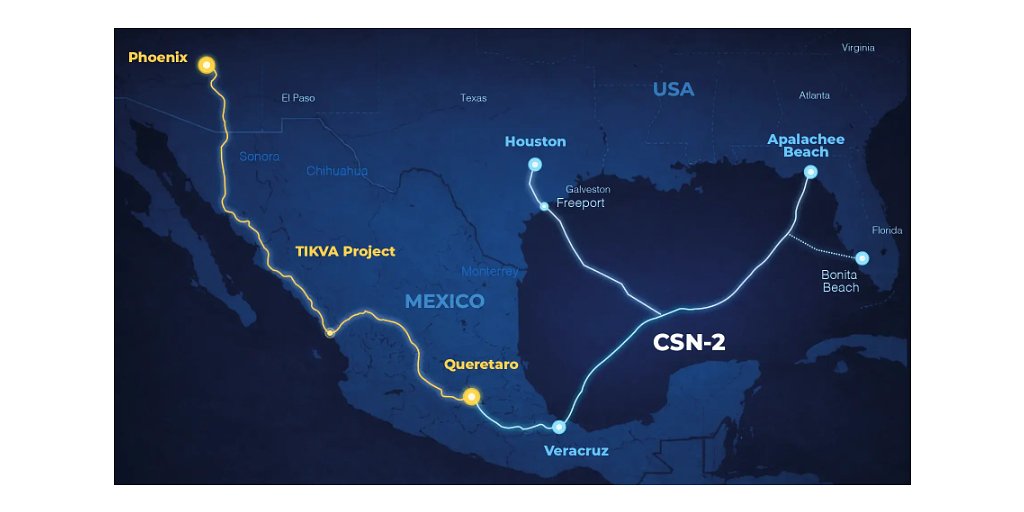
New 'AI Backbone' to Link US and Mexico Across the Gulf of Mexico
MEXICO CITY – May 14, 2026 – In a significant move to bolster North America's digital infrastructure, C3ntro Telecom and Telconet today announced a partnership to construct CSN-2, a next-generation subsea and terrestrial fiber optic network. Dubbed a new “AI Backbone,” the system is purpose-built to connect the burgeoning data center hubs of Mexico and the United States, directly addressing the monumental data demands of artificial intelligence and hyperscale cloud computing.
This ambitious project creates a new, high-capacity digital corridor across the Gulf of Mexico, combining a new submarine cable with extensive terrestrial routes. The partnership leverages the unique strengths of Mexico-based C3ntro, a specialist in terrestrial fiber for hyperscalers, and Ecuador's Telconet, a leader in regional digital infrastructure with proven subsea cable expertise. Together, they aim to deliver a unified network architecture focused on diversity, scalability, and the low-latency performance critical for the AI era.
The AI Data Deluge and Mexico's Rise
The development of CSN-2 is a direct response to a seismic shift in global data consumption. Industry analysts project that AI-related workloads could constitute up to 70% of all data center demand by 2030, with generative AI applications driving a tenfold annual increase in data traffic. This “deluge of AI data” requires a fundamental rethinking of the underlying network infrastructure, favoring systems that can handle massive, rapid data transfers with minimal delay.
Mexico, and the city of Querétaro in particular, has emerged as a critical nexus in this new landscape. Driven by the nearshoring trend and its strategic proximity to the U.S., the country's data center market is forecast to more than double from $1.06 billion in 2024 to $2.27 billion by 2030. Querétaro alone accounts for over half of Mexico’s current data center capacity, attracting billions in investments from hyperscale giants like Microsoft, Amazon Web Services, and Google Cloud. CSN-2 is designed to directly serve this explosive growth, providing a vital artery to connect Mexico's expanding digital ecosystem with key U.S. hubs.
“The success of Tikva demonstrated the growing demand for new infrastructure routes aligned with AI and hyperscale growth,” said Simón Masri, President of C3ntro Telecom. “By combining CSN-2 with Tikva and leveraging Telconet's proven subsea track record, we are creating a network that directly connects the newest AI data center markets in North America with the diversity, resiliency, and scalability required for the next generation of digital infrastructure.”
Architecting a Digital Superhighway
CSN-2’s innovative design lies in its fully integrated subsea and terrestrial architecture. The submarine segment will create a new diverse route across the Gulf of Mexico, linking Veracruz, Mexico, to Apalachee Beach, Florida. The system includes a strategic branch to Galveston, Texas, providing a direct connection to the Houston data center market. A potential future branch to Bonita Beach, Florida, would enable interconnection with Telconet’s CSN-1 system, further enhancing regional resiliency.
Crucially, the subsea cable will be seamlessly integrated with new and existing terrestrial fiber. A new segment will be built from Querétaro to the landing station in Veracruz. This path will fully integrate with C3ntro’s Tikva network, a 2,500-kilometer AI-ready terrestrial system currently under construction that connects Querétaro to Phoenix, Arizona. The result is a continuous, high-capacity corridor stretching from the U.S. Southwest, through the heart of Mexico’s data center alley, and across the Gulf to major interconnection points in Texas and the U.S. Southeast, including hubs in Georgia and Virginia.
Being “purpose-built for AI” means the network is engineered to support transmission speeds of 400G and 800G, providing the massive throughput required to move petabyte-scale AI training models. The direct, low-latency routes are designed to minimize the time it takes for data to travel between compute clusters and storage, a critical factor for maximizing the efficiency of expensive GPU resources.
A Strategic Alliance Reshaping the Gulf
The partnership between C3ntro and Telconet represents a strategic synergy of regional specialists aiming to disrupt the telecommunications landscape. While the US-Mexico corridor is served by existing cables, CSN-2 distinguishes itself by being conceived from the ground up as a unified system rather than a collection of standalone deployments. This approach promises greater efficiency, reliability, and end-to-end performance.
This project builds upon the momentum of two major infrastructure initiatives by the partner companies. Telconet is in the final stages of completing its CSN-1 subsea cable, a $300 million system connecting Ecuador, Panama, Colombia, and Florida. C3ntro, meanwhile, is well underway with its $250 million Tikva network, for which it has already secured $70 million in pioneering project financing.
Tomislav Topic, CEO of Telconet, highlighted the long-term vision. “CSN-2 reflects our long-term vision of building scalable, high-capacity infrastructure across the Americas. Following the momentum of CSN-1, partnering with C3ntro allows us to combine subsea and terrestrial networks into a single platform connecting one of the fastest-growing digital infrastructure ecosystems in the world.”
This collaborative model allows the two firms to challenge larger incumbents by offering a highly specialized and resilient alternative across the Gulf, a region where diverse routing options are increasingly valuable for mitigating risks from natural disasters or other disruptions.
With both the Tikva and CSN-1 projects on track for completion by late 2026, the CSN-2 announcement signals that the partners are not waiting to plan their next phase of expansion. The project represents a forward-looking investment designed to pre-emptively build the capacity and performance that the next wave of technological innovation will demand. By architecting a digital backbone for the AI era, C3ntro and Telconet are making a significant bet on the continued integration and growth of the North American digital economy.