
- 180 TOPS: The M2 Pro offers 180 Trillions of Operations Per Second of computing power.
- 9600MHz: Supports memory speeds up to 9600MHz.
- 60%: AI-enabled computers could account for nearly 60% of all new PC shipments by 2027.
Experts would likely conclude that the MINISFORUM M2 Pro represents a significant advancement in privacy-focused AI computing, offering a compelling solution for users concerned about data security and the high costs of cloud-based AI services.
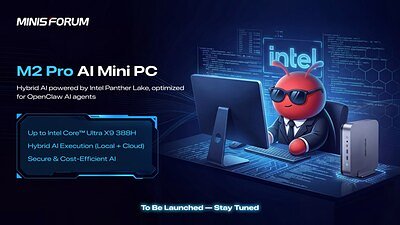
MINISFORUM M2 Pro: A Privacy-First AI Powerhouse for Your Desk
HONG KONG – March 12, 2026 – In a significant move signaling the next phase of personal computing, MINISFORUM today announced its upcoming M2 Pro AI Mini PC. The compact powerhouse, positioned as the company's most powerful AI-focused device, promises to tackle two of the biggest hurdles in the widespread adoption of artificial intelligence: data privacy and spiraling operational costs.
Powered by Intel's cutting-edge Panther Lake platform, the M2 Pro is engineered to run complex AI workloads locally, shifting the balance of power from centralized cloud servers to the user's desktop. The company announced the device is optimized to run AI agents like OpenClaw in a hybrid mode, a strategy that keeps sensitive data secure on-device while intelligently tapping into the cloud only when necessary. This announcement places MINISFORUM at the forefront of the burgeoning AI PC market, offering a tangible solution for users increasingly wary of how their data is handled and the unpredictable expenses tied to cloud-based AI services.
The Engine of Next-Generation AI
At the heart of the M2 Pro lies Intel's formidable new Panther Lake architecture, specifically processors up to the Core™ Ultra X9 388H. This platform represents a monumental leap in chip design, being the first built on Intel's advanced 18A process node. This technology allows for unprecedented transistor density and power efficiency, forming the bedrock of the M2 Pro's capabilities.
The press release boasts some impressive figures: a total of 180 TOPS (Trillions of Operations Per Second) of computing power and support for memory speeds up to a blistering 9600MHz. This raw power is not derived from the CPU alone but from a balanced "XPU" design that integrates three distinct processing units for AI tasks.
This includes the fifth-generation Neural Processing Unit (NPU 5), a dedicated silicon engine designed for sustained, low-power AI workloads, contributing around 50 TOPS. The integrated Xe3 GPU provides the heavy lifting with up to 120 TOPS, ideal for parallel processing tasks common in AI. Finally, the CPU itself adds its own AI acceleration capabilities. This trifecta allows the M2 Pro to efficiently distribute AI tasks to the most suitable processor, whether it's summarizing a document in the background or performing complex data analysis.
A Hybrid Model for Privacy and Practicality
The true innovation highlighted by MINISFORUM is not just the hardware but its application in a hybrid AI model. As AI tools become more integrated into daily workflows, concerns over data privacy have grown in tandem. Sending confidential business documents, personal emails, or sensitive financial data to a third-party cloud for processing creates significant security vulnerabilities and compliance challenges.
The M2 Pro's "local-first" approach directly addresses this. By performing the bulk of its reasoning and processing on the device itself, it ensures that a user's most sensitive information never has to leave the physical machine. According to MINISFORUM, the system is designed for "maximized privacy protection," with cloud AI being used only for non-sensitive tasks and with explicit user approval.
This architecture is particularly relevant for the M2 Pro's intended use as a "24/7 AI work assistant" optimized for an agent named OpenClaw. While details on OpenClaw remain scarce—suggesting it may be a proprietary or newly developed solution—the concept is clear: an always-on assistant that can automate information and content workflows without compromising confidentiality. This hybrid execution preserves the full functionality of an AI agent, allowing it to interact with external systems while safeguarding the user's core data locally.
Taming the Runaway Costs of Cloud AI
Beyond privacy, the M2 Pro presents a compelling economic argument for businesses and power users. Most sophisticated cloud AI services, especially large language models, operate on a pay-per-use model, often measured in "tokens"—small pieces of text that are processed. For frequent users, these token costs can quickly accumulate into substantial and unpredictable operational expenses.
By handling a significant portion of AI workloads locally, the M2 Pro dramatically reduces the need to make costly API calls to the cloud. Tasks like document understanding, summarization, and data retrieval from local files can be processed on-device at no incremental cost beyond the initial hardware investment. This strategy not only lowers the total cost of ownership but also makes AI spending more predictable, transforming it from a variable operational expense into a manageable capital expenditure.
For small businesses, startups, and even large enterprises looking to deploy AI at scale, this economic shift is crucial. It democratizes access to powerful AI tools, enabling scalable deployment without the fear of uncontrolled cloud bills, making the M2 Pro a potentially strategic investment for boosting productivity efficiently.
Navigating the Competitive AI PC Landscape
MINISFORUM is launching the M2 Pro into a market that is rapidly heating up. The concept of the "AI PC" is the industry's new frontier, with market analysts projecting that AI-enabled computers could account for nearly 60% of all new PC shipments by 2027. Major players like ASUS, HP, Dell, and Lenovo are all integrating Intel's new AI-ready Core Ultra processors into their latest lineups.
However, MINISFORUM, a specialist in compact computing solutions, is differentiating itself by not just including the hardware but by building a clear narrative around its benefits. By explicitly focusing on the twin pillars of privacy and cost-efficiency, the company is targeting a growing segment of savvy users and businesses who want more than just a new chip; they want more control. As the digital world continues to grapple with the implications of pervasive AI, devices like the M2 Pro represent a critical step toward a more secure, efficient, and user-centric computing future.