
- 82% of sub-samples returned gold values above detection limits, confirming widespread mineralization.
- High-grade bands up to 6.77 g/t Au identified within broader mineralized zones.
- 1.7-kilometre-long mineralized corridor established through prior surface work and drilling.
Experts would likely conclude that the high-resolution micro-sampling has significantly de-risked the Mercator Gold Project by confirming continuous, high-grade gold mineralization, enhancing its economic potential.
Micro-Sampling Unlocks Macro Potential at Québec's Mercator Gold Project
VANCOUVER, BC – June 08, 2026 – In the world of mineral exploration, success is often measured in metres and grams per tonne. But sometimes, the most significant breakthroughs are measured in centimetres. Canadian GoldCamps Corp. (CSE: CAMP) has just demonstrated this principle with new data from its flagship Mercator Gold Project in Québec, where a shift to a finer analytical scale is revealing a much richer and more consistent picture of gold mineralization than previously understood.
In a news release that has caught the attention of geologists and investors alike, the Vancouver-based junior explorer announced results from a high-resolution re-sampling program. By analyzing drill core at 25-centimetre intervals—a significant increase in precision from the previous 0.5 to 1.5-metre samples—the company has confirmed not only the continuity of its gold system but also the presence of significantly higher-grade bands within the broader mineralized zones. This technological pivot from a wide-angle lens to a macro view is a classic example of how modern exploration techniques are de-risking complex assets and unlocking value that was previously obscured.
A Clearer Picture Through a Finer Lens
The core of the announcement revolves around 111 new sub-samples taken from historically drilled holes. The results are compelling: approximately 82% of these samples returned gold values above detection limits. This isn't just a statistical victory; it's a powerful confirmation of the widespread nature of the gold system. For investors, it transforms the project from a series of promising but disconnected hits into a more cohesive and predictable mineralized body.
"The 25 cm re-sampling program has provided a more detailed view of gold distribution within the Mercator system," commented George Yordanov, President & CEO of Canadian GoldCamps. He emphasized that the data supports "the continuity of mineralization across the intervals tested, demonstrating the widespread distribution and continuity of gold mineralization within the horizons tested."
This new, granular detail is particularly crucial for the type of deposit found at Mercator. The project is hosted in silicate-sulphide banded iron formations (BIFs), a geological environment notorious for its variability. Gold in these systems can be distributed unevenly, with high-grade 'nuggets' or bands interspersed with lower-grade material. The previous, wider sampling intervals could average out these high-grade peaks, effectively masking the deposit's true potential. By narrowing the focus to 25 cm, Canadian GoldCamps has successfully isolated these richer layers. For instance, in drill hole MCT-22-08, the original composite grade was a respectable 2.62 g/t Au over 17.80 metres. The new analysis within that same interval uncovered individual bands grading as high as 3.40 g/t Au. Even more impressively, hole MCT-22-11 yielded sub-samples up to 6.77 g/t Au, confirming what the company calls the "sustained high-grade nature" of the intersection.
The Geological Significance of a Frontier District
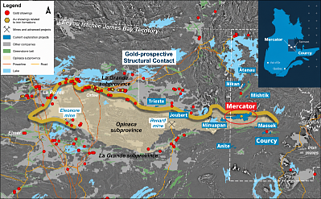
The Mercator Project is situated in the Caniapiscau district of northeastern Québec, a remote but highly prospective region within the Canadian Shield's Churchill Province. The geology is complex, defined by rocks that have been subjected to intense heat and pressure, metamorphosing them into what are known as granulite facies. While this makes exploration challenging, it is also the very process that can concentrate minerals like gold into economically viable deposits.
Mercator's gold is found within these BIFs, which are essentially ancient, iron-rich sedimentary rocks. Petrographic studies have shown that gold occurs in several distinct micro-environments, often associated with arsenic-bearing minerals like arsenopyrite and löllingite. This geological fingerprint is critical, as elevated arsenic now serves as a reliable pathfinder, guiding geologists toward the most promising zones. The company is awaiting further multi-element data that will help them geochemically "fingerprint" the high-grade bands, further refining their targeting model for the 2026 field season.
The project itself, comprising 113 claims over 58.6 square kilometres, was optioned from Stelmine Canada Ltée, which had established a 1.7-kilometre-long mineralized corridor through surface work and shallow drilling between 2020 and 2023. Canadian GoldCamps is now systematically testing the down-dip continuity of this corridor, and these latest results provide a major boost to that effort.
An Investment De-Risked
For a junior exploration company like Canadian GoldCamps, whose market capitalization reflects the high-risk, high-reward nature of its business, every piece of data that reduces uncertainty is invaluable. These high-resolution results function as a significant de-risking event. They not only confirm the presence of gold but provide a much clearer understanding of its distribution, which is fundamental for any future economic assessment.
"What this data does is add a layer of predictability," noted one industry analyst. "When you can demonstrate continuity and isolate high-grade domains within a bulk-tonnage target, you start to build a compelling case for economic viability. The market sees that. It moves a project from a geological concept to a potential asset."
Indeed, the grades reported are robust. While some high-grade vein systems in Québec's famous Abitibi Greenstone Belt may boast higher peak values, the intercepts at Mercator, such as 2.62 g/t Au over a substantial 17.80 metres, are significant for a BIF-hosted system, which often has the advantage of scale and mineability. The discovery of new priority targets in Zones Unid-1, Unid-2, and Unid-3, where 19 of 30 new samples returned over 1.0 g/t Au, further expands the project's scope and provides immediate targets for follow-up work.
The company's rigorous quality assurance and control program, which included inserting certified reference materials and blanks, adds another layer of confidence. The strong reproducibility of high-grade samples, validated by an independent lab, confirms the data's reliability. With this stronger geological model in hand, Canadian GoldCamps is better positioned to attract further investment and strategically plan the next phase of drilling, moving the Mercator Project systematically down the path toward a potential resource estimate and, ultimately, a mine.