
- 85 seconds: The time it takes for pickle juice to stop a muscle cramp, according to research.
- First formal partnership: McDonald's New Zealand and Auckland FC's collaboration is the first publicized alliance of its kind, repurposing pickle juice for professional sports.
- Expanded reach: The trial extends beyond Auckland FC to amateur sports teams across New Zealand.
Experts in sports science and sustainability agree that this partnership is a groundbreaking example of how food by-products can be repurposed to address real-world athletic challenges, supported by evidence of pickle juice's rapid cramp-relief effects.
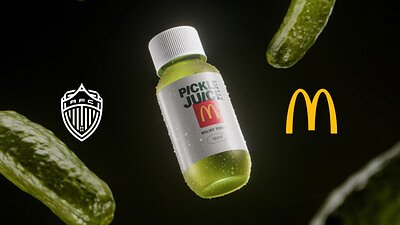
McDonald's Sideline Secret: Pickle Juice Tackles Pro Football Cramps
AUCKLAND, New Zealand – May 20, 2026 – On the sidelines of New Zealand's professional football pitches, a surprising new performance aid is making an appearance, and its source is even more unexpected. Auckland FC, a top club currently deep in A-League play-offs, has partnered with McDonald's New Zealand to trial a novel remedy for muscle cramps: repurposed pickle juice sourced directly from the fast-food giant's kitchens.
In what is being hailed as a potential global first for professional sports, the initiative sees the leftover brine from McDonald's pickle jars collected, bottled, and delivered to the team's medical staff. This unlikely collaboration turns a common kitchen by-product into a tool designed to keep elite athletes on the field during the most grueling moments of competition, particularly in high-stakes matches that stretch into extra time and penalty shootouts.
The Science Behind the Brine
While the sight of a professional athlete sipping on pickle juice might seem strange, the practice is grounded in a growing body of sports science research. For years, athletes have anecdotally sworn by the salty liquid's ability to rapidly alleviate debilitating muscle cramps. Initially, its high sodium and potassium content was thought to be the reason, replenishing electrolytes lost through sweat. However, recent studies suggest a more complex and much faster mechanism is at play.
Scientists now believe the primary benefit comes from the acetic acid in the vinegar-based brine. When the juice hits receptors in the mouth and throat, it is thought to trigger a neural reflex. This signal travels to the central nervous system and effectively short-circuits the malfunctioning nerve signals that cause a muscle to cramp. Research has shown that this reflex can stop a cramp in as little as 85 seconds—far too quickly for the electrolytes to have been absorbed into the bloodstream.
This scientific backing is what convinced Auckland FC's medical team to embrace the unconventional partnership. "Cramps can come on quickly and stop a player in their tracks," said Bede Christey, Lead Physiotherapist at Auckland FC. "Pickle juice is an option for us when cramps strike, and having it readily available on the sideline just makes sense."
An Unlikely Alliance for Sustainability
The collaboration is more than just a sports science experiment; it represents an innovative step in corporate sustainability and waste reduction. The idea originated not in a lab, but from keen observation by the McDonald's communications team.
"We kept spotting players reaching for pickle juice during games and thought, why not lean into it? At the same time, we've got plenty of pickle juice in our kitchens," explained Simon Kenny, Head of Communications at McDonald's New Zealand. "This felt like a simple way to connect the two."
This simple connection carries significant weight. While individual athletes have used pickle juice for years, this appears to be the first formal, publicized partnership where a major fast-food chain has systematized the repurposing of a specific food by-product for use by a professional sports team. By diverting a liquid that would otherwise be discarded, the program embodies the principles of a circular economy, finding new value in a waste stream.
While the exact volume of pickle juice being repurposed has not been disclosed, the initiative serves as a powerful case study. It challenges other large-scale food service operators to think creatively about their own by-products, opening the door for similar symbiotic relationships across different industries. It’s a testament to the idea that sustainable solutions can be found in the most unexpected places.
From Elite Pitch to Community Sport
The benefits of this "pickle power" play are not being confined to the professional ranks. Recognizing the grassroots nature of sport in New Zealand, McDonald's has extended the trial beyond Auckland FC. A limited number of amateur sports teams across the country are also receiving supplies of the repurposed pickle juice, allowing weekend warriors and community players to access the same remedy as their professional heroes.
This expansion broadens the initiative's impact, reinforcing the brand's long-standing community engagement efforts and positioning it as a supporter of sport at all levels. It’s a move that recognizes that a game-ending cramp is just as frustrating for an amateur player as it is for a professional footballer.
"If our leftover pickle juice helps keep players moving, whether they're playing professionally or with their mates on the weekend, then we're all for it," Kenny added, underscoring the initiative's inclusive spirit.
A Savvy Play for Brand and Performance
Strategically, the partnership is a win-win. For Auckland FC, it provides a cost-effective, readily available tool that could offer a crucial competitive edge in a league where games are often decided in the final, physically demanding minutes. For McDonald's, the marketing and brand-building implications are profound.
The initiative allows the company to generate positive headlines that have nothing to do with burgers and fries. It reframes the brand as innovative, environmentally conscious, and deeply integrated into the local community and its sporting culture. It's a savvy public relations move that generates authentic goodwill by providing a genuine, science-backed solution to a real-world problem for athletes.
The future scalability of the program remains a key question. If the trial proves successful, it could provide a model for other McDonald's markets globally, or inspire other food companies to explore similar partnerships. However, scaling up would require overcoming logistical hurdles related to hygiene, collection, quality control, and distribution to ensure the product remains safe for consumption by athletes.
For now, what began as a quirky observation has evolved into a pioneering partnership. As Auckland FC players reach for their small bottles of pickle juice during intense matches, they represent a unique fusion of elite sport, corporate innovation, and practical sustainability that could change the way we think about the relationship between the drive-thru and the sideline.