
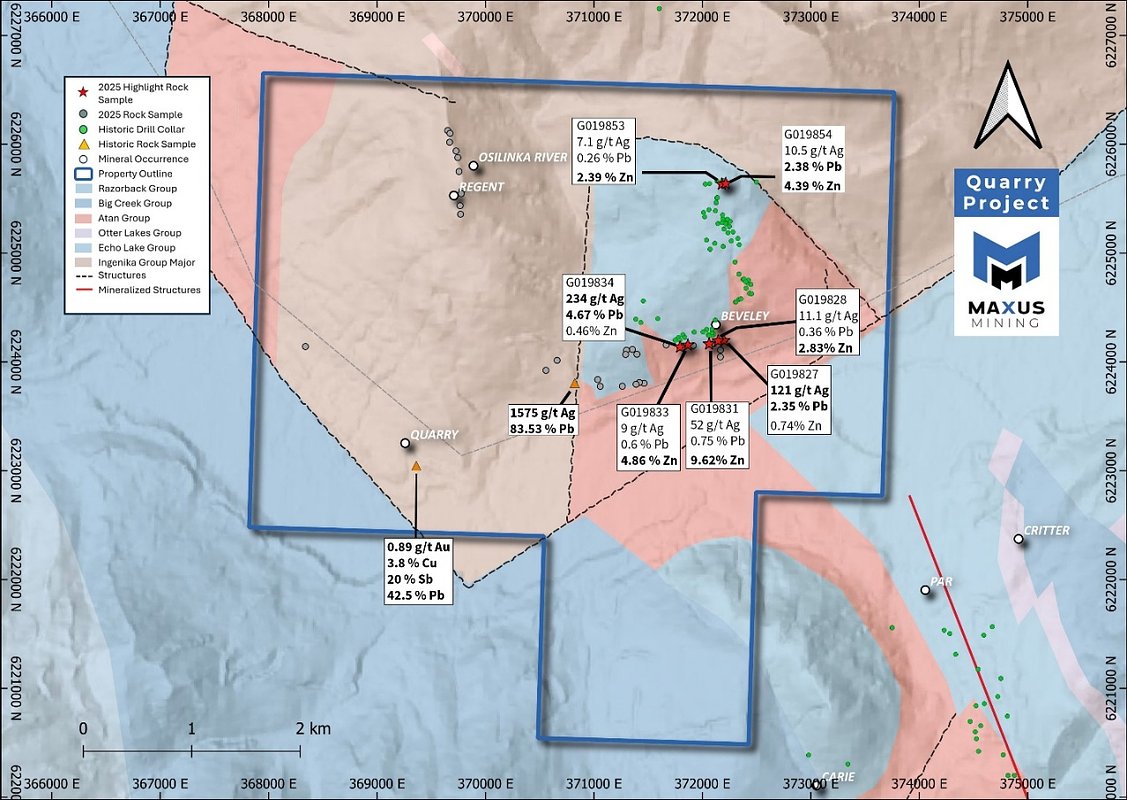
- 234 g/t silver, 4.67% lead, and 0.46% zinc in sample G019834
- 9.62% zinc, 52.1 g/t silver, and 0.75% lead in sample G019831
- 3 km mineralized corridor identified at the Quarry property
Experts would likely conclude that Maxus Mining's high-grade silver, lead, and zinc findings at the Quarry property represent a significant discovery with strong exploration potential, reinforcing the project's role in North America's critical minerals strategy.
Maxus Mining Unearths High-Grade Silver, Zinc at BC Quarry Project
VANCOUVER, BC – March 16, 2026 – Maxus Mining Inc. has unveiled significant high-grade polymetallic findings at its Quarry Antimony Property in British Columbia, signaling a potentially valuable discovery in a region pivotal to North America's critical minerals strategy. The company's latest assay results from a 2025 field program confirm the presence of substantial silver, lead, and zinc mineralization, reinforcing the project's exploration upside and its role within Maxus's growing portfolio.
The announcement sent a strong signal to the market, highlighting the untapped potential within Canada's own borders for metals deemed essential for modern technology, green energy, and national defense.
A Discovery of Rich Grades
The results from the reconnaissance program, conducted in the Omineca Mining District, validated the historical promise of the property with tangible, high-grade numbers. Outcrop and grab samples returned impressive values, with one sample, G019834, yielding 234 grams per tonne (g/t) silver, 4.67% lead, and 0.46% zinc. Another standout, sample G019831, returned 9.62% zinc, 52.1 g/t silver, and 0.75% lead.
To put these figures in perspective, typical economic thresholds for zinc and lead mining often fall in the 1-4% range, making the grades at Quarry exceptionally high for early-stage surface sampling. The silver grades are also well above the levels often considered viable for economic extraction. While the recent samples showed more modest antimony values, the associated polymetallic system is what excites geologists and investors alike.
“These results reinforce the strong polymetallic potential at Quarry and highlight the presence of a structurally controlled Ag–Pb–Zn ± Sb system across the Property,” said Scott Walters, Chief Executive Officer of Maxus Mining, in the company’s official release. “The grades returned from several samples, combined with the scale of the mineralized corridor identified in historical and recent work, suggest the system has significant exploration upside.”
The findings point to a mineralized corridor extending over three kilometers, suggesting a large-scale system that warrants more intensive exploration.
From Historic Data to Modern Discovery
Maxus Mining's success at the Quarry property is a testament to a modern exploration strategy that skillfully blends historical data with new technology. Before its field teams ever set foot on the ground, the company's geologists compiled and digitized decades of previous work, including tantalizing but unverified historical reports.
The property's history includes grab samples from 1954 that reportedly averaged an astonishing 83.5% lead and 1,576 g/t silver, and 1990s samples that assayed up to 20% antimony and 42.5% lead. Furthermore, a 1978 report outlined a historical resource estimate for the "Bullseye Zone," though the company is careful to note this estimate is not compliant with current NI 43-101 standards and cannot be treated as a modern mineral resource.
Instead of relying on these old figures, Maxus is using them as a guide. The company is now integrating the 2025 sample results into a centralized 3D geological model. This digital framework will help its technical team visualize the subsurface geology, interpret the structural controls on mineralization, and ultimately design a targeted and cost-effective drilling program.
“Our technical team will continue advancing the Project through detailed modeling and data integration, leading into developing drill plans and spacing studies designed to expand on these known mineralized trends, in particular the Bullseye Zone,” Walters added. This methodical approach is aimed at upgrading and potentially expanding upon the historical findings to define a modern, compliant mineral resource.
The Strategic Imperative for Critical Metals
The findings at the Quarry project arrive at a critical moment in global geopolitics and supply chain dynamics. Antimony, a key component of the property's polymetallic signature, is designated a "critical mineral" by both Canada and the United States. Its unique properties make it irreplaceable in flame retardants, high-tech semiconductors, and crucial defense applications, from armor-piercing munitions to night-vision equipment.
Currently, the global supply of antimony is overwhelmingly controlled by China and Russia, creating a significant vulnerability for North American industries and defense sectors. The push to develop secure, domestic sources of antimony and other critical minerals is a cornerstone of national strategy. Projects like Quarry represent a tangible step toward achieving that goal.
Silver, another key metal found at the property, is also experiencing soaring demand. Its role in solar panels, electric vehicles, and 5G technology has transformed it from a precious metal to an indispensable industrial commodity. With the global silver market facing a persistent supply deficit, high-grade discoveries in stable jurisdictions like British Columbia are of immense interest.
Building a British Columbia Powerhouse
The encouraging results from the Quarry property are not an isolated event for Maxus Mining. They represent a key piece of a much larger, deliberate strategy to build a diversified portfolio of critical and strategic mineral projects across British Columbia. The company has methodically assembled a collection of properties targeting some of the most sought-after commodities in today's market.
Maxus's portfolio includes three distinct antimony projects, with its flagship Alturas Antimony Project showing historical grades of over 57% antimony. It also holds the Lotto Tungsten Project, where historical samples assayed nearly 11% WO₃, and the Penny Copper Project, located near the legendary Sullivan Mine.
This multi-pronged approach diversifies risk and positions Maxus to capitalize on various market trends. By focusing exclusively on British Columbia, the company leverages its regional expertise and operates within one of the world's most established and predictable mining jurisdictions. The latest success at Quarry serves to validate this focused strategy, demonstrating the company's ability to identify and advance projects with significant potential, thereby contributing to the future of Canada's domestic critical mineral supply chain.
Topics & Related
Sustainability & Climate
Geopolitical Risk
Solar Panels
Revenue
Related Company Pulse