
- 4,200 marine solar modules installed at the Soneva Secret resort, generating up to 90% of its electricity.
- 2,000 tons of carbon emissions reduced annually, saving nearly one million liters of diesel fuel each year.
- The Maldives spends over 16% of its GDP on diesel imports, a burden the project aims to alleviate.
Experts view this floating solar project as a scalable and sustainable solution for island nations, offering a blueprint for energy independence and significant reductions in carbon emissions and fuel costs.
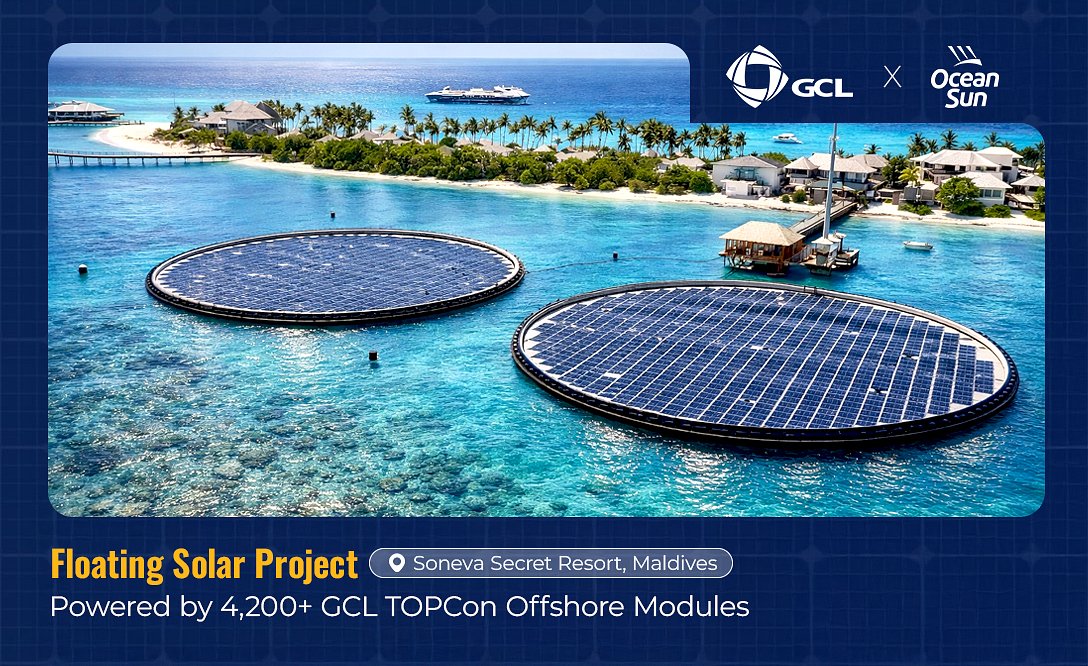
Maldives Floats Solar Dream to Cut Diesel Dependence
MALE, Maldives – January 19, 2026 – In the turquoise waters of the Maldives, a new vision for sustainable island life is taking shape. GCL System Integration (GCL SI), in partnership with Ocean Sun, has successfully completed a pioneering floating solar energy project for the new Soneva Secret resort. The installation, featuring over 4,200 specialized marine solar modules, is set to generate up to 90 percent of the resort's electricity, almost entirely replacing its noisy, carbon-intensive diesel generators.
The project marks a significant milestone not just for the luxury tourism sector but for countless remote island communities worldwide. By harnessing the vast, untapped potential of the ocean's surface, this initiative provides a powerful blueprint for achieving energy independence, reducing carbon emissions by an estimated 2,000 tons annually, and saving nearly one million liters of imported diesel fuel each year.
A Blueprint for Island Nations
For island nations like the Maldives, the paradox of paradise has long been its reliance on polluting and expensive fossil fuels. Comprised of nearly 1,200 islands scattered across the Indian Ocean, the country operates on a series of isolated mini-grids, making it acutely vulnerable to volatile global fuel prices. The government spends over 16% of its GDP on diesel imports, a staggering economic burden that hinders development.
Furthermore, the very geography that makes these islands a tourist haven—their small size and pristine landscapes—creates a critical constraint for renewable energy. Limited land and roof space make it difficult to scale up traditional solar projects to meet energy demands. This is the challenge that floating solar, or 'floatovoltaics,' is uniquely positioned to solve.
The Soneva Secret project demonstrates a scalable pathway forward. With a 2 megawatt-peak (MWp) capacity and a 3 megawatt-hour (MWh) battery storage system, the installation provides a reliable, 24/7 power source. This model directly aligns with the Maldives' ambitious national strategy. At the recent COP28 summit, President Dr. Mohamed Muizzu committed to sourcing 33% of the nation's electricity from renewables by 2028. Initiatives like the World Bank-supported ASPIRE and ARISE projects are already working to attract private investment and build out solar capacity, aiming to slash the country's annual fuel import bill by tens of millions of dollars.
With hundreds of resort islands in the Maldives alone, the replication potential is immense. Each successful project de-risks the technology and builds a stronger business case for other resorts, local communities, and governments in Small Island Developing States (SIDS) to follow suit.
Engineering for the Ocean's Edge
The success of marine solar hinges on its ability to withstand one of the planet's most challenging environments. Constant exposure to high salinity, intense humidity, powerful waves, and corrosive salt spray can rapidly degrade standard photovoltaic equipment. GCL SI's solution for the Maldives project involved a suite of purpose-built technologies designed for extreme durability.
The GCL-NT10/60GT monocrystalline modules are not ordinary solar panels. They feature several key innovations:
- Enhanced Corrosion Resistance: The aluminum frames are treated with a thicker anti-corrosion coating and a fatigue-resistant design to combat the relentless effects of saltwater.
- Robust Physical Protection: Double-coated glass strengthens the modules against the mechanical stress of wind and wave loads, while a dual-layer POE (polyolefin elastomer) encapsulant acts as a superior moisture barrier.
- Waterproof Components: The junction boxes, which house critical electrical connections, are highly waterproof (IP68-rated) and feature an upgraded diode chip to manage heat dissipation effectively. A unique four-buckle connector design ensures a tighter seal, reducing the risk of water ingress and electrical arcing.
These TOPCon marine modules, which have passed stringent certifications from TÜV Rheinland, also offer a significant performance advantage. The direct contact with the ocean, facilitated by Ocean Sun's membrane-based platform, provides a natural cooling effect. This can boost the panels' energy conversion efficiency by over 10% compared to land-based systems, which often suffer performance degradation in hot climates. This inherent efficiency gain helps shorten the project's financial payback period, estimated at just four to five years.
A Rising Tide in the Global Energy Market
The Maldives project is a high-profile example of a rapidly growing global trend. The floating solar market, valued at nearly $7 billion in 2025, is projected by some analysts to surge to over $40 billion by 2035. While much of the current capacity is on freshwater reservoirs and lakes, the frontier is undeniably moving offshore.
The Asia-Pacific region is the epicenter of this expansion, with forecasts from Wood Mackenzie suggesting it will account for over 80% of global FPV capacity by 2033. Nations like India, China, and Indonesia are leading the charge, driven by land scarcity and ambitious renewable energy targets. GCL SI, alongside other major players like Sungrow and Ciel & Terre, is positioning itself to capture this burgeoning market.
While floating solar installations can have higher upfront costs compared to ground-mounted systems, the gap is narrowing. Declining module prices and increasing efficiency are improving the economic viability. Moreover, for land-constrained regions, the value proposition extends beyond simple cost-per-watt calculations. By utilizing otherwise unproductive water surfaces, FPV avoids land-use conflicts, preserves agricultural land, and can even reduce water evaporation from reservoirs.
Balancing Energy with Ecology
Deploying large-scale infrastructure in sensitive marine ecosystems like the coral atolls of the Maldives requires careful consideration of the environmental impact. While the primary benefit is the displacement of fossil fuels, the physical presence of the solar arrays themselves introduces new ecological dynamics.
Emerging research suggests that floating solar platforms can have a positive 'artificial reef' effect. The submerged structures provide surfaces for marine organisms like barnacles and algae to colonize, which in turn attracts fish and other mobile species, potentially increasing local biodiversity. Some studies have found that such installations can support significantly more biomass than the surrounding open water.
However, potential drawbacks must be managed. The shade cast by the panels reduces light penetration, which could affect photosynthetic organisms on the seabed in shallow waters. The structures can also alter local water flow and thermal patterns. Best practices are evolving to mitigate these risks, including conducting thorough environmental impact assessments (EIAs), designing platforms to minimize shading, and strategically placing arrays to avoid critical habitats like seagrass beds and coral reefs.
This project in the Maldives thus serves as a critical testbed not only for marine-grade technology but also for the principles of sustainable deployment. As the world seeks to rapidly scale up clean energy production, the ability to generate power in harmony with nature will be paramount. By turning a stretch of open ocean into a source of clean, reliable electricity, the Soneva Secret project demonstrates a practical and inspiring path toward a more resilient and sustainable energy future for coastal communities everywhere.