
- $10.24 million: Record-breaking Kickstarter funding for the Makera Z1.
- 0.02 mm: Claimed precision of the Z1, rivaling machines costing far more.
- 67 countries: Where the Z1 has already shipped, demonstrating global demand.
Experts would likely conclude that the Makera Z1 represents a significant leap in democratizing subtractive manufacturing, combining industrial-grade precision with user-friendly design and AI-powered software to make CNC machining accessible to a broader audience.
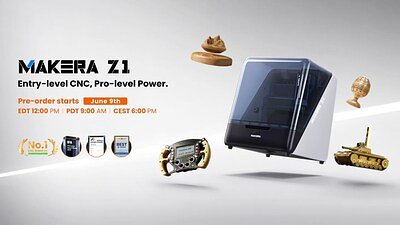
Makera's Z1: The Machine That Finally Makes Everyone a Manufacturer
MIDDLETOWN, DE – June 09, 2026 – A press release landed this week announcing the global pre-order for a desktop machine called the Makera Z1. On the surface, it’s another story of a hardware startup capitalizing on a wildly successful crowdfunding campaign—in this case, a record-shattering $10.24 million haul on Kickstarter. But to dismiss this as just another gadget launch is to miss the tectonic shift happening just beneath the headlines. The Makera Z1 isn't just a new tool; it's the most compelling sign yet that subtractive manufacturing, the precise art of carving objects from solid blocks, is about to break out of the factory and land on desktops worldwide.
For decades, CNC (Computer Numerical Control) machining has been the exclusive domain of skilled machinists and heavily capitalized businesses. The machines were enormous, astronomically expensive, and required a deep understanding of arcane G-code and complex CAM software. While the maker movement has been supercharged by the accessibility of 3D printing, its subtractive counterpart has remained stubbornly out of reach for the average creator. Makera is betting it has finally cracked the code, and the market's initial response suggests they’re right.
Bridging the Chasm: From Industrial Power to Desktop Appliance
The fundamental challenge Makera set out to solve was a chasm in the market. On one side, you have cheap, entry-level CNC kits with flimsy extruded aluminum frames that vibrate and flex, failing to deliver the precision they promise. On the other, you have professional machines that deliver accuracy but come with a five-figure price tag and a steep learning curve. The Z1 plants its flag squarely in the middle, offering industrial-grade precision in a package that feels more like a high-end appliance than a piece of factory equipment.
The secret starts with the hardware. Instead of a bolted-together frame, the Z1 is built around a single-piece cast aluminum body. This provides the immense rigidity needed to achieve a claimed precision of up to 0.02 mm—a specification that rivals machines costing many times more. This rigidity means the Z1 can accurately cut not just woods and plastics, but also carbon fiber and soft metals like aluminum and brass, a feat that has long been a holy grail for desktop machines.
But professional power is useless if it’s intimidating. Makera’s engineers systematically dismantled every point of friction. The fully enclosed design contains dust and dampens noise, making it suitable for a studio or classroom, not just a garage. An integrated dust collection system, dubbed AeroDust™, keeps the workspace clean without external vacuums. And a series of automated features—including auto-leveling to map the material's surface, automatic tool-length setting, and a quick-change system for swapping bits in seconds—eliminate the tedious, error-prone setup that plagues traditional CNC workflows. It’s a machine designed not for the seasoned machinist, but for the curious creator.
The Real Revolution Is in the Software
While the hardware is impressive, the true disruption lies in the software. The most significant barrier for aspiring CNC users has always been the complex workflow of CAD (Computer-Aided Design) to CAM (Computer-Aided Manufacturing) to machine controller. This process typically involves manually setting toolpaths, feed rates, and spindle speeds, all culminating in a dense file of G-code that directs the machine's every move. It’s a process where one wrong setting can result in a broken bit or a ruined project.
Makera Studio, the company’s proprietary software, aims to make G-code a historical footnote for most users. It offers a “one-click CAM” function that automates the entire toolpath generation process. More profoundly, it features an upcoming function called AI Craft, which allows users to generate complete 3D relief models from simple text prompts or uploaded images. The idea that someone with zero CAD experience could type “a detailed carving of a lion’s head” and have the machine produce a ready-to-cut file is no longer science fiction; it’s a feature set for 2026. As one industry analyst noted, this level of AI integration is a “fundamental unlock” for beginners, shifting the user’s role from technical operator to creative director.
This focus on radical simplicity is what draws the clearest parallel to the 3D printing revolution. Early 3D printers required immense technical skill; today, they are practically plug-and-play. The Z1 is positioned to do the same for subtractive manufacturing, making the creation of durable, functional parts from a vast library of over 500 materials as accessible as printing a plastic figurine.
The Economic Ripple Effect of Accessible Precision
The implications of this democratization extend far beyond the hobbyist community. For small businesses and entrepreneurs, the ability to prototype and even produce small batches of finished goods in-house is a game-changer. An architect can now mill a detailed site model from wood. A jewelry designer can carve intricate wax molds. An engineer can create functional aluminum parts for a custom drone. This capability collapses development cycles and reduces reliance on costly and slow third-party manufacturing services.
In education, the Z1 provides a safe and approachable tool for teaching the principles of digital fabrication. Students can move from a digital design to a physical object made of robust materials, gaining hands-on experience that was previously impossible without an industrial workshop. This shift is critical for training the next generation of engineers, designers, and innovators.
Makera’s Product Manager, Leon Hou, captured this sentiment in the company's announcement. "Makera Z1's record-breaking Kickstarter performance has already sent an unmistakable signal: desktop CNC has finally broken out of the niche maker circle and entered the mainstream," he stated. "The fact that machines have already shipped to 67 countries confirms that demand was never the question—accessibility was."
A Proven Playbook for a New Market
The Z1’s journey from a crowdfunding concept to a global product launch is a masterclass in modern hardware strategy. The $10.24 million raised wasn't just funding; it was an overwhelming validation of market demand, effectively de-risking the entire venture before a single unit hit the mainstream market. This playbook, which leverages community-building and direct-to-consumer engagement, has allowed Makera to bypass traditional gatekeepers and speak directly to a global audience hungry for innovation.
The multiple international design and innovation awards—from the IFA in Berlin to the French Design Awards in Paris—are more than just marketing accolades. They signal that the Z1's blend of form, function, and user experience is being recognized by industry experts as a significant step forward. With a pre-order price of $1,099, Makera has aggressively positioned the Z1 not against other CNC machines, but as a logical next step for the millions of people who have already embraced 3D printing. With the Z1, Makera isn't just shipping a product; it's shipping a new set of possibilities, placing the power of industrial creation directly onto the desktops of a new generation of innovators.