
- Market Growth: ITFM software market projected to grow from $5.9B in 2026 to $12.7B by 2032. - AI Cost Management: 98% of organizations now actively managing AI costs, but 40% cannot quantify AI ROI. - SaaS Waste: 51% of SaaS licenses estimated to go unused.
Experts agree that MagicOrange's unified approach to IT financial management addresses critical gaps in governing AI and cloud costs, marking a necessary evolution in enterprise technology economics.
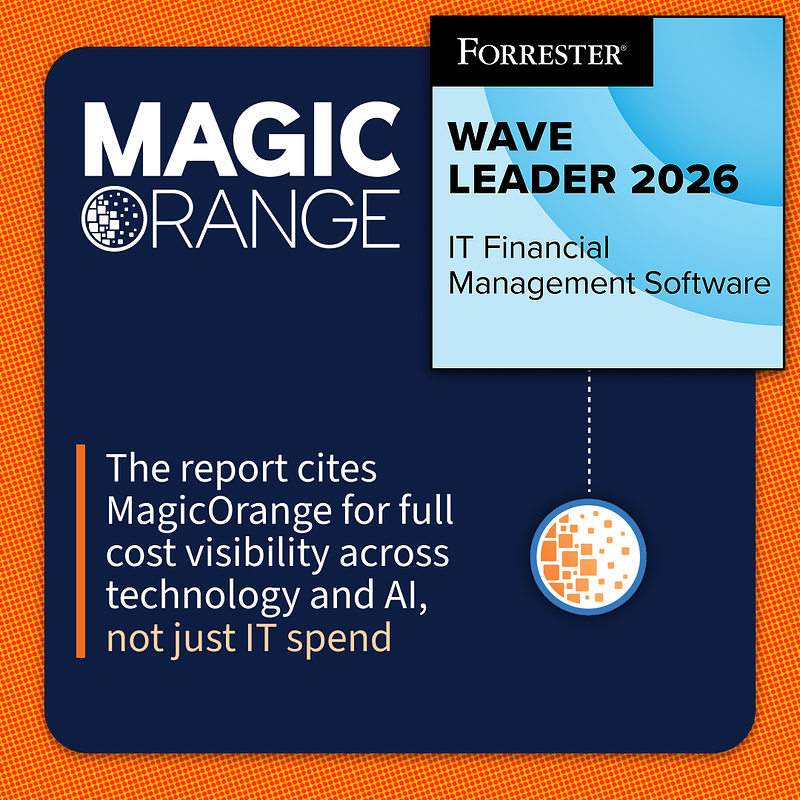
MagicOrange Leadership Signals a New Era for Managing AI's Hidden Costs
BOSTON, MA – June 17, 2026 – In a move that validates a significant shift in enterprise technology management, analyst firm Forrester has named MagicOrange a Leader in its Q2 2026 Wave™ evaluation for IT Financial Management (ITFM) Software. While such reports are a regular feature of the tech landscape, this particular recognition serves as a bellwether for a much larger trend: the urgent need for a new financial discipline to govern the spiraling costs and complexities of cloud, SaaS, and, most critically, artificial intelligence.
The press release highlights praise for MagicOrange’s “modern analytics, speed, and ease of use.” However, the true significance lies in a subtler observation from the report, which notes the company’s vision to “bring in costs outside of technology to effectively govern the full costs and benefits of AI transformation.” This points directly to the central challenge facing today's CIOs and CFOs. As technology spending becomes more distributed and consumption-based, the old models of IT finance are breaking. The age of simply tracking server costs is over; the era of governing complex technology economics has begun.
The New Imperative: Governing Technology Economics
The ITFM software market, projected to grow from approximately $5.9 billion in 2026 to over $12.7 billion by 2032, is no longer a niche concern for back-office accountants. It has become a strategic battleground where enterprises fight for financial transparency and control. The drivers are clear: the explosive growth of multi-cloud environments with their labyrinthine pricing models, the unchecked proliferation of SaaS applications—where an estimated 51% of licenses go unused—and the rise of the FinOps discipline, which seeks to instill financial accountability into the variable spending model of the cloud.
This shift is forcing a convergence. The traditionally separate domains of IT Financial Management (ITFM), FinOps (for cloud), and Technology Financial Planning & Analysis (FP&A) are proving inadequate on their own. Operating with fragmented tools creates blind spots, making it impossible to get a single source of truth for all technology spending. A company might optimize its AWS bill with a FinOps tool but remain oblivious to redundant SaaS contracts or the ballooning labor costs associated with a new data platform.
“Organizations are suffering from tool fatigue,” an industry analyst who covers enterprise software told me. “They have one platform for cloud visibility, another for SaaS management, and spreadsheets for everything else. The real value is in connecting those dots—seeing how a decision in one area impacts the entire technology value chain.”
This is the problem space MagicOrange aims to own with what it calls its “Technology Economics Platform.” By unifying ITFM, FinOps, and Technology FP&A, the platform promises to connect cost, consumption, and planning to tangible business value. According to the company, this integrated model allows leaders to move the conversation away from “What does IT cost?” to “What value are we getting from our technology investments?”
AI's Unchecked Expense: The Next Frontier for FinOps
Nowhere is this need for a unified economic view more acute than in the realm of Artificial Intelligence. AI is not just another line item; it's a cost category with entirely new dynamics. The computational expense of training a large language model, the unpredictable costs of token usage in generative AI applications, and the difficulty in distinguishing R&D experimentation from outright waste present unprecedented financial governance challenges.
Recent industry data is stark. The 2026 “State of FinOps” report revealed that while 98% of organizations are now actively managing AI costs—a staggering jump from 31% in 2024—a concerning 40% admit they cannot quantify the value or ROI of their AI initiatives. This gap represents a massive financial risk. Without a clear line of sight connecting AI spend to business outcomes, companies are essentially funding a high-stakes science experiment with a corporate blank check.
Forrester’s nod to MagicOrange’s AI strategy suggests the market is waking up to this reality. “We are particularly encouraged by Forrester's recognition of our vision for helping organizations govern the economics of AI transformation,” said David Harding, CEO of MagicOrange, in the company’s announcement. His statement underscores a proactive approach to a problem that is still in its infancy for many enterprises. An effective platform must be able to dissect an AI cost spike, tracing it back to a specific driver like increased token consumption in a new application feature, and then map that cost against the feature’s user engagement or revenue contribution.
This capability moves financial management from a reactive, historical reporting function to a proactive, strategic enabler. It allows businesses to make informed decisions about which AI projects to scale, which to optimize, and which to terminate, based on a clear understanding of their unit economics.
A Unified Answer to Financial Fragmentation
MagicOrange's recognition as a Leader is ultimately a testament to its bet on a unified platform in a fragmented market. While competitors often excel in specific niches—be it cloud cost management, SaaS optimization, or traditional IT asset tracking—the strategy of integrating these functions into a single economic model appears to be resonating.
The Forrester report notes that MagicOrange is a “strong fit for organizations seeking modern analytics, speed, and ease of use without unnecessary complexity.” This is crucial, as the primary barrier to effective IT financial governance is often the complexity of the tools themselves. By providing a platform that can automate cost allocations, run dynamic forecasts with live data, and trace cost impacts across the entire business in a single view, the goal is to democratize financial intelligence beyond a small team of experts.
Furthermore, the report’s inclusion of glowing customer feedback—specifically that clients felt MagicOrange was “part of their team”—cannot be overlooked. In a field as complex and mission-critical as technology finance, high-touch support and a partnership approach are significant differentiators. Navigating the intricacies of multi-cloud billing, hybrid infrastructure costs, and AI consumption models requires more than just software; it demands expertise and collaborative problem-solving.
As enterprises continue to pour billions into digital and AI transformation, their ability to understand and govern the underlying economics of these investments will separate the winners from the losers. The focus is no longer just on cutting costs, but on optimizing value. Platforms that can provide a clear, unified, and forward-looking view of the entire technology cost landscape are no longer a luxury, but a fundamental requirement for modern business strategy.