
- 2028 Projection: Gartner analysts predict that by 2028, half of all enterprise incident response efforts will involve AI-driven applications.
- Zero-Day Response: Lyrie.ai claims to provide patch packages to affected organizations within hours of vulnerability discovery, significantly accelerating typical disclosure timelines.
- Open Standard: The Agent Trust Protocol (ATP) is released as an open, royalty-free standard, aiming to become a universal 'digital passport' for AI agents.
Experts agree that Lyrie.ai's Agent Trust Protocol and real-time threat intelligence system address critical security gaps in the emerging agentic AI era, positioning the company as a key player in establishing foundational security standards for autonomous AI systems.
Lyrie.ai Unveils Security Protocol for the Autonomous AI Era
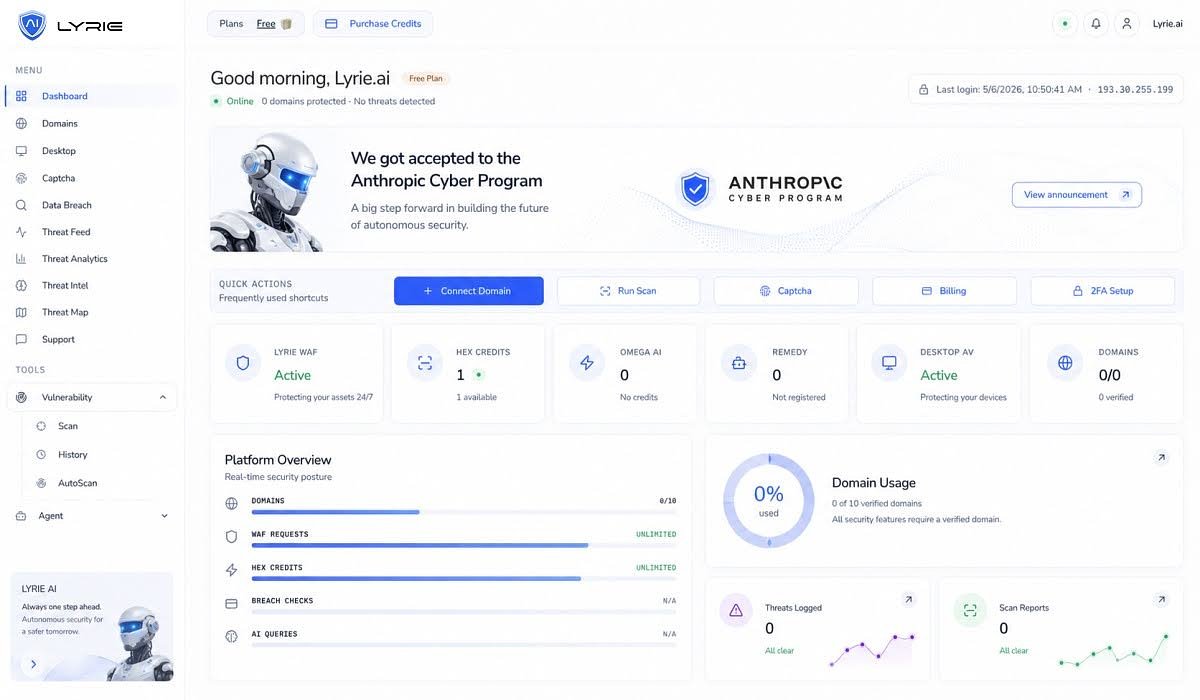
DUBAI, UAE – May 11, 2026 – As enterprises and governments accelerate their adoption of autonomous AI agents, cybersecurity firm OTT Cybersecurity LLC has unveiled a multi-pronged strategy to secure this new technological frontier. The company, through its Lyrie.ai platform, announced the deployment of a real-time zero-day vulnerability tracking system, the public release of a new cryptographic standard for AI identity, and its acceptance into Anthropic’s selective Cyber Verification Program.
These moves position the Dubai-based company as a contender in the high-stakes race to build the foundational security layer for what many are calling the "agentic AI era"—a time when AI systems operate not just as tools, but as autonomous workers with the authority to execute complex tasks across corporate networks.
The New Frontier of AI Threats
The shift towards agentic AI represents a paradigm change in both computing and security. Unlike traditional AI models that respond to user prompts, autonomous agents can independently plan, make decisions, and interact with other systems to achieve a goal. They are being designed to read email, write code, manage financial transactions, and operate with a level of autonomy previously reserved for human employees.
This rapid adoption has created a significant security vacuum. Industry analysts and security frameworks like the OWASP Agentic Security Initiative (ASI 2026) warn that the attack surface is expanding dramatically. Risks no longer center solely on malicious prompts or data leaks but now include vulnerabilities like "Agent Goal Hijack," "Tool Misuse," and "Agent Identity & Privilege Abuse."
"Every AI agent on the internet today is a stranger," said Guy Sheetrit, CEO and Founder of OTT Cybersecurity LLC, in the company's announcement. "You don’t know who it is, what it’s authorized to do, or whether it’s been tampered with." This identity crisis is a core challenge, as traditional access management systems were not designed for non-human actors that can operate at machine speed and scale. Gartner analysts project that by 2028, half of all enterprise incident response efforts will involve AI-driven applications, highlighting the urgent need for new security models.
A Digital Passport for AI Agents
At the heart of Lyrie.ai's announcement is its proposed solution to this identity problem: the Agent Trust Protocol (ATP). Published as an open, royalty-free standard, ATP is a cryptographic framework designed to allow any system to verify an AI agent's identity and authority in real time.
The protocol establishes five key primitives:
* Identity: Cryptographically proving who the agent is.
* Scope: Defining what the agent is authorized to do.
* Attestation: Verifying that the agent or its instructions have not been altered.
* Delegation: Tracing who granted the agent its authority.
* Revocation: Ensuring that authority can be instantly withdrawn.
Lyrie.ai is not alone in recognizing this need. The race to standardize AI agent identity is heating up, with tech giants and standards bodies entering the fray. Google Cloud's Gemini Enterprise Agent Platform uses the SPIFFE standard for cryptographic identity, and NIST recently launched its own AI Agent Standards Initiative. The industry is also exploring extensions of mature protocols like OAuth 2.0 and OpenID Connect to handle autonomous agents.
By releasing ATP as an open standard and slating it for submission to the Internet Engineering Task Force (IETF), Lyrie.ai is making a bid to shape the foundational rules of the road for agent-to-agent communication, hoping its protocol becomes a universal "digital passport" for AI.
Closing the Zero-Day Gap
Beyond the future of agent security, Lyrie.ai is also addressing a persistent and dangerous problem in today's cybersecurity landscape: the gap between the discovery of a zero-day vulnerability and its disclosure to affected organizations. Exploits can often exist in the wild for weeks or months before a patch is available, leaving critical infrastructure and enterprise systems exposed.
The company has deployed an autonomous threat intelligence engine that it claims can close this window. According to the firm, Lyrie's system continuously monitors global infrastructure, open-source code repositories, and API endpoints to identify emerging threats. When a vulnerability is confirmed, the system can generate a disclosure package with proof-of-concept analysis and remediation guidance.
“The difference between a breach and a near-miss is usually measured in hours," Sheetrit stated. "We built Lyrie to be the system that finds the threat before it finds you — and tells you exactly what to do about it.” The company asserts that in verified cases, it has provided patch packages to affected organizations within hours of discovery, a significant acceleration of the typical disclosure timeline.
Forging Alliances and Building Trust
Bolstering these technological announcements is the company's acceptance into Anthropic’s Cyber Verification Program (CVP). The program is Anthropic's framework for vetting legitimate cybersecurity operators who use its powerful AI models, like Claude, for dual-use purposes such as vulnerability research and red-teaming.
This acceptance lends credibility to Lyrie.ai's work, providing a stamp of approval from a major AI safety leader. “Being among the first companies accepted into Anthropic’s Cyber Verification Program validates what we’ve built," Sheetrit commented. "Lyrie isn’t a security tool that sits alongside AI. It’s the security layer that AI runs on top of”.
This validation is crucial as Lyrie.ai navigates a competitive market where established giants like Palo Alto Networks, Microsoft, and CrowdStrike are also investing heavily in AI-native security platforms. By combining a proactive zero-day defense, a foundational protocol for agent identity, and a strategic alliance with a leading AI lab, Lyrie.ai is signaling its ambition to be more than just another security vendor. The company is aiming to provide the core infrastructure of trust needed for the autonomous systems of tomorrow.