
- Mobile AI Agent: Litera's new iOS app brings its AI legal agent, Lito, to mobile devices, enabling lawyers to work seamlessly across desktops and iPhones/iPads.
- Agentic AI: The app leverages agentic AI, which acts as a proactive, autonomous partner capable of executing multi-step tasks, unlike traditional generative AI.
- Security Focus: The platform integrates with secure document management systems like iManage and NetDocuments, ensuring enterprise-level security for sensitive legal work.
Experts view Litera's mobile AI legal agent as a strategic leap in legal technology, offering significant efficiency gains and work-life integration, though adoption will hinge on overcoming security concerns and demonstrating tangible ROI.
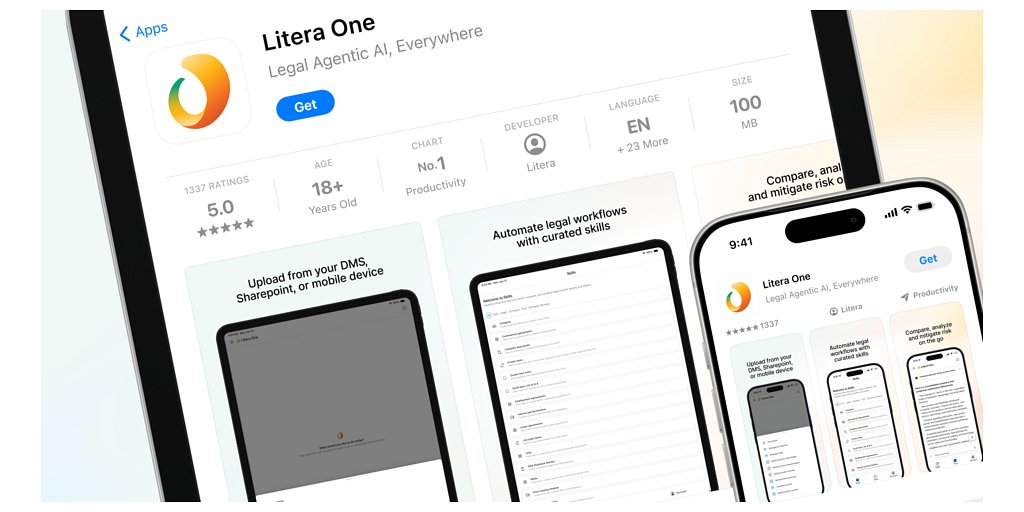
Litera's New App Puts an AI Legal Agent in Every Lawyer's Pocket
CHICAGO, IL – January 20, 2026 – Litera, a global leader in legal technology, has launched the iOS mobile application for its Litera One platform, effectively placing a sophisticated AI legal agent into the pockets of lawyers everywhere. The new app extends the company’s agentic AI, known as Lito, beyond the desktop and into the hands of legal professionals via iPhones and iPads, promising to transform dead time into productive work sessions.
This move aims to solve a persistent challenge for the legal profession: maintaining momentum and context while working outside the traditional office environment. Whether traveling between client meetings, commuting, or preparing for a courtroom appearance, lawyers often find their workflow fragmented. Litera claims its mobile solution bridges this gap.
“Lawyers need to stay productive whether they’re traveling, moving between meetings, or preparing to walk into a client conversation,” said Pasquale Colella, VP of Global SaaS Operations at Litera, in the company's announcement. “With Litera One Mobile, that continuity is seamless. Work begun on the web—or in Microsoft Word or Outlook—is instantly available on mobile, and anything started on mobile carries effortlessly back to the desktop.”
The Untethered Lawyer: Redefining On-the-Go Productivity
The core promise of the Litera One mobile app is the concept of the “untethered lawyer”—a professional no longer chained to a desk to perform complex, high-value work. The app facilitates a true two-way synchronization, ensuring that any analysis, query, or document review remains in a constant state of readiness, regardless of the device being used.
This is not merely about document access. The app brings Litera’s full suite of AI-powered workflows to the mobile interface. Lawyers can utilize conversational AI, asking the Lito agent questions via text or speech-to-text dictation to launch workflows or get quick insights. They can also perform in-depth document analysis, review AI-generated summaries of key terms and risks, and leverage the company’s market-leading document comparison technology—all from a mobile device.
For business development, the app enables the rapid creation of client-ready summaries and updates, allowing lawyers to be more responsive and prepared. By making these powerful tools accessible during moments that were previously unproductive, such as waiting for a flight or sitting in a taxi, Litera is betting that it can deliver a significant and tangible boost to efficiency and work-life integration for its users.
Agentic AI: A Strategic Leap Beyond the Chatbot
At the heart of this launch is the technology of agentic AI, which represents a significant evolution from the more common generative AI. While generative AI excels at creating content in response to a specific prompt, agentic AI is designed to be a proactive, autonomous partner. In the legal context, it can function less like a research tool and more like a virtual junior associate, capable of executing multi-step tasks to achieve a defined goal.
Litera’s Lito agent, for instance, can interpret a user’s intent and then access and orchestrate various tools and data sources—including a firm’s private documents and knowledge bases—to deliver a comprehensive outcome. This might involve comparing a draft agreement against a firm’s playbook, identifying potential risks, and summarizing the deviations, all with minimal step-by-step guidance.
This move into mobile agentic AI is a strategic gambit in the increasingly competitive legal tech arms race. While competitors like Thomson Reuters and LexisNexis have heavily invested in their own AI platforms, Litera’s focus on bringing this advanced, autonomous functionality to a seamless mobile experience serves as a key differentiator. The launch signals a belief that the future of legal work is not just AI-powered, but also mobile-native and deeply integrated into the platforms lawyers already use, such as Microsoft 365.
Navigating Security and Trust in a Mobile-First World
The most powerful technology is useless if it isn’t trusted, and nowhere is this truer than in the legal profession. The prospect of conducting sensitive client work on a mobile device using a third-party AI raises immediate and critical questions about data security, confidentiality, and compliance. Lawyers are bound by strict ethical duties and regulations like GDPR to protect client information, making the security of their technology paramount.
Litera appears to have anticipated these concerns, stating that its platform “maintains secure access to firm-specific documents, data, or workflows.” The architecture is built on enterprise security principles and is designed to integrate with a firm's existing secure environments, including document management systems like iManage and NetDocuments. The Lito agent reportedly only connects to permissioned, structured firm data, providing a layer of governance over its autonomous capabilities.
However, the introduction of agentic AI adds a new dimension to risk management. The risk shifts from merely inaccurate content (a “content risk”) to flawed autonomous actions (a “conduct risk”). This places an even greater burden on firms to conduct thorough due diligence and on providers to be transparent about their security protocols and the operational boundaries of their AI. Building and maintaining trust will be the central challenge as the industry moves towards adopting these powerful new tools.
The Road to Adoption and the Future of Legal Work
The launch of the Litera One mobile app marks a significant milestone, but its ultimate impact will be determined by user adoption. Overcoming the legal industry's inherent resistance to change and deep-seated security concerns will require more than just impressive features. It will demand a frictionless user experience, demonstrable return on investment, and unwavering reliability.
In a nod to the global nature of legal practice, Litera also announced the addition of French-Canadian language support within Litera One, underscoring a broader trend toward making legal AI tools more accessible across different jurisdictions and languages. As AI becomes more deeply embedded in legal workflows, the ability to automate routine tasks will increasingly free up professionals to focus on strategic counsel, complex problem-solving, and client relationships.
This launch is more than an app release; it’s a clear indicator of where the legal profession is heading. The industry is moving toward a future characterized by a deep, collaborative partnership between human expertise and artificial intelligence, where work is no longer defined by location. How firms and their lawyers choose to navigate this new landscape of mobile, agentic AI will shape the practice of law for years to come.
Topics & Related
Agentic AI
Generative AI
Digital Transformation
Regulation & Compliance
Software & SaaS
AI & Machine Learning
Related Company Pulse