
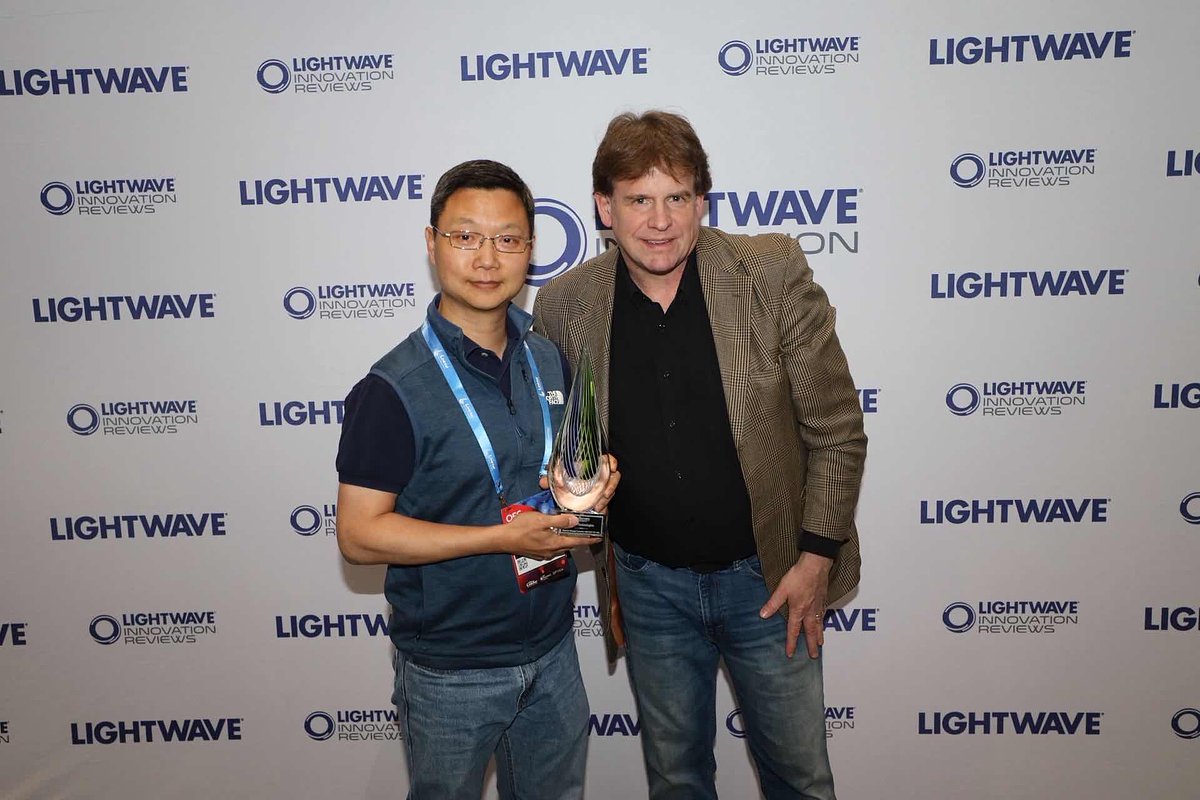
- Linktel's 800G OSFP FR4 10km module earned a perfect 5.0 score in the 2026 Lightwave Innovation Reviews.
- The 800G OSFP 2LR4+ 20km module received a 4.0 score.
- Power consumption in AI data centers is forecasted to grow at a compound annual rate of nearly 45% through 2027.
Experts agree that Linktel's dispersion-managed optical transceivers represent a critical advancement in overcoming the data transmission bottlenecks faced by AI infrastructure, offering superior performance and energy efficiency.
Linktel's Optical Breakthrough Fuels AI's Insatiable Data Appetite
LOS ANGELES, CA – March 18, 2026 – As the global technology industry converges on the Optical Fiber Communication Conference (OFC), Linktel Technologies has emerged with a significant validation of its core technology, securing high honors in the prestigious 2026 Lightwave Innovation Reviews. The company's two 800G dispersion-managed transceivers received near-perfect scores, a recognition that underscores the critical role of advanced optical hardware in sustaining the explosive growth of artificial intelligence.
Linktel’s 800G OSFP FR4 10km module earned a perfect 5.0 score, described by the Lightwave panel as a "Superb product that demonstrates breakthrough performance and/or innovation." Its counterpart, the 800G OSFP 2LR4+ 20km module, received a 4.0, denoting an "Excellent product with technical features and performance that provide clear and substantial benefits." This industry acknowledgment places Linktel at the forefront of solving one of the most pressing challenges in the race to build bigger, faster, and more efficient AI infrastructure.
The Unseen Engine of AI
The AI revolution, powered by massive large language models (LLMs) and complex algorithms, runs on an unseen foundation of physical infrastructure. Inside sprawling data centers, tens of thousands of GPUs must communicate with each other in a tightly choreographed dance to train and run these models. This constant, high-volume "east-west" traffic—the data flowing between servers within a data center—is creating a communications bottleneck of unprecedented scale.
For years, copper wiring served as the data highway, but it is hitting a wall. At the speeds required for modern AI clusters, electrical signals in copper degrade rapidly, limiting effective reach to just a few meters and consuming unsustainable amounts of power. Power consumption is now widely seen as the single greatest bottleneck for AI data centers, with some forecasts predicting energy use will grow at a compound annual rate of nearly 45% through 2027. Optical interconnects, which use light to transmit data over fiber optic cables, have become the only viable path forward, offering vastly higher bandwidth over longer distances with greater energy efficiency.
However, even light has its limits. As data rates climb to 800 gigabits per second (800G) and beyond, physical phenomena that were negligible at lower speeds become formidable obstacles. The challenge is no longer just about moving data, but about moving it with perfect integrity over meaningful distances without consuming a data center's entire power budget.
Beating the Limits of Light
One of the most significant physical hurdles in high-speed optics is chromatic dispersion. Put simply, when a pulse of light containing multiple frequencies (or colors) travels down a fiber, some colors travel slightly faster than others. Over distance, this causes the light pulse to spread out and blur, corrupting the data it carries. This effect becomes exponentially worse as data rates increase, severely limiting the stable reach of 800G and future 1.6T connections.
This is the problem Linktel’s award-winning technology directly addresses. The company has developed a proprietary Dispersion Managed Device (DMD) that is integrated into its transceivers. This technology actively counteracts the effects of chromatic dispersion, ensuring the light signal remains crisp and error-free over extended distances.
The results are impressive. The 5.0-rated 800G FR4 10km module, designed for large campus networks, demonstrated an exceptionally low bit error rate and achieved Error-Free performance, a new benchmark for its class. Its sibling, the 4.0-rated 800G 2LR4+ 20km module, extends this stable, power-efficient connectivity up to 20 kilometers, making it ideal for connecting data centers across a metropolitan area (Metro-edge DCI). By solving the dispersion problem at the component level, Linktel is enabling network architects to design larger, more interconnected AI clusters without requiring complex and costly external compensation equipment.
A High-Stakes Race for Optical Supremacy
Linktel’s success does not exist in a vacuum. The OFC 2026 exhibition floor is a testament to a ferocious innovation race among optical component makers, all vying to supply the hardware for the AI gold rush. The industry is rapidly transitioning from 400G to 800G as the new standard, and major players are already showcasing their roadmaps to 1.6T and even 3.2T.
Competitors are pursuing various strategies. Giants like Broadcom and NVIDIA are championing co-packaged optics (CPO), which aims to place optical I/O directly on the same package as the main processing chips (like GPUs and switches) to drastically cut power and improve bandwidth density. While CPO is considered a likely long-term solution, its complexity and disruptive nature mean that advanced pluggable modules, like those from Linktel, remain the dominant, most practical solution for the massive build-outs occurring today.
The immense challenge of scaling AI has also spurred unprecedented collaboration. The recent formation of the Optical Compute Interconnect (OCI) Multi-Source Agreement by titans including AMD, Broadcom, Meta, Microsoft, and NVIDIA, signals a collective move to standardize the optical building blocks for future AI systems. This initiative aims to foster a multi-vendor ecosystem and prevent the kind of proprietary lock-in that could stifle innovation.
Within this dynamic landscape, Linktel’s validated performance in dispersion management for pluggable optics carves out a crucial and strategic position. As the industry showcases its future, Linktel is delivering a proven, high-performance solution that meets the immediate, critical needs of hyperscalers today. At its OFC booth, the company is not only demonstrating its award-winning 800G modules but also its next-generation technologies, including 1.6T modules and advanced liquid-cooled optical engines, signaling its readiness for the next chapter in the relentless pursuit of speed.