
- 121% ROAS: LinkedIn ads deliver a 121% return on ad spend, outperforming Google Search (67%) and Meta (51%).
- 272-Day Buyer Journey: The average B2B purchasing process now spans 272 days, up from 211 days previously.
- 41% Budget Share: LinkedIn captures 41% of B2B paid social budgets, reflecting its dominance in the space.
Experts agree that LinkedIn's precision targeting and high-quality audience make it indispensable for B2B marketers, while the extended, complex buyer journey necessitates a strategic shift toward content marketing and long-term nurturing.
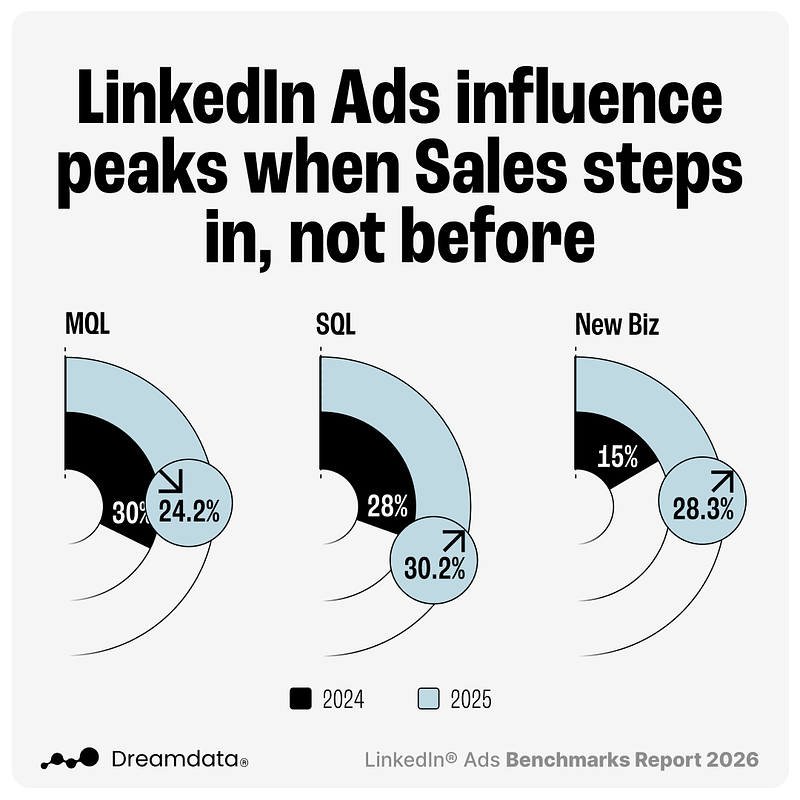
LinkedIn's B2B Ad Dominance Grows as Buyer Journeys Hit 272 Days
NEW YORK, NY – March 10, 2026 – A new benchmark report has revealed a stark divergence in the effectiveness of major digital advertising platforms for business-to-business (B2B) marketers, with LinkedIn emerging as the sole channel delivering a positive return on investment. The findings, part of the 2026 LinkedIn Ads Benchmarks Report by B2B attribution platform Dreamdata, highlight a profound shift in both advertising performance and the fundamental nature of the corporate purchasing process.
The report, which analyzed over 66 million sessions across 3.5 million customer journeys, found that LinkedIn ads deliver a 121% return on ad spend (ROAS). This figure stands in sharp contrast to its main competitors, Google Search at 67% ROAS and Meta platforms at 51%, neither of which crossed the profitability threshold for the B2B companies studied. This performance has cemented LinkedIn's position as the leading platform, capturing 41% of B2B paid social budgets.
Beyond ad performance, the research paints a picture of a dramatically longer and more complex B2B buyer journey. The average journey now spans 272 days, a significant increase from 211 days in the previous year. Perhaps most strikingly, buyers now spend the first 220 days—roughly seven months—in a self-directed research phase before ever making formal contact with a company's sales department.
The LinkedIn Advantage in B2B Advertising
LinkedIn's superior performance, according to the data, is not an anomaly but a reflection of its unique position in the digital ecosystem. Unlike the broad, consumer-focused audiences of Meta or the intent-based but often generic nature of Google Search, LinkedIn provides B2B marketers with unparalleled targeting capabilities based on job title, industry, company size, and seniority. This precision allows companies to place their message directly in front of the specific decision-makers they need to reach, minimizing wasted ad spend.
The platform's dominance is reflected in budget allocation. With 41% of the B2B paid social pie, marketers are voting with their wallets, reinforcing LinkedIn's status as the primary digital venue for professional engagement. Dreamdata, a certified LinkedIn Marketing Partner, leverages deep integrations with the platform to track these outcomes, providing the data that underpins the report's conclusions. The findings suggest that for B2B marketers focused on revenue generation, not just lead volume, LinkedIn has become an indispensable part of their strategy. While its cost-per-click can be higher than other platforms, the high quality of the audience and the resulting positive ROAS present a compelling case for continued investment.
The 272-Day Marathon: Navigating the New B2B Buyer Journey
The report's second major revelation concerns the radical transformation of the B2B purchasing process. The journey from initial awareness to a closed deal has become a marathon, not a sprint. The extension to 272 days is compounded by increasing complexity at every stage. A typical buying decision now involves an average of 10 stakeholders, up from 6.8 the prior year, and spans 88 distinct touchpoints across 4 different channels.
This shift signifies that B2B purchasing is now more consensus-driven and distributed than ever before. The most critical part of this evolution is the 220-day "nurturing phase," where potential buyers engage in extensive self-education. They consume white papers, watch webinars, read case studies, and compare solutions, all largely anonymously, long before they fill out a "contact us" form. This means that by the time a lead formally enters a company's CRM, their opinions and preferences have already been heavily shaped. Marketing now effectively owns 81% of the buyer's journey, with deals being "essentially won before sales get involved in the process," according to Steffen Hedebrandt, Co-founder and CMO at Dreamdata.
This new reality presents a significant challenge for traditional sales and marketing models. It requires a strategic shift away from a focus on bottom-of-the-funnel lead generation toward a more holistic approach centered on content marketing, brand building, and providing value throughout the long, anonymous research phase.
Beyond Clicks: The Growing Crisis in Marketing Attribution
The lengthening and increasingly anonymous nature of the buyer journey creates a critical problem for B2B leaders: proving the value of their marketing investments. As Hedebrandt noted in the press release, "proving marketing's impact is difficult, since CRMs aren't built to track multiple anonymous touchpoints or connect early engagement to a deal that closes months later."
This disconnect leads to a systemic undervaluation of marketing's contribution to revenue. When attribution models only credit the last touchpoint—such as a demo request form—they ignore the months of content consumption and brand engagement on platforms like LinkedIn that made the final conversion possible. Consequently, marketing departments struggle to justify budgets for top-of-funnel activities that are crucial for long-term growth but difficult to measure with traditional tools. This often leads to a vicious cycle of underinvestment in the very strategies that build the foundation for future sales.
The Attribution Technology Arms Race
The challenges highlighted by the Dreamdata report have fueled a growing market for sophisticated B2B attribution and analytics platforms. Companies like Dreamdata, along with competitors such as Adobe's Marketo Measure (formerly Bizible) and Ruler Analytics, are racing to provide a "single source of truth" for revenue data. These platforms work by integrating with a company's entire marketing and sales technology stack—from ad platforms and websites to CRM and payment systems.
By stitching together data from dozens of sources, these tools aim to map the complete, multi-touch journey of every account, from the first anonymous website visit to the final signed contract. They employ various attribution models, moving beyond the simplistic "last-touch" model to more nuanced data-driven approaches that assign credit across all 88 touchpoints. This allows marketers to finally see which channels, campaigns, and content are truly influencing deals, even those that close months down the line.
As B2B commerce continues to digitize and buyers take greater control over their own journey, the ability to connect these disparate dots is becoming a key competitive differentiator. The insights from Dreamdata's report serve as a clear signal that for B2B companies, investing in understanding their customer's complex path to purchase is no longer optional; it is essential for survival and growth in an increasingly complicated digital landscape.