
- 80% energy efficiency target: The startup claims its technology could achieve 80% energy conversion efficiency, far surpassing current industry benchmarks. - $2.0 million capital sought: The company is raising pre-seed funding to build and validate nine proprietary prototypes. - Patent No. 12,504,001 issued: The U.S. patent protects a novel turbine architecture that leverages mechanical advantage for torque multiplication.
Experts would likely view Ducted Vortex's claims with cautious optimism, acknowledging the potential for a paradigm shift in renewable energy efficiency but emphasizing the need for independent validation of the technology's performance.
Leveraging Physics: A Startup's Audacious Plan for 80% Energy Efficiency
JACKSONVILLE, FL – March 31, 2026 – A Florida-based energy startup has announced a newly issued patent for a technology it claims could fundamentally reshape the renewable energy landscape. Ducted Vortex, Inc. asserts its "Wajda Energy System" can overcome long-standing efficiency barriers in wind and solar power, setting an ambitious "roadmap to 80% efficiency" by applying ancient physics to a modern problem.
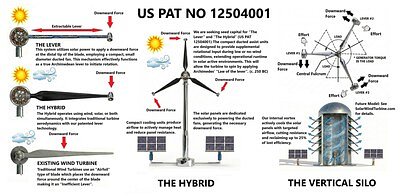
The company's announcement centers on the issuance of U.S. Patent No. 12,504,001, which protects a novel turbine architecture. Unlike conventional wind turbines that rely on aerodynamic lift, this new system is said to harness Archimedes' "Law of the Lever" to achieve significant torque multiplication. If the company's claims hold true, the technology could represent a paradigm shift in how we generate clean energy.
A New Lever for Green Energy
At the heart of the Wajda Energy System is a radical departure from the towering, three-bladed Horizontal Axis Wind Turbines (HAWT) that dominate today's wind farms. According to the company, the patented design replaces the principles of aerodynamic lift with a framework built on mechanical advantage. By using a sophisticated system of levers, the technology can allegedly convert low-magnitude environmental inputs—like moderate wind—into high-torque rotational energy suitable for industrial-scale power generation.
This mechanical approach is combined with a thermodynamic one. The system integrates solar power generation with a novel cooling mechanism, creating what CEO Robert Wajda describes as a "unified kinetic-thermal ecosystem." In a statement, Wajda explained the synergy: "Just as a high-performance internal combustion engine relies on a synchronized cooling to maintain structural and operational integrity, solar and wind technologies achieve peak performance only through deep integration. By utilizing the turbine's mechanical motion to provide continuous cooling for PV arrays, our system creates a self-sustaining cycle where thermal management is linked to power generation."
This integrated design, featuring modular architecture with "Parallel and Series" coupling topologies, is what underpins the company's most audacious claim: a roadmap to achieving 80% energy conversion efficiency. Such a figure would shatter current industry benchmarks.
Scrutinizing the Breakthrough
The promise of 80% efficiency is a monumental claim in a sector governed by hard physical limits. The theoretical maximum efficiency for a conventional wind turbine, known as the Betz limit, is 59.3% of the wind's kinetic energy, with real-world operational capacity factors typically falling between 35% and 50%. Similarly, commercially available solar panels generally convert 17% to 23% of sunlight into electricity. Ducted Vortex's target suggests a system-level efficiency that would be revolutionary, but it remains unsubstantiated by independent, third-party analysis.
While the company announced the formal issuance of U.S. Patent No. 12,504,001 on March 31, 2026, publicly accessible patent databases more prominently feature the company's earlier intellectual property. This includes a granted patent for an HVAC system and a published, but not yet granted, patent application from 2023 for a "Solar Wind Turbine with Lever Assist via Compounding Mechanical Advantage." This application shares conceptual DNA with the newly announced patent, describing a system of mechanical levers providing compounded advantage to a central fulcrum. The distinction between a published application and a formally issued patent is significant, with the latter providing much stronger legal and technical validation.
The company itself acknowledges the need for empirical proof. Chief Mechanical Engineer Mohammed Usman stated that the immediate mandate is the "delivery of high-fidelity technical data." This data is expected to come from the next phase of the company's development.
A Strategic Gambit for Market Entry
With its core engineering designs finalized, Ducted Vortex is moving from sub-scale modeling to building commercial-grade hardware. The company is now seeking $2.0 million in pre-seed capital to fund the fabrication and, crucially, the "independent aerodynamic validation" of nine proprietary prototypes. This step is designed to provide the empirical evidence needed to substantiate its efficiency claims.
In a move that signals confidence in its technology and a desire for rapid scaling, Ducted Vortex is bypassing traditional retail equity markets. Instead, it is pursuing direct alliances with enterprise-scale solar and wind developers and Tier-1 electric utilities. This strategy aims to integrate the technology directly into large-scale energy grids, leveraging the infrastructure and market access of established players.
The approach is a high-risk, high-reward gambit. Success hinges on convincing these industrial giants of the technology's viability, but a successful partnership could accelerate commercialization dramatically. "While our development trajectory remains independent of external financing, a $2 million capital infusion will significantly compress our roadmap," CEO Robert Wajda noted, explaining it would help mitigate the "12-to-24-month latency inherent in sequential prototyping and administrative grant processes."
Solving Renewable Energy's Persistent Problems
Beyond the headline-grabbing efficiency numbers, perhaps the most compelling aspect of the Wajda Energy System is its potential to solve the persistent environmental and social challenges that often hinder renewable energy projects. The company claims its advanced system directly addresses critical industry constraints such as intermittent output, acoustic emissions, wildlife safety, radar interference, shadow flicker, and restrictive zoning regulations.
Conventional wind farms frequently face public opposition and regulatory hurdles due to noise pollution, the risk turbines pose to birds and bats, and their visual impact on the landscape. A turbine design that is inherently quieter, safer for wildlife, and less obtrusive could dramatically improve public acceptance and streamline project approvals. The "ducted" aspect of the company's name may imply an enclosed design that would naturally mitigate many of these issues by shielding moving parts.
If Ducted Vortex can deliver a technology that is not only more efficient but also a better neighbor, it could unlock development opportunities in areas where traditional wind and solar are not feasible. The next 12 to 24 months will be critical, as the company seeks to transform its patented concepts and ambitious claims into validated, commercial-grade prototypes ready for industrial deployment.