
- HK$3 billion AI Subsidy Scheme: Hong Kong's government-funded initiative to support AI adoption.
- 50% of organizations: Anticipate needing over 12 months to achieve full AI readiness in Hong Kong.
- 3,000 petaflops: Capacity of the Cyberport AI Supercomputing Centre (AISC) by 2025.
Experts agree that Hong Kong's 'AI+' strategy, backed by significant government investment and Lenovo's Hybrid AI framework, is positioning the city as a global AI hub, though challenges in execution and governance remain critical hurdles.
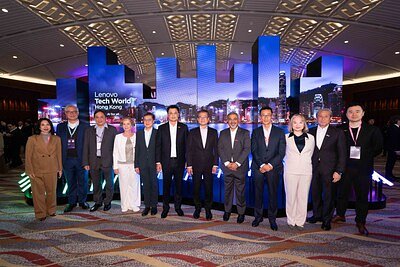
Lenovo Powers Hong Kong's 'AI+' Vision Beyond the Hype
HONG KONG – March 10, 2026 – As the global technology landscape pivots from artificial intelligence experimentation to execution, Lenovo today showcased a series of practical, real-world AI deployments at its Tech World '26 Hong Kong event. The demonstrations signal a significant commitment to the city's burgeoning AI sector, moving beyond theoretical concepts to tangible systems capable of reasoning and acting in complex environments across sports, entertainment, robotics, and intelligent mobility.
This strategic focus comes as Hong Kong aggressively pursues its vision to establish innovation and technology as a primary pillar of economic growth. The city is fostering an environment where organizations are encouraged to adopt operational, agentic AI, and Lenovo is positioning its global capabilities to serve as a key enabler of this transition.
Hong Kong's 'AI+' Gambit
The backdrop for Lenovo's showcase is a concerted, government-led effort to transform Hong Kong into a premier global AI hub. This ambition, branded as 'AI+' by Financial Secretary Paul Chan, represents a dual strategy: developing AI as a core strategic industry while simultaneously harnessing it as a powerful enabler across the entire economy.
Speaking at the event, Mr. Chan underscored the strategic importance of this push. "Every major economy now recognises the strategic importance of AI," he stated. "Innovation thrives only in an ecosystem where government, academia and industry work closely together. Lenovo's deep strengths in AI, and its experience in deploying AI solutions across industries, can provide valuable support to Hong Kong's efforts."
This support is being channeled into a well-funded ecosystem. The government has already launched a HK$3 billion AI Subsidy Scheme to help local entities leverage the formidable computing power of the Cyberport AI Supercomputing Centre (AISC). This state-of-the-art facility, which was set to reach a capacity of 3,000 petaflops in 2025, provides the critical infrastructure needed for developing large language models and other advanced AI applications. Further investment, including a HK$10 billion scheme to promote R&D commercialization, underscores the city's commitment to building a self-sustaining innovation pipeline.
Bridging the Readiness Gap
Despite the surge in investment and ambition, the path to widespread AI adoption is fraught with challenges. According to the "Lenovo CIO Playbook 2026," a report developed with industry analyst firm IDC, a significant readiness and governance gap persists. The report reveals that while AI spending is projected to grow by 15% across Asia Pacific, many organizations are struggling with the practicalities of implementation.
In Hong Kong, the findings are particularly stark: 50% of surveyed organizations anticipate needing more than 12 months to achieve full AI readiness. Furthermore, across the wider Asia Pacific region, nearly half (47%) of businesses are still developing AI policies that have yet to be implemented. This data suggests the primary bottleneck is not a lack of technology, but a deficit in execution strategy, robust governance, and seamless integration.
Lenovo aims to address this chasm directly. "AI is entering a new phase of execution and measurable impact," said Ken Wong, Executive Vice President and President of Lenovo's Solutions & Services Group. "As Hong Kong accelerates AI adoption across sectors, success will depend on trusted infrastructure, strong governance and ecosystem collaboration. Lenovo's Hybrid AI approach helps organizations scale AI securely, efficiently and responsibly."
The Hybrid AI Framework in Action
At the heart of Lenovo's strategy is its Hybrid AI framework, a multi-pronged approach designed for scalable and governable deployment. The framework integrates three core layers: Personal AI to enhance individual workforce productivity on devices; Enterprise AI to orchestrate and govern complex systems within an organization; and Public AI to enable large-scale collaboration at the city and ecosystem level.
This model provides the flexibility for enterprises to deploy AI workloads where they are most effective—whether on-device at the edge, on-premises for security and control, or in the public cloud for scale. The goal is to move beyond isolated pilot projects and deliver measurable return on investment.
Nowhere is this practical application more evident than in the company's collaboration with autonomous driving firm WeRide. The partnership, formalized in 2024, focuses on co-creating Level 4 autonomous driving solutions for commercial use. By integrating Lenovo's AD1 autonomous driving domain controller with WeRide's solution platform, the collaboration has already yielded significant results. In mid-2025, WeRide launched a new high-performance computing platform jointly developed with Lenovo that reduced the cost of its autonomous driving suite by 50%, a critical step toward the large-scale commercial deployment of its Robotaxi GXR. This partnership exemplifies the shift from research to real-world impact, delivering safer and more reliable autonomous services.
Lenovo also highlighted the breadth of its AI applications through collaborations with global brands like FIFA and DreamWorks, as well as its involvement with the 15th National Games in the Hong Kong Region, demonstrating AI's growing role in optimizing operations in sports and entertainment.
A Competitive and Collaborative Ecosystem
Lenovo is entering a dynamic and increasingly competitive AI market in Hong Kong. The city is already home to established AI giants like SenseTime, a pioneer in computer vision, and is a key battleground for regional behemoths such as Alibaba Cloud and Tencent. These players, along with a vibrant ecosystem of over 500 AI-related organizations and startups, are all contributing to the 'AI+' vision.
This competitive pressure is fostering a dual environment of intense innovation and necessary collaboration. The government's cultivation of research hubs like the InnoHK clusters at Hong Kong Science and Technology Parks is creating fertile ground for partnerships that bridge the gap between academic research and industrial application. As companies like Lenovo bring their global experience and scalable solutions to the table, they are not just selling products but are becoming integral partners in building the city's technological future, proving that the next phase of AI will be defined by practical application and measurable results within a thriving, interconnected ecosystem.