
- Sequential Read Speeds: Up to 7,000 MB/s (10% improvement over BG6 Series)
- Random Read/Write Performance: 1,000,000 IOPS (16% improvement over BG6 Series)
- Power Efficiency: 67% improvement in sequential write operations
Experts agree that KIOXIA's BG7 SSDs represent a significant advancement in storage technology, offering substantial improvements in speed, power efficiency, and cost-effectiveness, making them a game-changer for both end-users and PC manufacturers.
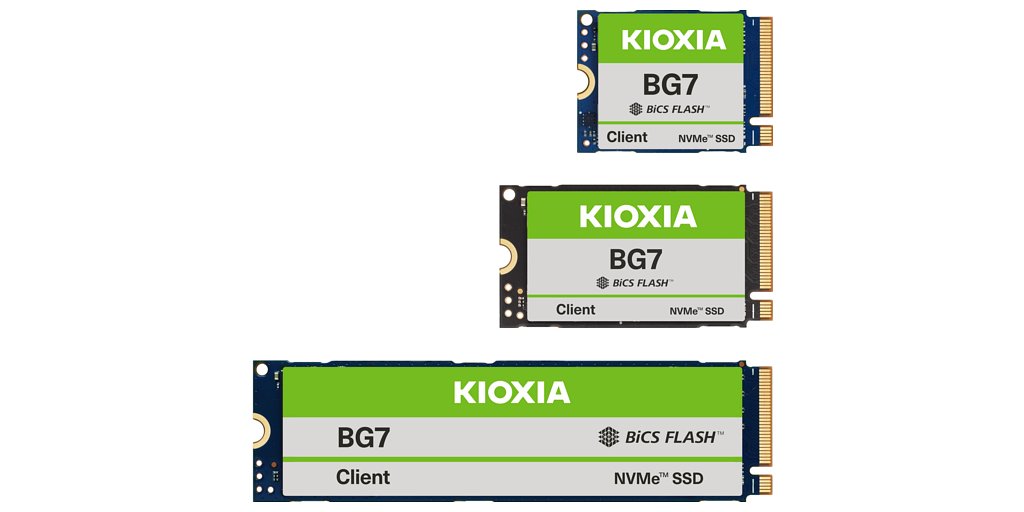
KIOXIA's BG7 SSDs to Boost Laptop Speed and Battery Life
SAN JOSE, CA – January 05, 2026 – KIOXIA America, Inc. has unveiled its next-generation BG7 Series solid-state drives (SSDs), a move poised to significantly impact the design and performance of future consumer and commercial PCs. The new series is the first to feature the company's latest BiCS FLASH™ Generation 8 3D flash memory, combined with an innovative manufacturing process called CMOS directly Bonded to Array (CBA), delivering a potent mix of speed, power efficiency, and cost-effectiveness for PC original equipment manufacturers (OEMs).
As the PC market pivots towards thinner, lighter devices and embraces the demands of AI-powered applications, the role of storage has never been more critical. The BG7 Series, set to debut at CES 2026, directly addresses these trends, promising not just an incremental upgrade but a foundational shift in what users can expect from their notebooks and desktops.
A Leap in Performance and Battery Life
For the end-user, the technical specifications of a storage drive translate directly into the daily computing experience. The KIOXIA BG7 Series promises substantial upgrades, with sequential read speeds hitting up to 7,000 MB/s and random read/write performance reaching 1,000,000 IOPS (Input/Output Operations Per Second). These figures represent a roughly 10% and 16% improvement, respectively, over the preceding BG6 Series. In practical terms, this means faster system boot times, near-instantaneous application loading, and smoother multitasking, even with demanding software.
However, the most significant advancement may be in power efficiency. Leveraging its new CBA technology, KIOXIA has achieved an approximately 67% improvement in power efficiency during sequential write operations. This dramatic reduction in energy consumption is a game-changer for mobile computing. For users of laptops and ultra-portable notebooks, this translates directly into longer battery life, allowing them to work, create, and play for extended periods without being tethered to a power outlet. This focus on efficiency without compromising performance is a key differentiator in a market where mobility is paramount.
The performance is enabled by the drive's compliance with the PCIe® 4.0 interface, which doubles the data throughput compared to the previous generation, and the NVMe™ 2.0d protocol, which optimizes the communication path between the SSD and the system's processor.
The OEM Advantage: Cost, Flexibility, and a Competitive Edge
While end-users will feel the benefits, the BG7 Series is engineered with PC manufacturers in mind. KIOXIA has made several strategic design choices to give OEMs a competitive advantage in a crowded marketplace. A cornerstone of this strategy is the drive's DRAM-less architecture, which utilizes Host Memory Buffer (HMB) technology. HMB allows the SSD to use a small portion of the host PC's main memory (DRAM) for its management tasks, eliminating the need for a dedicated, costly DRAM chip on the SSD itself. This significantly reduces the bill of materials (BOM) for OEMs, enabling them to integrate high-speed NVMe storage into a wider range of products, from entry-level consumer laptops to high-volume commercial desktops, without inflating the final price.
Flexibility is another key theme. The BG7 Series expands on KIOXIA's existing M.2 form factors (2230 and 2280) by introducing a new Type 2242 option. This mid-size form factor provides OEMs with greater versatility in motherboard layout and system design, particularly for compact and thin-and-light devices where every millimeter of internal space is precious. This expanded offering, combined with capacities ranging from 256GB to 2TB, allows manufacturers to tailor storage solutions precisely to their target market's needs.
The adoption of the NVMe 2.0d specification further empowers OEMs by providing finer control over the drive's features and power states, helping them optimize their systems for performance and battery life. In a client SSD market projected to grow exponentially, reaching over 800 million units annually by 2026, these cost and design advantages position KIOXIA's partners to capture a larger share.
Under the Hood: The Science of BiCS FLASH Gen 8 and CBA
The performance and efficiency gains of the BG7 Series are not just marketing claims; they are rooted in fundamental advancements in semiconductor technology. The drive is built on KIOXIA's BiCS FLASH Gen 8, a 3D NAND architecture that stacks 218 layers of memory cells. This results in what the company claims is the world's highest bit density for this technology node, enabling more storage capacity in a smaller physical area. This generation also boasts a 60% faster interface speed and a 20% improvement in write performance over its predecessor.
The true innovation, however, lies in the CMOS directly Bonded to Array (CBA) technology. In traditional designs, the logic circuitry (CMOS) is built on a silicon wafer first, and the memory cell array is then fabricated on top. CBA decouples these two processes. The memory array and the CMOS peripheral circuits are manufactured on separate wafers, each optimized with its own ideal fabrication process. The two wafers are then precisely bonded together.
This separation allows for higher-temperature processing for the memory array, enhancing its performance and reliability, without damaging the temperature-sensitive logic circuits. The result is a synergistic improvement where both components perform at their peak. This advanced manufacturing technique is the primary driver behind the BG7's remarkable 67% power efficiency improvement, as it allows for a more optimized and efficient chip design.
Enhanced Security for the Modern Workplace
Beyond speed and efficiency, the BG7 Series also addresses the critical need for data security. The drives are available with self-encrypting drive (SED) capabilities that comply with the TCG Opal 2.01 standard. This provides robust, hardware-based encryption, where all data is automatically encrypted and decrypted by the SSD's controller. Unlike software-based encryption, this method does not consume host CPU resources, ensuring that security does not come at the cost of performance. This feature is especially vital for commercial and enterprise customers, providing a strong defense against data theft or unauthorized access if a laptop is lost or stolen.
"Storage for client computing applications must keep pace with consumer demand for ultra-mobility without compromise," said Neville Ichhaporia, senior vice president and general manager of the SSD business unit, KIOXIA America, Inc., in the company's announcement. "The new KIOXIA BG7 Series delivers enhanced performance and power efficiency for end users while remaining economical for our PC OEM customers."
With samples already being evaluated by select PC manufacturers, the technologies packed into the BG7 Series are on a clear path to becoming integral components in the next generation of personal computers, shaping the user experience for years to come.