
- 84% of developers now use or plan to use AI tools for coding.
- 46% of developers do not trust the accuracy of AI-generated code.
- AI now generates over a third of all new code in some reports.
Experts agree that while AI-powered coding tools significantly boost productivity, they introduce architectural chaos and 'trust debt,' necessitating solutions like JigsawML's Architectural Intelligence Platform to restore visibility and control over AI-generated code.
JigsawML Launches to Tame the Chaos of AI-Generated Code
BOSTON and SAN FRANCISCO – March 17, 2026 – As artificial intelligence continues to accelerate software development to unprecedented speeds, a growing sense of unease has permeated engineering teams: they are losing the ability to see, understand, and manage the very systems they are building. Today, a new company, JigsawML, emerged from stealth to launch what it calls the world's first Architectural Intelligence Platform, a system designed to tackle this burgeoning “AI visibility crisis” head-on.
The platform launches at a critical inflection point for the tech industry. AI-powered coding assistants like GitHub Copilot, Cursor, and others are no longer novelties but have become integral to developer workflows. While these tools offer staggering productivity gains—with some reports suggesting AI now generates over a third of all new code—they have introduced a profound and dangerous side effect: architectural chaos. As developers generate thousands of lines of code daily with AI assistance, the resulting systems are evolving faster than any human, or any traditional documentation, can track.
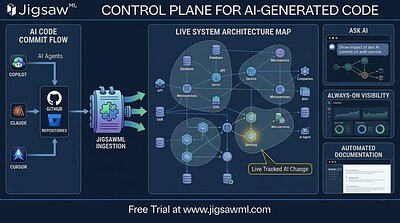
JigsawML's solution is a control plane that promises to restore order by automatically ingesting entire codebases and generating interactive, comprehensive, and continuously updated views of a company’s software architecture.
The Growing 'Visibility Crisis'
The problem JigsawML addresses is not theoretical. Industry data and developer sentiment paint a clear picture of a crisis in the making. The rapid proliferation of AI-generated code has led to what analysts call “architectural debt”—a hidden tangle of poorly understood dependencies, duplicated services, and inconsistent patterns that accrue silently until they trigger catastrophic failures or grinding slowdowns. A late 2025 report from Ox Security identified ten recurring architectural antipatterns in AI-generated code, noting it is often “highly functional but systematically lacking in architectural judgment.”
This lack of judgment is a core limitation of current AI models, which excel at statistical pattern matching but lack a holistic understanding of a complex software system. They can replicate existing patterns, including flawed ones, at an alarming rate. This has created a phenomenon some developers call “Trust Debt,” where engineers commit AI-written code without fully grasping its implications, creating profound organizational vulnerabilities.
Developer surveys reflect this growing tension. The 2025 Stack Overflow Developer Survey found that while 84% of developers now use or plan to use AI tools, a staggering 46% do not trust the accuracy of the output—a significant jump from the previous year. A top frustration, cited by 66% of developers, was dealing with AI solutions that are “almost right, but not quite.”
“AI coding agents are fundamentally changing how software gets built, but they have created a new problem,” said Pracheer Gupta, CEO and Co-Founder of JigsawML, in the company's launch announcement. “Developers commit AI-written code without fully understanding its implications, leading to architectural debt they cannot see, measure, or manage. Engineering leaders struggle to grasp what their teams are building. JigsawML is the control plane that makes AI-modified software comprehensible.”
A Control Plane for AI-Driven Development
JigsawML, founded by veterans from AWS, Pinecone, and other major enterprise technology firms, aims to be the essential bridge between machine-speed code generation and human-scale comprehension. The platform connects directly to code repositories like GitHub and Bitbucket, ingesting code to build a living model of the software architecture.
Its core capabilities are designed to directly counter the challenges of the AI coding era:
Always-on Visibility: Instead of static, quickly outdated diagrams, the platform provides an interactive architectural map that updates in real-time with every code commit. This allows teams to see exactly how a new piece of AI-generated code impacts the broader system.
Natural Language Querying: A feature called AskAI allows developers, architects, and even non-technical stakeholders to ask questions about the architecture in plain English, such as “What services will be affected if we deprecate the legacy billing API?” or “Show me all new dependencies introduced in the last sprint.”
Automated Documentation: The platform effectively becomes the single source of truth for the system's architecture, generating documentation that is guaranteed to be current because it is derived directly from the code itself.
This approach provides a crucial feedback loop that has been missing from the AI development lifecycle. It allows engineering leaders to enforce architectural standards, helps DevOps teams troubleshoot issues in a system that is constantly in flux, and empowers individual developers to build with confidence, knowing they can see the full impact of their work.
The Dawn of 'Architectural Intelligence'
JigsawML is positioning its solution as the vanguard of a new software category: Architectural Intelligence. The term, coined by Chief Analyst Dinesh Chandrasekhar of the research firm Stratola in a late 2025 report, describes “a living, queryable model of enterprise architecture that connects all the fragmented pieces of visibility into a unified semantic layer.” The goal is to enable organizations to understand their systems at the same speed at which AI generates them.
This concept marks a significant departure from traditional software architecture practices, which have long relied on manual diagramming and documentation—processes that are hopelessly outmatched by the pace of modern development. In the AI era, the architect’s role is shifting from being a primary author to a curator and governor of a system co-created with AI agents. Without tools that provide a system-wide, real-time view, that role becomes impossible.
By bringing the Architectural Intelligence concept to life, JigsawML is betting that visibility is the key to unlocking the full potential of AI in software engineering. By providing a control plane, they are not seeking to slow down AI, but to make it safer, more reliable, and ultimately more effective. The platform, which is available for a free trial, supports both cloud-based and secure on-premise installations for teams with stringent security requirements.
As organizations continue to embrace AI-driven development, the ability to maintain trust, transparency, and control over their software assets will be a critical differentiator. The chaos of unmanaged AI code poses a significant threat, but platforms aiming to provide this new layer of intelligence suggest a path forward where human oversight and machine-speed innovation can coexist and thrive.