
- 2,000-square-meter: Size of Apollo Go Park, Baidu's first operations hub outside China.
- 1,000+: Target fleet size of autonomous vehicles in Dubai in the coming years.
- 25%: Dubai's goal for autonomous transportation trips by 2030.
Experts view Dubai's partnership with Baidu as a strategic milestone in advancing autonomous vehicle technology, positioning the city as a global leader in smart mobility while highlighting the need to address socio-economic challenges like job displacement and public acceptance.
Dubai Taps Baidu for Driverless Future, Kicking Off Robotaxi Race
DUBAI, UAE – January 07, 2026 – By James Walker
Dubai has officially greenlit the next phase of its autonomous transport ambitions, granting Chinese technology giant Baidu the emirate's first permit to test fully driverless vehicles on public roads. The move, which allows Baidu's Apollo Go robotaxis to operate without a human safety driver, marks a pivotal moment in the city's aggressive push to become a global leader in smart mobility and ignites a new chapter in the international race for autonomous vehicle supremacy.
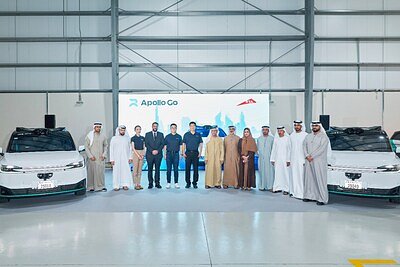
The announcement was made concurrently with the inauguration of Apollo Go Park, a 2,000-square-meter facility in downtown Dubai that will serve as Baidu's first comprehensive operations and management hub outside of China. This strategic foothold is designed to support a planned commercial ride-hailing service launch as early as the first quarter of 2026 and an eventual fleet target of over 1,000 autonomous vehicles in the coming years.
"The opening of Apollo Go's first operations center outside China reflects the strong confidence of leading global companies in Dubai's advanced regulatory environment," said H.E. Mattar Al Tayer, Director General and Chairman of the Board of Executive Directors at Dubai’s Roads and Transport Authority (RTA). He framed the permit as a "qualitative milestone" in developing a secure legislative framework that keeps pace with rapid technological advancements.
A Global Testbed for an Autonomous Vision
This partnership is a cornerstone of Dubai's ambitious strategy to make 25% of all transportation trips autonomous by 2030. The emirate is positioning itself as a premier global testbed, leveraging its advanced infrastructure and a proactive regulatory posture to attract the world's top AV technology firms. The RTA is not placing all its bets on one company; it is fostering a competitive ecosystem. Other major players, including WeRide and Pony.ai, have also secured trial permits and are actively deploying vehicles, often in partnership with ride-hailing platforms like Uber.
However, Baidu's permit to operate fully driverless vehicles without a safety driver on board gives it a critical edge. This level of autonomy is the holy grail for the industry, representing a significant vote of confidence from the RTA in the maturity and safety of Baidu's technology.
Dubai's commitment extends far beyond regulatory approvals. The city is making substantial investments in the underlying digital and physical infrastructure. The RTA's state-of-the-art Intelligent Transportation Systems (ITS) Center in Al Barsha already uses AI and big data to manage traffic across 60% of the city's main roads, a figure set to reach 100% by 2026. Furthermore, plans are underway to roll out a Vehicle-to-Everything (V2X) network, allowing direct communication between vehicles and traffic signals, which is crucial for the seamless operation of a large-scale AV fleet.
Baidu's International Gambit
For Baidu, the Dubai expansion is a landmark achievement in its quest for global leadership in artificial intelligence and autonomous driving. While Apollo Go boasts staggering operational metrics—over 240 million autonomous kilometers logged and more than 17 million rides completed across 22 cities—the vast majority of this experience has been within China. Success in Dubai provides a powerful international showcase, proving its technology can compete with and even surpass Western rivals like Waymo and the now-defunct Cruise operations in some markets.
"We are honored that the RTA has entrusted Apollo Go with Dubai's first driverless vehicle trial permit," stated Yunpeng Wang, Corporate Vice President of Baidu. "Building on our proven expertise worldwide, we look forward to working closely with the RTA and local partners to deliver safe, efficient, and sustainable autonomous ride-hailing services."
The company's sixth-generation robotaxi, the Apollo RT6, is central to this strategy. Purpose-built for autonomous operation at a relatively low production cost of under $40,000, the RT6 is equipped with 38 sensors, including 8 LiDARs and 12 cameras, and boasts 1200 TOPS of computing power. This hardware, combined with Baidu's extensive real-world data, underpins its L4 autonomous capabilities. Yet, the path has not been without bumps. In its home market, Apollo Go has faced public scrutiny over isolated incidents, including a vehicle veering into a construction pit and another involved in a minor collision with a pedestrian, highlighting the immense complexity of navigating unpredictable urban environments.
The Robotaxi Revolution and Its Urban Impact
The large-scale deployment of robotaxis promises to fundamentally reshape urban life in Dubai, bringing both transformative benefits and profound societal questions. The economic upside is a key driver for the government, with projections estimating that the autonomous transport strategy could generate AED 22 billion (approx. $6 billion) in annual economic returns by 2030. These gains are expected from a 44% reduction in transport costs, a 12% drop in traffic accidents, and significant cuts in carbon emissions.
For residents and tourists, the vision is one of enhanced safety, reduced congestion, and greater accessibility, particularly for the elderly and people of determination. "Through this trial permit... we will rigorously test safety, reliability, and customer experience, ensuring that any future large-scale rollout fully meets Dubai's standards," affirmed Ahmed Hashem Bahrozyan, CEO of the Public Transport Agency at the RTA.
However, this technological leap also forces a difficult conversation about the future of work. Each robotaxi, capable of operating for much longer hours than a human, could potentially displace multiple drivers in the taxi and ride-hailing sectors. In a region heavily reliant on a migrant workforce for such roles, this raises significant concerns about job displacement and economic equity. Public acceptance also hinges on overcoming anxieties related to cybersecurity and data privacy, which studies show are major considerations for potential users. The successful integration of this technology will depend not just on its technical performance, but on how well the city navigates these complex socio-economic challenges.