
- $660M Investment: Japan allocates $660 million to solid-state battery (ASSB) supply chain development.
- 2035 Target: Aims to triple global battery-related sales by 2035 and produce 150 GWh annually by mid-2030s.
- Patent Leadership: Japan controls nearly 37% of global solid-state battery patents.
Experts agree that while Japan's strategic investment in solid-state batteries positions it as a frontrunner, success hinges on overcoming technical hurdles and competing with cost-effective alternatives like LFP batteries.
Japan's $660M Gamble: Can Solid-State Batteries Secure Its Auto Future?
TOKYO, Japan – June 25, 2026 – In a bold move to reshape the future of mobility and energy, Japan is placing a multi-billion-yen bet on a single technology: the all-solid-state battery (ASSB). The Japanese government, through its Ministry of Economy, Trade and Industry (METI), has accelerated its national battery strategy, earmarking US$660 million in subsidies for the ASSB supply chain, according to a new report from global tech analysis firm TrendForce. This massive public investment underscores a high-stakes industrial policy designed to help Japan leapfrog current battery technologies and reclaim its historical dominance in the global automotive sector.
This initiative is not merely about funding research; it is a coordinated national effort to build an entire domestic ecosystem, from raw materials to finished electric vehicles (EVs). With titans like Toyota, Honda, and Nissan already running pilot production lines, Japan is signaling its intent to commercialize these next-generation batteries by 2030. The question for business leaders and strategists is whether this focused, top-down approach can overcome immense technical hurdles and fend off fierce competition from both lower-cost alternatives and rival nations pursuing the same prize.
A National Strategy to Reclaim Dominance
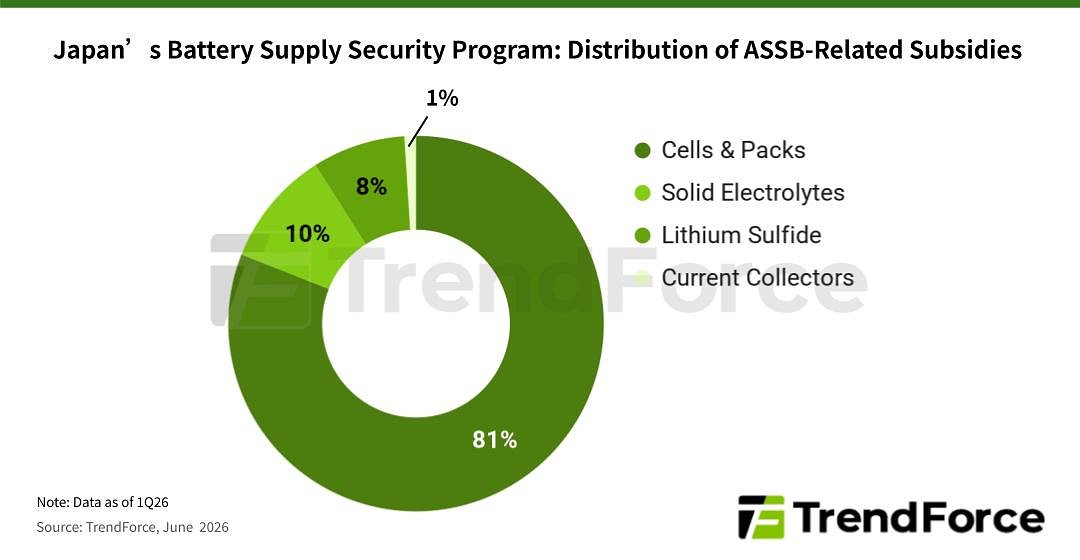
At the heart of this strategic push is METI's recently revised "Battery and Power Industry Strategy." This comprehensive plan goes far beyond simple subsidies, laying out ambitious targets to secure Japan's industrial future. The government aims to help Japanese companies triple their global battery-related sales by 2035 and establish a formidable domestic manufacturing base capable of producing 150 GWh of batteries annually by the mid-2030s. The $660 million in approved funding, distributed across five major projects as of early 2026, is the financial muscle intended to make these ambitions a reality.
The strategy is laser-focused on overcoming critical bottlenecks. Approximately 18% of the funding is specifically directed at developing mass-production technologies for sulfide solid electrolytes and lithium sulfide (Li₂S)—the core, and currently very expensive, components of the most promising ASSB designs. Companies like Idemitsu Kosan are direct beneficiaries, receiving government support to scale up production of solid electrolytes from lab-scale samples to industrial volumes. This targeted investment highlights a deep understanding that technological leadership, evidenced by Japan's control of nearly 37% of global solid-state battery patents, is meaningless without a viable path to cost-effective mass production.
For Japan's automakers, this government backing is a crucial enabler. Toyota, a longtime leader in ASSB patent filings, has already had its development plans certified by METI and is targeting a 2027-2028 launch for its first EVs powered by the technology, promising a range of 1,000 km and 10-minute charging. This state-industry partnership is a classic Japanese approach, marshaling national resources to pursue a long-term technological advantage that individual corporations might struggle to achieve alone.
The Two-Front War: LFP Cost vs. Solid-State Performance
While Japan concentrates its resources on a future breakthrough, it faces a pressing challenge in the present. The primary threat comes not from a rival next-generation technology, but from the relentless advancement of existing, lower-cost lithium iron phosphate (LFP) batteries, led by Chinese manufacturing giants CATL and BYD. As TrendForce notes, the rapid market adoption of LFP batteries presents a "significant cost barrier" to the commercialization of ASSBs.
Chinese firms have brilliantly innovated around LFP's inherent limitations, using architectural advances like Cell-to-Pack (CTP) technology to boost energy density and drive down costs. By eliminating module casings and integrating cells directly into the battery pack, they have made LFP batteries increasingly competitive, even for longer-range vehicles. This has created a powerful market dynamic where affordability and proven reliability are winning out, particularly in the mass-market EV segment.
This puts Japan's strategy in a precarious position. It is fighting a two-front war: one against global rivals in the race to perfect ASSBs, and another against the market reality created by cost-effective LFP. While ASSBs promise superior energy density, safety, and charging speed, they will have to justify a significant price premium upon entering the market. If LFP technology continues its rapid improvement curve, the performance gap may not be wide enough to convince automakers and consumers to pay for the solid-state alternative, potentially relegating ASSBs to a niche, high-performance market for years.
The Global Race for a Solid-State Breakthrough
Even within the solid-state arena, Japan is far from alone. The promise of a battery that is smaller, safer, and faster-charging has ignited a global R&D arms race. South Korea's Samsung SDI is aggressively pursuing its own ASSB development, with commercialization timelines that reportedly match its Japanese competitors. In the United States, well-funded startups like QuantumScape, backed by Volkswagen, are making significant strides. Meanwhile, China is pursuing a shrewd dual strategy: capturing current market share with semi-solid-state batteries while simultaneously investing heavily in a collaborative national effort to crack the code for full ASSB mass production.
This intense global competition means Japan's early lead in patents provides no guarantee of market success. The transition from laboratory to factory floor is notoriously difficult, and the first company to achieve reliable, high-volume, and cost-effective production will have a tremendous advantage. Competitors in South Korea, China, and the US are all working to solve the same technical problems, creating a dynamic where a breakthrough could emerge from anywhere. Japan's national strategy provides focus, but it also risks being outmaneuvered by more agile or better-funded international rivals.
Beyond the Hype: The Hard Road to Mass Production
Ultimately, the success or failure of Japan's $660 million gamble will be determined not in government boardrooms, but on the factory floor. The technical hurdles separating today's pilot lines from tomorrow's giga-factories remain immense. The core challenges lie in achieving consistent manufacturing yield and quality at scale. The solid-on-solid interfaces within the battery are notoriously difficult to maintain during the volume changes that occur with charging and discharging, leading to degradation and reduced battery life.
Furthermore, the supply chain for critical ASSB materials is nascent and fragile. Sulfide-based electrolytes offer high performance but are difficult to handle and expensive to produce. The high cost and limited availability of precursors like lithium sulfide represent a major bottleneck that the industry is only now beginning to address. Japan's focused investment in this area is a clear recognition of this vulnerability.
Toyota's 2027-2028 target is ambitious and serves as a powerful motivating force for the entire Japanese supply chain. However, the path is fraught with risk. Success requires not just a single scientific breakthrough, but a cascade of innovations in materials science, process engineering, and quality control. Japan has placed its bet, and now the monumental task of execution begins, with the nation's future industrial competitiveness hanging in the balance.