
- 2,266 smallholders certified: 4,171 hectares of farmland now compliant with both RSPO and ISPO standards.
- 40% of Indonesia's oil palm plantations managed by independent smallholders, previously marginalized.
- 25% income gains for certified farmers due to improved efficiency and market access.
Experts would likely conclude that Jambi's dual-certification model offers a scalable, multi-stakeholder approach to sustainable palm oil production, bridging smallholder inclusion with global market demands.
Jambi's Palm Oil Pivot: A New Blueprint for Durable Value
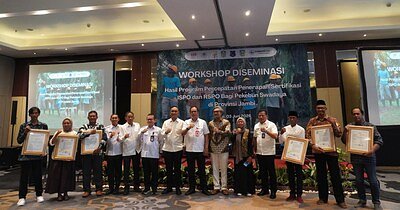
JAMBI, Indonesia – June 03, 2026 – In the dense agricultural heartlands of Jambi province, a quiet but profound shift is underway. An initiative involving 2,266 independent oil palm smallholders has culminated in a historic dual certification, a move that does more than tick a sustainability box. It represents a masterstroke of strategic alignment, forging a durable link between some of the world's smallest producers and the increasingly stringent demands of the global market. This is not merely a story about sustainable palm oil; it's a case study in building resilience and unlocking permanent value against a backdrop of volatility.
The achievement is numerically impressive: 4,171 hectares of farmland are now compliant with both the Roundtable on Sustainable Palm Oil (RSPO) and the Indonesian Sustainable Palm Oil (ISPO) standards. But the true significance lies in the architecture of the success—a multi-stakeholder model that systematically dismantled the barriers that have long isolated smallholders from the global economy.
Building a Resilient Foundation
For decades, Indonesia's independent smallholders, who manage roughly 40% of the nation's vast oil palm plantations, have been caught in a structural trap. Lacking clear land titles, access to capital, and the organizational capacity to meet complex global standards, they were often relegated to the margins of the value chain. The Jambi initiative, launched in November 2022, was designed to break this cycle.
By uniting the Jambi Provincial Government, local regencies, the RSPO, and the implementing NGO Yayasan Setara Jambi, the program created a powerful synergy. The government's role was pivotal, providing the institutional muscle to tackle the intractable problem of land legality by facilitating data collection and issuing critical cultivation and environmental certificates. This addressed a primary obstacle that often halts certification efforts before they can even begin.
"This achievement is not merely a handover of certificates, it demonstrates that Indonesian independent smallholders have the capacity and commitment to meet the highest sustainability standards," said Guntur Cahyo Prabowo, Head of Smallholder for RSPO. "When government systems, farmer organisations, legal processes, and market actors collaborate, smallholder inclusion and certification can be achieved."
This collaboration is the very mechanic of resilience in action. Instead of imposing a top-down mandate, the model built capacity from the ground up, organizing farmers into three key groups—the Rimbo Ulu Palm Oil Farmers Association (PPSRU), the Agro Tani Lestari Consumer Cooperative (KKATL), and the Mandali Jaya Farmers Association (PPMJ). This provided the collective strength needed to navigate the complexities of certification and market engagement.
Unlocking Value in a Bifurcating Market
The timing of this achievement could not be more critical. The global palm oil market is rapidly bifurcating into what some analysts call a "Certification or Exclusion" environment. Driven by regulations like the European Union Deforestation Regulation (EUDR) and powerful corporate ESG commitments, access to premium Western markets is increasingly conditional on proven, traceable sustainability. Uncertified palm oil risks being confined to lower-margin, price-sensitive domestic markets.
The dual certification brilliantly navigates this new reality. By securing ISPO compliance, the smallholders meet Indonesia's national mandate. With RSPO certification, they gain an all-access pass to the world's most discerning and lucrative buyers. This dual-pathway approach transforms a potential compliance burden into a distinct competitive advantage.
The economic impact is tangible and immediate. "After receiving training and improving the way we manage our farms, we started to see improvements in our production," noted Sulistio from the Agro Tani Lestari Consumer Cooperative. More importantly, the certification unlocked direct market access. "For more than a year now we have been selling our fresh fruit bunches directly to PT. Inti Guna Nabati through our partnership arrangement. The prices we receive are higher compared to farmers who are not part of such partnerships."
While direct price premiums for certified oil can be inconsistent, research confirms that the true economic uplift often comes from the operational discipline that certification instills. Studies in the region have shown that certified farmers can achieve income gains of over 25%, driven not by premiums alone, but by improved technical efficiency, higher yields, and better farm management practices learned during the certification process.
A New Template for Policy and Progress
Perhaps the most enduring legacy of the Jambi project is the policy template it offers. It proves that national and international sustainability standards need not be viewed as competing systems, but as complementary frameworks that can be mutually reinforcing. This insight is crucial for scaling such efforts across a nation with over 6 million hectares of smallholder plantations.
"One important lesson from Jambi is that smallholders do not view sustainability standards as competing systems," stated Dr. Iim Mucharam, a Director at Indonesia's Ministry of Agriculture. "Smallholders are seeking practical solutions that improve legal compliance, strengthen their organisations, provide market access, and improve livelihoods."
By integrating the processes, the dual-certification model proved more affordable and administratively efficient, tackling the high costs that often serve as a primary barrier for small-scale producers. The lesson for policymakers is clear: the future of sustainable commodity production lies not in creating additional burdens, but in building integrated pathways that make compliance efficient and rewarding. Dr. Mucharam added, "If a farmer has already demonstrated compliance with sustainability requirements, then our collective challenge is how to make that achievement more efficient, more accessible, and more rewarding for the farmer."
The Long Road to Scale
While the Jambi model is a landmark victory, it also illuminates the sheer scale of the challenge ahead. Across Indonesia, a mere fraction of smallholder land—an estimated 43,000 out of more than 6.37 million hectares—is currently certified to these high standards. Replicating the Jambi success will require a monumental, coordinated effort to address the same systemic issues of land legality, financial access, and organizational support on a national level.
The Jambi project provides the blueprint. It has demonstrated that with focused, intelligent collaboration, the forces that once locked smallholders out of the global economy can be harnessed to propel them forward. For businesses and investors seeking to build resilient, permanent value chains, the identifying marks of a winner are becoming clear: it is found in the partnerships that turn compliance into opportunity and transform smallholders into strategic suppliers for a sustainable world. The work in Jambi is a powerful first step on that long but necessary road.